
 Scoop has an Ethical Paywall


GNS: 6.3 Magnitude Earthquake Part of Aftershock Sequence
25 February 2011
6.3 magnitude earthquake part of aftershock sequence
This week’s
devastating magnitude 6.3 earthquake centred southeast of
Christchurch was part of the aftershock sequence that has
been occurring since the September magnitude 7.1 quake
near Darfield, 40km west of the city, an earthquake
geologist said today.
It caused 17km of subsurface
rupture in an east-west direction between Halswell and
Taylors Mistake on the coast, Natural Hazards
Research
Platform Manager at GNS Science, Kelvin Berryman said.
The number of aftershocks in the first 24 hours were
higher than expected for a magnitude 6.3 earthquake, but had
since tailed off
sharply and were now less frequent than
aftershocks at the equivalent time after the magnitude 7.1
earthquake, Dr Berryman said.
In time, the rate of
aftershock activity would decay back down to the level
before the magnitude 6.3 earthquake, and then continue
to decrease as before.
There was no obvious
underground structure directly connecting the subsurface
rupture that produced Tuesday’s earthquake with
the
Greendale Fault that ruptured in September’s magnitude 7.1
earthquake,
“Aftershocks have been spreading both west
and east since the magnitude 7.1 Darfield earthquake in
September and this has resulted
in increased stresses in
the earth’s crust in the Canterbury region,” Dr Berryman
said.
An expanding “cloud” of aftershocks,
particularly at both ends of the main fault rupture, was a
familiar pattern with large earthquakes
worldwide, he
said.
Dr Berryman said seismic energy travelled in waves and could be reflected off hard surfaces, much like sound waves.
With the epicentre of Tuesday’s earthquake in
the Port Hills, a large amount of energy could have been
reflected off hard volcanic rock
at depth. This would
have compounded the impact of the earthquake at the surface.
Geologists had suspected for some time that there were
buried and unrecognised faults in Canterbury. Some of these
faults might not have
moved for many thousands of years,
but had been reactivated as stresses in the earth’s crust
had been redistributed since September 2010.
“If you
strip away the sediment and gravels of Christchurch and the
Canterbury plains you would see the bedrock looking like
broken glass
from millions of years of earthquake
activity.”
The underlying geology of Canterbury was the
western end of the Chatham Rise which was broken with many
east-west trending faults.
Many geologists believed that
modern-day tectonic plate motions in the South Island had
reawakened some of these very old faults,
causing them
to fail.
The Greendale Fault that ruptured in
September’s earthquake was one of these very old faults.
Dr Berryman said the magnitude 7.1 earthquake
in
September was an extraordinarily complex event with up to
four interconnected faults rupturing almost simultaneously.
“The pattern of aftershocks since September has also
been complex, making it difficult for scientists to
understand the stress-related
mechanisms occurring in
the earth’s crust.”
This week’s magnitude 6.3 earthquake appears to have been a less complex event with just one fault rupturing.
The frequency of aftershocks
would continue to decrease in the coming weeks. When viewed
over periods of many weeks,
this reduction tended to be
fairly regular, but there were often anomalies, as the
magnitude 6.3 earthquake had shown.
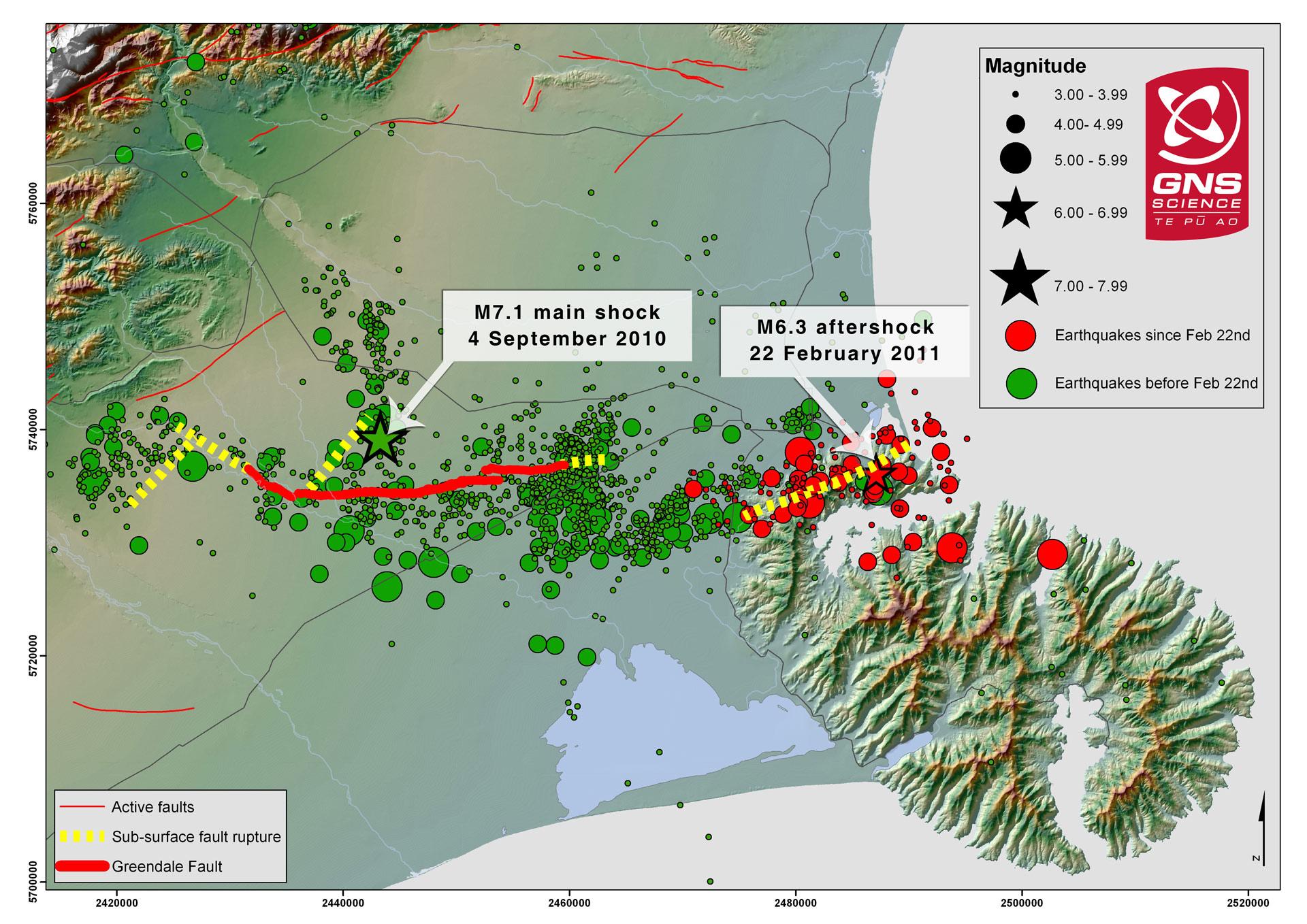
Click for big version
Graphic showing location
of main shock, aftershocks above magnitude 3, and fault
ruptures in Canterbury.
Graphic by Rob Langridge and
William Ries, GNS Science
ENDS
 Gordon Campbell: On Children’s Book Classics - The Moomins
 Johnnie Freeland: Ko Tātou Tātou - Climate Action In Aotearoa Begins With Relationship
 Zero Waste Network Aotearoa: Container Return Scheme Bill Would Double Recycling Rates And Put Money Back In Households
 Wellington City Council: Statement From The Wellington Mayoral Forum On Options For Regional Governance Reform
 MUNZ: TAIC Report On Kaitaki Incident Gives Shocking Picture Of Decline Of NZ Maritime Infrastructure
 Greenpeace: New Climate Report Yet More Reason To Reduce Dairy Herd
 Better Public Media: Opposing Plans To Scrap The BSA


