
 Scoop has an Ethical Paywall


Encircled Lands: Te Urewera 1820–1921 By J Binney
Encircled Lands: Te Urewera, 1820–1921 Judith Binney
Publication: late November 2009 RRP: $79.99 ISBN
978-1-877242-44-1
PRESS RELEASE
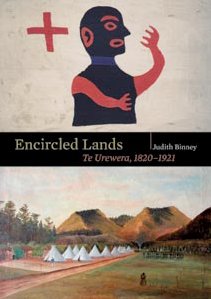
For Europeans during the nineteenth century, the Urewera was a remote and savagely enticing wilderness; for Tühoe (and others) who lived there, it was a sheltering heartland. This history documents the !rst hundred years of Te Rohe Pötae o Te Urewera – the encircled lands of the Urewera – following European contact.
The terrain was criss-crossed by early missionaries, many French Roman Catholic, and from 1866 by the ‘booted feet’ of government troops. In 1866–67 large areas were taken by con!scation or forced cession from the northern and southern boundaries of Tühoe’s land.
At the end of the !ghting in 1872, by the agreed terms of peace, the Urewera became an autonomous district, collectively governed by its own leaders, who named themselves Te Whitu Tekau (The Seventy).
These are men who stand tall in any history of Aotearoa New Zealand – among them, Te Whenuanui I, Erueti Tamaikoha, Kereru Te Pukenui and Te Makarini Tamarau (Tamarau Waiari) – although they are little recognised. The borders of their lands were further circumscribed during the 1880s and early 1890s, yet these leaders worked together to negotiate Te Rohe Pötae o Te Urewera as a separate tribal district, formally rati!ed in 1896. This agreement is unique, for it was the only legally recognised tribal enclave in Aotearoa New Zealand. In 1896, the Premier, Richard Seddon, acknowledged that this recognition was made in ful!lment of earlier promises exchanged with Tühoe’s leaders.
But in 1921–22 the ‘Urewera District Native Reserve’ created in 1896 was abolished in law. Its existence, its history, and even the very name Te Rohe Pötae for the Urewera became almost totally forgotten – except in local memory. The governance of Te Whitu Tekau was steadily undermined, and Urewera lands progressively alienated from their original owners by the Crown.
Encircled Lands recovers this lost history from a wealth of contemporary archived documents, many written by the Urewera leaders themselves, and over 150 early photographs, along with oral sources and original maps. It explains how the idea of internal self-government for Tühoe was born – and for a period partly realised. It provides the historical context of an idea that has come again to the negotiating table: Tühoe’s never-ending quest for a constitutional agreement that restores their authority in their lands.
Judith Binney, DNZM, is Emeritus Professor of History at the University of Auckland. She is the author of several prize-winning books including Redemption Songs: A Life of Te Kooti Arikirangi Te Turuki, which won the Montana Book of the Year, 1996. This work followed her earlier writing on the people of Te Urewera – Mihaia: The Prophet Rua Kenana and his Community at Maungapohatu (with Gillian Chaplin and Craig Wallace) and Nga Morehu/The Survivors: The Life Histories of Eight Maori Women (with Gillian Chaplin).
A Fellow of the Royal Society of New Zealand, Judith Binney was for many years editor of the New Zealand Journal of History. She was given the Prime Minister’s Lifetime Literary Achievement Award for Non Fiction in 2006. In 2009, she received the Polynesian Society’s Elsdon Best Medal. In 2006, she was awarded DCNZM (later DNZM) for her historical research.
Encircled Lands: Te Urewera, 1820–1921 draws on the two-part report she was commissioned by the Crown Forestry Rental Trust to write for the Waitangi Tribunal.
160 x 185 mm hardback 680 pages approx 200 full colour illustrations (photographs, paintings, maps)
ENDS
 New Zealand College of Midwives: Celebrating Midwives Across Aotearoa This International Day Of The Midwife
 PPTA Te Wehengarua: Building The Secondary Curriculum On Broken Drafts Is A Serious Risk
 Whanganui Regional Museum: Whanganui Makers Bring Textile Traditions To Life During Symposium Weekend
 Palmerston North Hospital Foundation: Fundraising For Publicly-Owned Surgical Robot Hits $2 Million Milestone In Less Than Three Months
 Otago Shore And Land Trust: Hīkoi O Te Taoka - Larger Than Life Hoiho Statues Go To Auction For Charity
 Tertiary Education Union: Historic MECA Negotiations In Polytechnic Sector Begin