
 Scoop has an Ethical Paywall


David Lange Passes Away After Long Illness
David Lange Passes Away After Long Illness
By Selwyn Manning - Scoop co-editor
Former Prime Minister David Lange died at 10pm on Saturday August 13 at Middlemore Hospital in south Auckland. His brother Peter and son Roy were at his side.
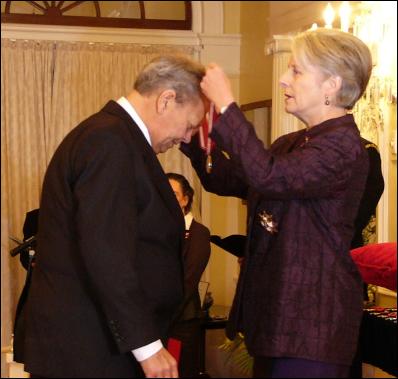
David Lange receiving his
Member of the Order of New Zealand
honour.
David Lange had been in hospital receiving dialysis after his kidneys had failed due to complications arising from diabetes. He lapsed into unconsciousness on Friday.
On Saturday, his wife Margaret Pope had been at his side until 6pm. She quickly returned to Middlemore Hospital after hearing the news at 10pm.
His brother Peter said David Lange had found it difficult over the past week to talk although enjoyed telephone conversations with his 9-year-old daughter Edith.
David Lange received surgery on August 2 where a leg was amputated. He was conscious during the surgery.
In 1984, David Lange led the Labour Party to victory in a snap election over National's Robert Muldoon. The two politicians were great adversaries and David Lange often referred to his rise to become Prime Minister as opportunistic: saying that he would not have become leader had Muldoon not been there.
It was accurate that David Lange represented the hopes of a polarized nation where those who supported a unilateralist, some would say almost totalitarianist's approach to leadership, followed Muldoon. Lange balanced this with good humour, charisma and a consensus style of leadership.
Once David Lange won the 1984 election, he became the pride of south Auckland. For the first time there on the national and world stage was a man who had been born and bred in south Auckland and who carried the conscience of the working people with him.
He was known to his loyal Pacific Islands constituency as "Mr Honourable" a title David Lange was proud of and was determined to live up to.
In factories around south Auckland, "Rob's Mob" (supporters of Robert Muldoon) were mainly in the foremen's office. Those on the "shop-floor" were right behind Lange - even during the turbulent times that were to mark the second half of his prime ministership.
The Lange government rewrote how New Zealand ought to see itself both on the world stage [via New Zealand's anti-nuclear stance and later anti-nuclear laws] and domestically by removing farming subsidies, opening markets, floating the New Zealand dollar, removing varying sale and producer taxes and replacing with a goods and services taxation regime. His government also pioneered social and human rights reform such as the New Zealand homosexual law reform legislation, Resource Management Act, and bill of rights legislation.
However, the economic reform labeled Rogernomics offset the Lange government with many within the Labour Party. By 1987 the effects of Rogernomics were impacting among Labour's core constituencies and David Lange witnessing this called for "a cup of tea". His desire to halt the advance of the then new right economics heralded by Douglas caused a rift within the Labour Cabinet, leading to the demotion of Douglas and the eventual resignation of David Lange from the Prime Ministership in 1989.
Three months later he announced his separation from first wife Naomi. David Lange had three children to Naomi, Roy, Byron and Emily.
He later married Margaret Pope his former speech-writer and in 1992 David and Margaret had Edith.
Prime Minister Helen Clark today paid tribute to Rt Hon David Lange, who passed away last evening.
Helen Clark said she was deeply saddened by David Lange’s death, which comes after a long illness.
“To the end David was inspirational in his courage in dealing with great pain and suffering. He will be greatly missed.
“David Lange came to politics from the law, where he had established his reputation as a powerful advocate for marginalised people. His strong social conscience developed from his family background and his Methodist faith.
“From the time he entered Parliament in 1977, David was marked out as a future leader. He became Leader of the Labour Party only six years later, in 1983, and then the following year became New Zealand’s youngest Prime Minister at the age of 41.
“David will always be remembered for his strong advocacy of New Zealand’s nuclear-free policy, and for a foreign policy overall which reflected New Zealanders’ values and principles.
“His early visit as Prime Minister to Africa to rebuild New Zealand’s reputation after the damage done during the Muldoon years was also important for New Zealand’s relationships with the wider Commonwealth.
“At home, the economic policies of David’s government were controversial. David himself ensured that critical areas of social policy, like health and housing, were protected from the deregulators.
“I personally will always be grateful for the support David gave me when I became Leader of the Labour Party and then Prime Minister.
“David was a man with a big heart and powerful skills of intellect, oratory, and communication. He was exceptionally quick witted, which showed not only in his great humour, but also in his capacity to master any brief within a short time.
“David Lange was an outstanding and proud New Zealander who left his mark on our country in many ways. His years among us were too short. My thoughts today are with his family who have supported David through his years of ill-health and suffering,” Helen Clark said.
President of the Council of Trade Unions, Ross Wilson, today gave tribute to David Lange on behalf of unionists throughout the country: “David Lange led us to the dignity of an independent foreign policy. This was in stark contrast to the subservience of the Vietnam War period”, Ross Wilson said.
United Future leader Peter Dunne said: “David was bigger than politics. As well as leading this country through what history now records as a massive period of transition, he in very many ways transcended politics and - particularly in recent years - touched the heart of New Zealand in a way that very few people ever do," Peter Dunne said.
 Ramzy Baroud: Subjects Of Empire - Breaking The Cycle Of Arab Dependency On US Elections
 Peter Dunne: Dunne's Weekly - The Pragmatic Food For Fuel Deal With Singapore
 Eugene Doyle: After Israel’s Brutal Attack On Kiwis, Our Government Does Nothing
 Keith Rankin: Has Sweden Become A De Facto Apartheid Narco State?
 Bruce Mahalski: Change In The Weather #194
 Binoy Kampmark: Dangers To The Fourth Estate - The 2026 World Press Freedom Index