
 Scoop has an Ethical Paywall


Hizbullah Move To Aid Nahr el Bared Controversial
Lebanon: Hizbullah's Controversial Move To Aid Nahr el Bared Camp
 The
past 48 hours were very eventful in Lebanon, and set the
stage to what promises to be a critical development in the
protracted Lebanese conflict. The most important political
event was the TV address by Hizbullah leader Hassan
Nasrallah on the Occasion of Liberation Day, which
commemorates the Israeli withdrawal from Lebanon on May 25,
2000.
The
past 48 hours were very eventful in Lebanon, and set the
stage to what promises to be a critical development in the
protracted Lebanese conflict. The most important political
event was the TV address by Hizbullah leader Hassan
Nasrallah on the Occasion of Liberation Day, which
commemorates the Israeli withdrawal from Lebanon on May 25,
2000.
Nasrallah made many significant points, which deserve to be analyzed at length because they provide an insight on the possible evolution of the political and security situation in the country and in the region. However, the crux of the speech, which he left for the very last, was his clear statement of the position of Hizbullah vis a vis the siege of the Palestinian camp of Nahr el Bared and the events surrounding it.
Nasrallah unequivocally stated that, for Hizbullah, the army was extremely important, as it is the last "impartial" institution in the country (the quotes are mine), and that the breakdown of the army would inevitably lead to the political meltdown of Lebanon. He declared the army a "red line".
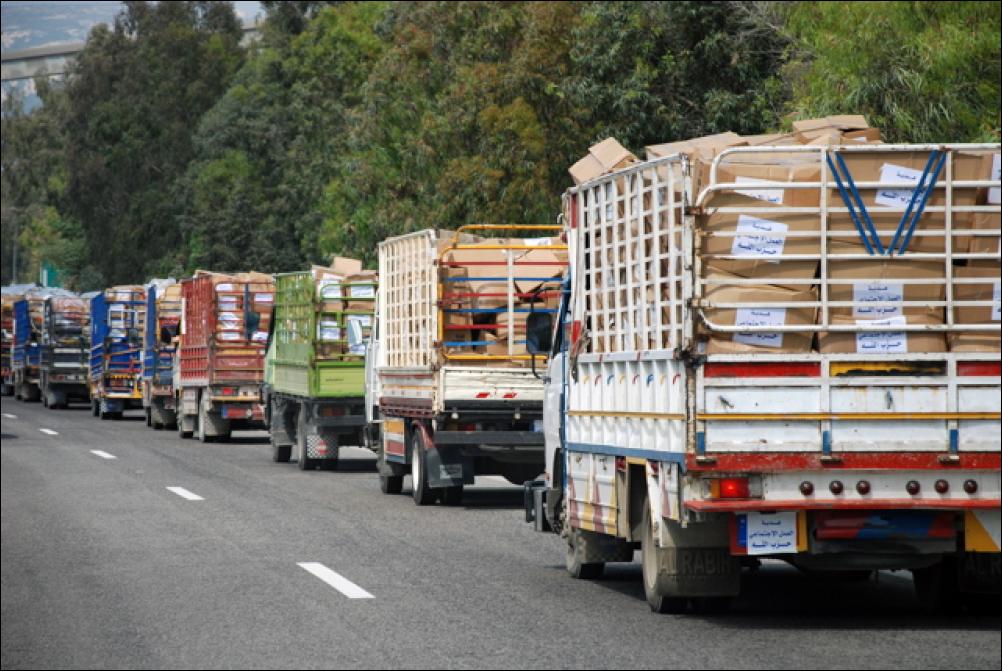
Photograph of Hizbullah aid convoy to the Nahr el Bared refugees, by Tanya Traboulsi.
Click for big version
But Nasrallah also went on to indicate that the Palestinians in Lebanon were another "red line", in clear reference to the shelling by the army of the Nahr el Bared Palestinian camp and the ensuing exodus of tens of thousands of people to the neighboring Beddawi camp, where they live today in squalid conditions.
By equating the army with the Palestinians in Lebanon, Nasrallah went out on a limb, and put his party, the Shi'a, and the whole opposition in a vulnerable position. The army expressed its dismay at Nasrallah's position, and the government forces were quick to react by accusing Hizbullah of purposely weakening the army, and of standing on the side of "foreigners" against the Lebanese.
In the currently divided Lebanon, the army has become a key player, as the two opponents (government and opposition) line up their pawns for a further set of their power game. The army has so far remained a wild card, but has been leaning more towards the opposition than towards the Government. It is not sure how Hizbullah's statement will be translated by the army's leadership. It is also unclear what this will mean in terms of realignment, especially in light of the significant military aid the army has recently received from the US and the other US-aligned Arab countries.
Clearly, Nasrallah has taken a very risky step. Nasrallah's statement was received with much relief by the population in the Palestinian camps. It provided a much needed political, human and moral support at a time where being Palestinian in Lebanon is a real curse. People in the camps felt that someone with political weight in Lebanon was finally interceding in their favor, and that their human rights situation might slightly improve.
Few Lebanese fully perceive the extent of the hardship under which the Palestinian live in Lebanon. Many have for them a particularly vicious form of racist hatred.
Others see them as an annoyance and a potential source of trouble. But most of the time, when they are quietly tucked into their camps, they are simply disregarded. In Lebanon, there are 400,000 people (one tenth of the population) living under extreme material and human hardship, which have completely slipped out of the ethical radar. Lebanon, a nation always praising itself on its significant contribution to "civilization", lives in denial of their existence. Except when the injustice spills out of the camps into their own little world.
The events taking place in the Nahr el Bared camp have revealed the extent of the discrimination to which Palestinians are subjected in Lebanon . The fighting between the Lebanese army and Fateh al Islam, a small group of radical Islamic militants of various nationalities, has resulted in the army siege of the camp of Nahr el Bbared (40,000 people) for 7 days and counting, its indiscriminate shelling in order to dislodge the militiamen, and the displacement of up to 20,000 people.
The displaced have sought refuge in the neighboring camp of Beddawi, creating a human tragedy in which poverty is compounded by displacement. In the Beddawi camp, the poor have now to cater for the need of the poorer, in overcrowded conditions where deprivation and destitution have become the norm. And while, in the past 5 days there has been an exponential increase in the number of camera-happy media types invading people's privacy far beyond what is reasonably acceptable for a fair coverage, this has not translated into an equivalent amplification of humanitarian aid.
Some Grassroot groups from Beirut and the Beddawi camp, however, have been quick to move. Since the first day of the fighting, small groups that were active during the displaced crisis caused by the Israeli war on Lebanon of July 2006, have regrouped and started to organize, raise funds, purchase essential goods and deliver them to the 6,000 families of refugees in the Beddawi camp, as well as to the 350 families that have reached the Beirut camps of Shatila and Burj el Barajneh. However, the fund raising and logistical capabilities of these groups are very limited, and fall very short of addressing the needs of all. Their spending capacity is of a few thousands of dollars per day, while the needs are in the order of several hundreds of thousands of dollars per day. I work with one of these groups, the Nahr el Bared Relief Campaign (www.nahrelbareddonations.blogspot.com).
Besides the grassroots groups and the slow moving giants, political aid is also being received by the camp refugees. The Future Movement of Mr. Hariri has been a donor, although its aid has been focusing on strengthening the grip of the PLO Fatah movement, aligned with Palestinian president Mahmoud Abbas, on the camps population. Moreover, in a move to support its statement with actions, Hizbullah sent yesterday a convoy of 12 trucks of essential goods. It is unclear which Palestinian side was at the receiving end, but it was not our local grassroot partners.
Rami Zurayk is a Professor of Ecosystem Management, American University of Beirut. The opinions expressed in this article are personal and do not necessarily represent the opinions of the American University of Beirut. Interested in food, farming and rural society? You can view more of Prof. Zurayk's work at www.landandpeople.blogspot.com
 Bruce Mahalski: Change In The Weather #195
 Keith Rankin: Haemorrhagic Plague?
 Eugene Doyle: Did The NZ Prime Minister Just Commit Treason?
 Binoy Kampmark: Ted Turner - The Devil Behind Cable News
 Keith Rankin: Clipping The Ticket; Solving Hormuz, In Context
 Ian Powell: Inhumanity Of US Economic Sanctions Against Cuba – Infant Mortality And Starvation; Time To End NZ’s Silence