
 Scoop has an Ethical Paywall


Right to Sign – Sign Language Week Kicks Off May 5
Right to Sign – Sign Language Week Kicks Off May 5
By Natasha Burling – AUT University Journalism Student
“The Freedom to Sign is Our Freedom of Expression” is the slogan for the second annual New Zealand Sign Language (NZSL) week, which kicks off May 5 with events around the country.
National Coordinator of NZSL Week Angela Lindsay says, “This year, the purpose is to raise public awareness that NZSL also gives Deaf people a voice.”
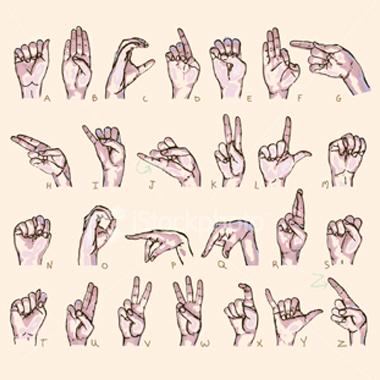
Click to enlarge file image
Sign alphabet
The right to use New Zealand Sign Language (NZSL) is now recognised by the New Zealand government and the United Nations, but a shortage of interpreters could mean deaf people cannot exercise that right.
Currently there is a shortage of NZSL interpreters and Auckland University of Technology (AUT) is the only tertiary institute that offers a Diploma in Sign Language Interpreting. Its five to eight graduating interpreters are not enough to serve the 7,000 people who are Deaf and who use NZSL.
A scholarship scheme announced in March aims to bolster the number of graduating NZSL interpreters.
On March 9 this year the Minister for Communications and Information Technology, Hon David Cunliffe, said the government would fund twenty scholarships for training in NZSL, totalling $100,000.
These scholarships will be for students of the AUT’s Diploma in Sign Language Interpreting. In return, AUT has to actively promote the Diploma in Sign Language Interpreting course and the availability of the new scholarships.
NZSL interpreters have been more in demand since NZSL became New Zealand’s third official language, alongside Maori and English, in April 2006.
NZSL’s status as an official language means that deaf people can now participate more fully in public life. For example, deaf people now have the right to have an interpreter in court and in hospital. This is a far cry from the days when use of NZSL was not allowed.
Office of Disability Issues analyst Carol Ratnam says, “For many Deaf people, NZSL is essential for effective daily communication and interaction. Yet for years, the use of NZSL was actively prohibited.”
As a result, deaf people missed out on a decent education, were often denied justice or misdiagnosed, says Ms Ratnam.
“And Deaf people facing violence, abuse and neglect were often unable to convey this to the people who could have protected them.”
Sign language is now recognised as a right of deaf people under the NZSL Act of 2006.
It is also part of the right to freedom of expression set out by the United Nations.
This means governments must now accept and facilitate the use of sign language in official proceedings.
Today NZSL is also given more importance in education.
“For years, schoolchildren were not allowed to use sign language in schools. When the first school for Deaf children opened in Sumner in 1880, no signing students were even admitted,” says Ms Ratnam.
Deaf children’s right to use NZSL is now recognised by the Ministry of Education.
“It also wants more people who are not Deaf to be users of NZSL and have an appreciation of Deaf culture,” says Ms Ratnam.
Sign language is now open to all rather than just being a special education subject, the Minister for Disability Issues Ruth Dyson said at the launch of “New Zealand Sign Language in the New Zealand Curriculum” on 15 March 2007.
Hearing students can now choose to study NZSL, just like any other language offered.
“It firmly places New Zealand Sign Language within the mainstream, where hearing students will have access to the language and culture of the Deaf; where someday its use will become unremarkable – just another facet of ordinary life,” says Ms Dyson.
Despite NZSL now being an official language “there’s still much to be done before Deaf people can be fully integrated into NZ Society,” says Lindsay.
Lindsay says more widespread use of NZSL would help.
“If all information was in NZSL or in captions as on TV, then Deaf citizens would be better informed of current affairs in New Zealand and the world, and be empowered to participate in public debate,” she says.
If everyone in New Zealand knew NZSL, “New Zealand Deaf people could then be fully integrated into New Zealand society.”
For more information on the events happening for NZSL week in high schools and libraries go to: www.nzsign.co.nz.
 Bruce Mahalski: Change In The Weather #195
 Keith Rankin: Haemorrhagic Plague?
 Eugene Doyle: Did The NZ Prime Minister Just Commit Treason?
 Binoy Kampmark: Ted Turner - The Devil Behind Cable News
 Keith Rankin: Clipping The Ticket; Solving Hormuz, In Context
 Ian Powell: Inhumanity Of US Economic Sanctions Against Cuba – Infant Mortality And Starvation; Time To End NZ’s Silence