
 Scoop has an Ethical Paywall


The Money Party: Enough of Everything but Dollars

Enough of Everything but Dollars
The Money Party at Work
The government bailout of failed financial institutions locks you into years of debt payments in behalf of the large private banks, debts that you did not create.
By all appearances, it also locks the country into years of a weak economy. That means unemployment, underemployment, and more suffering for those willing to work, but left out of the job market. It means lowered opportunities for those who do work and troubles for dependants and indigents. Vital national priorities including affordable health care and the massive effort required to save everyone form calamitous environmental catastrophes are now on hold or under funded.
We don't have enough dollars. It was the banks versus the people and we just lost.
The theory is that without these payments, the banks will fail and we'll all be in a world of trouble without them.
All of this depends on the questionable assumption that by saving the banks, we're saving our economy.
To date, , the government has given banks a total of $4.65 trillion. That's half of the accumulated debt for the federal government.
Citizens get the following from the recently passed $787 stimulus package: a voluntary program that allows banks to lower mortgage payments to help those with troubled loans; an extension of unemployment insurance beyond that provided by states; some innovative environmental programs; and, a much needed start on infrastructure repair. For those working and meeting their obligations, there little but a promise of rescue from calamity.
Here's how the federal government and Federal Reserve Board have spent your money and obligated your debt.
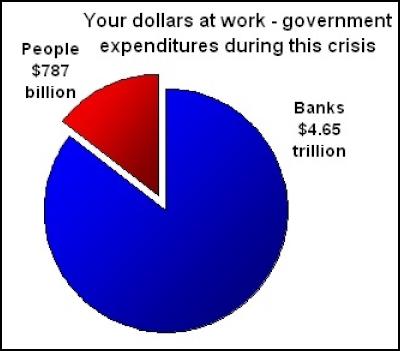
Graph: The banks received $3.2 trillion through the Federal Reserve, a $700 billion bailout in October, 2008 and 2009 budget item for another $750 billion bailout. An unspecified number of citizens will benefit from the recently passed $787 billion stimulus bill.
All the failed banks had to do was wag their tails in unison and dollars flowed their way.
There has been debate on how to describe the current economic state - recession or depression. Reluctant to admit that we're even in a recession, private banks, most U.S. economic gurus, and the federal government consistently uses the term recession.
If you're living this experience right now in an area hard hit, you'll be interested to know what the International Monetary Fund (IMF) had to say. On Apr. 9, 2008, the IMF warned of a danger that the U.S. recession could become a depression. Nine months later, this February, it noted that the "Advanced economies are already in a depression."
The program to avert a prolonged depression consists of massive infusions of money into the private banks. The recipient banks are, of course, the very same institutions and executives who brought us this economic catastrophe.
So right now, citizens are holding the bag for the money given to the banks, while the banks have no obligation to tell anyone where a majority of this money went or even to repay it.
The banks were expected to take our money via the federal government and create credit opportunities for citizens, credit that would boost the economy. Instead, they took the money and created much tighter credit. As a result, the dollars needed to save citizens from the suffering caused by a depression are not available for that purpose.
Even though citizens will see no benefit in the bank welfare program, they are allowed to anticipate years of economic hardship in order to pay for it. We are currently held hostage by false assumptions about the supposedly inevitable decline of the economy and the suffering that must follow. The most damaging assumption is that the public has to bail out private banks for losses due to massive negligence (at least) leading to their insolvency.
We have become indentured servants working to prop up a comatose financial system and the banks that crated this crisis in the first place.
Does it have to be this way?
The United States has the most productive workforce in the world, thirteen of the top twenty research universities anywhere, and plentiful natural resources. We can feed our selves reasonably well, provide health care for everyone if we choose, and address educational needs when they are recognized. In addition, we're located between two very friendly countries and populations. That constitutes real wealth.
The nation and people possess everything needed to address the current financial crisis except one seemingly vital element, dollars. We lack the dollars in both the private and public sector to support needed public initiatives and the requirements of business. Citizens also lack the dollars to spend on essentials and non essentials, a critical step in bring the economy back to some semblance of stability.
What are the banks doing with all those dollars they've received from us? First, they won't tell us because they don't have to for all but the most recent $750 billion gift. Second, they're in no hurry to make those dollars available for productive purposes. It raises a legitimate question. Do the banks even have this money anymore?
The suffering awaiting the ongoing economic collapse is guaranteed as long as we have faith in the necessity of preserving the current financial system and the assumption that underlies it: we need to pay the debt for what they spent and lost.
Why should we?
We have businesses, small and large, which meet important needs and provide services that are of value. We have citizens and organizations that want to acquire those goods and services. Paying the debt for financial institutions and investors who will do again what they've already done.
A great national debate should begin on what replaces the system that failed so miserably and it needs to start with the masses of people who actually do the work that produce our nation's true wealth. .
Permission to reproduce in whole or in part with attribution of authorship and a link to this article.
 Binoy Kampmark: Show Me The Money - A Loutish Administration Confronts A Craven Congress
 Ian Powell: Do Wellington Floods, Climate Change And Wealth Accumulation Equal “Suicidal Capitalism”?
 Ramzy Baroud: The Pendulum Swings - The Slow Death Of Europe’s Pro-Israel Consensus
 Dr Nasim: Poem From Gaza - Her Smile
 Keith Rankin: New Zealand's Dependence - Wheat, Rice, Fuel, Ships
 Peter Dunne: Dunne's Weekly - Luxon/Peters Spat Just Part Of Peters' Ongoing Plan