
 Scoop has an Ethical Paywall


Arts Festival Review: The Walworth Farce
Irish Mouths Are Grinning, But Irish Eyes Are Not Smiling
Review by Lyndon Hood
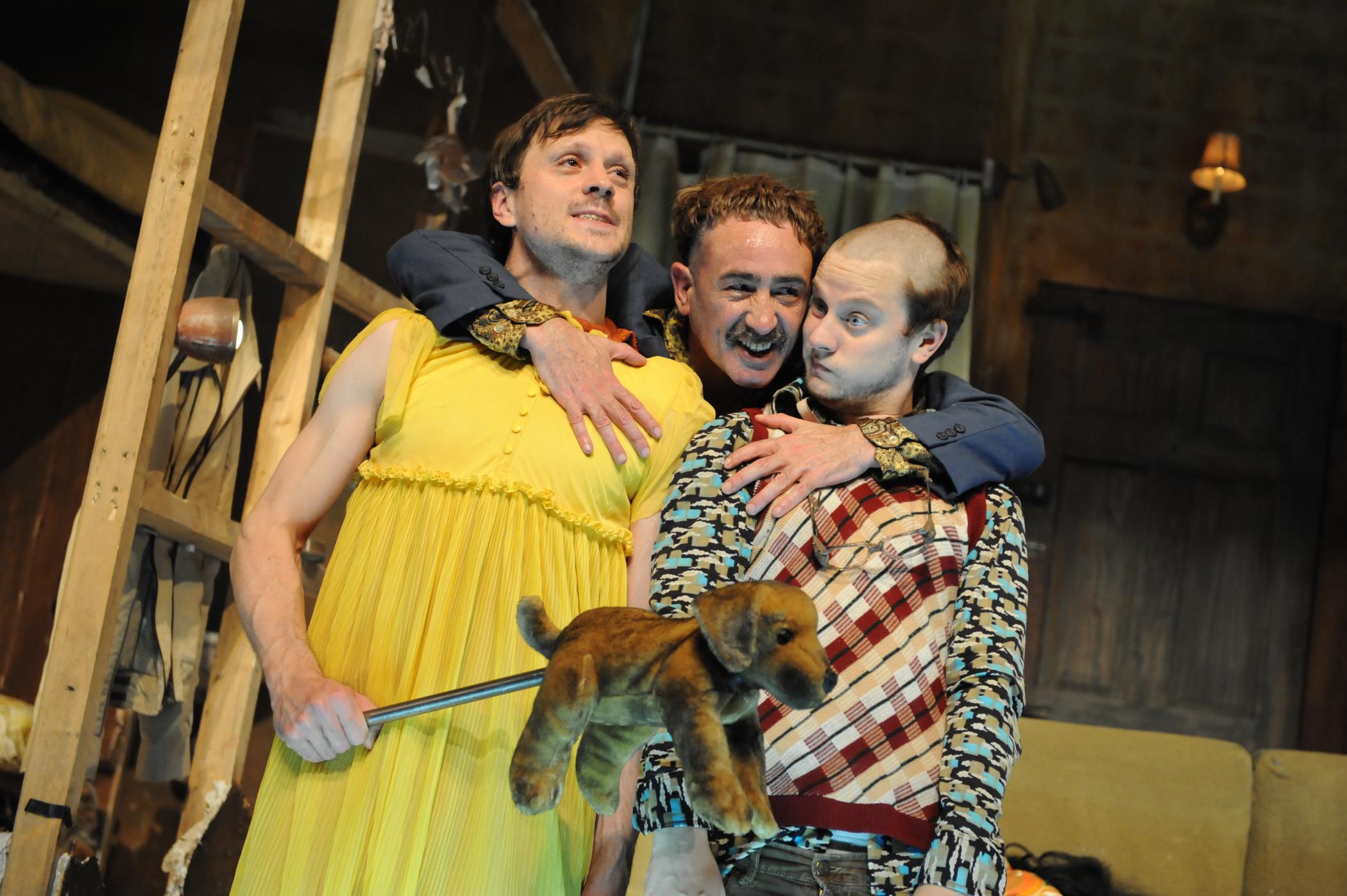
Click to enlarge
Photo: Robert Day
The Walworth
Farce
Druid, Ireland
Wellington Opera
House
17 – 21 March
Some of the festival's
publicity hasn't make it entirely clear what to expect, so
to be clear: of all the kinds of entertainment The
Walworth Farce is, it's not light entertainment.
But it is a wild and exciting ride. And it leaves you
wondering about the stories we tell and the stories that
tell us.
A lot of Irish theatre – at least what gets the world's attention – is not kind to Old Erin. One example, from the 2008 festival, would be Fabulous Beast's Giselle. A lot of gleefully manic nastiness; strange people being horrid to each other in unbearable situations.
The Walworth Farce takes a slice of this Hobbesian Ireland (solitary, poor, nasty, brutish and short), locks it a grimy flat 14 stories about London's Walworth Road and only lets it out to buy groceries. There, it starts inventing its own theatricals.
The Arts Festival schedulers will have taken a certain satisfaction in knowing that the opening night audience would walk from a Courtney Place echoing with St Patrick's day skiddeley fiddles into the too-ra-loo-ra-loora Irish Lullaby that marks the start and finish of this descent into madness.
Well, not descent so much. They're that crazy to begin with.
The 'farce' of the title is a play devised by Dinny, formerly of Cork City, and performed – daily, compulsively – by himself and his two sons in their flat. It ticks the boxes on a slightly old-fashioned farce – full of lies, compounded cover-ups, plots, crossed purposes, seductions, snappy dialogue and details that Will Be Important Later. Dinny plays himself in the lead, the sons play every other part.
At the same time, there is the real life (more or less) of the characters. It shares some elements of farce – a chain of events set off by one funny detail, a series of miscommunications and the whole thing snowballing towards its climax – but it's more a cross between a psychological thriller and an absurdist nightmare.
The difference between Dinny's play and 'real life', considering that the family are all different flavours of mad, is a matter of different kinds of manic energy. At the interval much of the talk seemed to be trying to nail down the details of the play-within-a-play, with its stops and starts and frantic changing of characters. As the performance goes on the family's propensity for re-enacting life – truthfully or otherwise – leaves you thinking of those boundaries in a state similar to the flat's internal walls in the set: a framework with the cladding demolished, only arbitrarily useful for keeping things apart.
The play, and Dinny's play in particular, is full of jokes. But as things went on I laughed at them less – the comedy in the farce rather overridden by what is actually happening. The outside world intrudes, and life in the flat proceeds towards crisis with the inevitability of a greek tragedy. The farcical elements of the 'real' story just settle the details of its unavoidable end. And the constant playing of Dinny's own farce becomes a symptom of this collapse (the farce's comic power is further diminished by deliberately revealing its most critical, and disturbing, plot points in advance).
Not everyone reacted like this, or so quickly; I may have been following things too well. Certainly, ongoing confusion about the details would not detract from the experience. And while I flatter myself that I had a handle on things, in retrospect I'm still having flickers of trouble. Wondering whether the characters could actually see each other, through those walls, and were just (mostly) pretending not to. The logic is equally mad, but events take on a different complexion...
The performances had vast amounts of energy and were utterly arresting, even though that same manic quality so some of the longer speeches dipping into garbled shouting. I'm tempted to suggest there might have been moments where more naturalistic acting of the family might have been in order. But since that might have discouraged me from questioning the reality of everything, I'm probably wrong.
Walworth might not be 'great' in a literary sense – one thinks of the twisting hidden story of Who's Afraid of Virginia Woolf or the manipulation of plays-within-plays in Peter Weiss' Marat/Sade; compared to them it seems almost straightforward. But the massive theatricality and focussed energy of the play and its performance – along with the compelling, grotesque and intriguingly complicated story – make it a great watch.
Press release:
Galloping
Irish Comedy Heading To The NZIAF
Art Festival
website: The
Walworth Farce
Video: The Walworth Farce, The National Theatre - The Walworth Farce interview
Scoop
Full Coverage: Arts Festival
2010
 Bruce Mahalski: Change In The Weather #195
 Keith Rankin: Haemorrhagic Plague?
 Eugene Doyle: Did The NZ Prime Minister Just Commit Treason?
 Binoy Kampmark: Ted Turner - The Devil Behind Cable News
 Keith Rankin: Clipping The Ticket; Solving Hormuz, In Context
 Ian Powell: Inhumanity Of US Economic Sanctions Against Cuba – Infant Mortality And Starvation; Time To End NZ’s Silence