
 Scoop has an Ethical Paywall


Gordon Campbell on the oil lobby’s claims about protests
Gordon Campbell on the oil lobby’s claims about the Petrobras protests
Nice of petroleum industry lobbyist John Pfahlert to offer to correct “the number of media inaccuracies” that he feels have crept into coverage of the Petrobras protests. Here’s an example of what Pfahlert offers as evidence of media “errors”.
New Zealand only gets a 5 percent royalty return from oil and gas exploration: Incorrect — the tax law requires the payment of the greater of a 5 percent ad valorem royalty (5 percent of the value of the oil or gas sold) or 20 percent of the accounting profits made by the producer — which for offshore oil and gas discoveries will mean a 20 percent accounting profit royalty in every case. This does not include the explorer paying corporate tax, GST and ETS costs. In addition, all employees pay PAYE, and all companies associated with oil and gas developments and servicing the industry pay taxes on their profits. To say it’s only 5 percent is grossly misleading.Well, what would be REALLY gross and misleading is any suggestion that this royalty and tax package constitutes a fair return for the exploitation of New Zealand’s oil and gas resources. Not to mention the risk to its coastline fishing and tourism activities that the activities of oil and gas companies such as Petrobras represent. The 5% headline royalty rate is in effect the baseline – since “20 per cent of the accounting profits made by the producer” opens the door to creative accounting of the kind perfected in Hollywood, where films amassing hundreds of millions of dollars can somehow languish in perpetual deficit. It also impresses oil and gas companies.
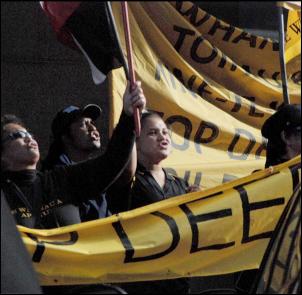
It is not because of media inaccuracies that the public thinks Petrobras are being virtually gifted our resources, at considerable risk to New Zealand. In 2007, then-Energy Minister Harry Duynhoeven was boasting in the media that New Zealand had one of the lowest royalty regimes in the world – and last year, there were indications those rates were to be lowered even further amid multimillion dollar sweeteners on seismic research.
But let us for a moment, take Pfahlert on his own terms. Within the industry, the combined package of royalties, corporate tax, GST etc to which he is referring above is called the “take.” According to this report – citing an oil industry executive - the average rate of the take for oil and gas exploration within the OECD during 2010 was 44%. What is it in New Zealand? Well, in 2007, the US Government Accountability Office calculated that the New Zealand “take” for oil and gas exploration was 37.5%. Below the OECD average, and well below what Norway and Angola demand and headed downwards. It may be that New Zealand’s deepwater fields and remoteness make some inducements to exploration companies appear essential – but face it, is there any sign that the government is willing or able to negotiate a good deal with the hardknuckle operators from the oil multinationals ?
In recent weeks, Greenpeace has done a brilliant job of exposing how New Zealand is carrying almost all the risks in the Raukumara Basin exploration by Petrobras, for negligible returns. When the issue first arose last year, the government assured the public that industry best practice would be followed. This week, Pfahlert’s Petroleum Exploration and Production Association blew that message by maintaining it would be ‘absurd’ for New Zealand to require Petrobras to have the best post-Deepwater Horizon oil spill technology on standby in New Zealand before its deepwater drilling began. (Keep in mind that Petrobras will be operating at depths comparable to the Gulf of Mexico conditions in which BP was operating the Deepwater Horizon rig, and then proceeding to twice that depth.) Only a beach cleanup afterwards would be practical, Pfahlert maintained.
On RNZ this morning, Pfahlert’s spokesperson was asked if Petrobras would be operating with blow out preventers (BOPs) Wrong question. BP had BOPs in place in the Gulf, and the problem was they didn’t work. Arguably, because the slack US regulatory authorities carried over from the Bush administration had allowed BP and others to operate without the $500,000 acoustic shutdown switch on their BOPs that other countries such as Norway regard as mandatory. Do we demand such switches on the BOPs in use here? The spokesperson also assured RNZ’s Geoff Robinson that the companies had every incentive to avoid oil spills. This is patently untrue. Liability for spills is capped – in New Zealand, the maximum punitive penalty tops out at a paltry $200,000 – and any cleanup costs faced by the companies are tax deductible.
Finally, if we are
ever to find the right balance between risk and return when
it comes to oil and gas exploration, we will need to upgrade
our systems for monitoring extraction. How do we propose to
monitor what amounts Petrobras is really taking out of this
remote field, and ensure they reporting honestly and
accurately? Apparently, not even the US government has the resources to do this job
accurately. Also, check this
out.
http://www.eenews.net/public/25/15175/features/documents/2010/04/14/document_pm_01.pdf
How do we propose to keep tabs on Petrobras?
 Keith Rankin: Clipping The Ticket; Solving Hormuz, In Context
 Ian Powell: Inhumanity Of US Economic Sanctions Against Cuba – Infant Mortality And Starvation; Time To End NZ’s Silence
 Ramzy Baroud: Subjects Of Empire - Breaking The Cycle Of Arab Dependency On US Elections
 Peter Dunne: Dunne's Weekly - The Pragmatic Food For Fuel Deal With Singapore
 Eugene Doyle: After Israel’s Brutal Attack On Kiwis, Our Government Does Nothing
 Keith Rankin: Has Sweden Become A De Facto Apartheid Narco State?