
 Scoop has an Ethical Paywall


Gay Red Stop: John Key and homophobic language
Gay Red Stop: John Key and homophobic language
by Anne Russell
November 9,
2012
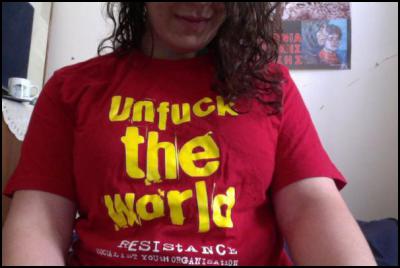
Workers Party and Queer Avengers member Marika Pratley dons a red shirt as a rebuttal to John Key's homophobic comments.
When John Key takes the time to appear on a farming radio show to talk about Adele and golf, one wonders what the job description for Prime Minister looks like, and if it isn't perhaps time for a rewrite. However, Key has done many puff pieces during his time in office, as have prime ministers before him. The incident would probably have slipped under the radar if not for Key's remark about his co-host's "gay red top".
Coupled with Key's remarks about David Beckham being "thick as batshit", the gaffe has made international news, attracting critiques from notable figures such as Ian McKellen. In the NZ Herald, Bryan Gould expressed embarrassment that New Zealand's international reputation is becoming somewhat farcical thanks to Key's flippant comments. Indeed, it is far from the first time that Key's offhand remarks have created controversy. In terms of these two recent incidents, however, one is merely offensive, depending on who you talk to, and the other is oppressive; the "gay red top" remark stems from and adds to the historical oppression of the queer community. The issue therefore goes beyond personal offence, and into a structural understanding of how queerphobia is perpetuated by the language we use.
Among his defences, Key claimed that he used the word 'gay' to mean 'weird', and that young people use it that way all the time. While Key is correct that many people understand 'gay' this way, majority rule doesn't render the language unproblematic, or not homophobic. Given how queerphobia has dominated much of Western history, the progression of gay meaning homosexual to gay also meaning weird or stupid is inextricably linked to a long-term negative understanding of homosexuality. Many people who use the word in this way are not necessarily trying to sideline queer people--and indeed, many queer people may not feel personally offended by its usage--but this doesn't nullify the term's oppressive history.
As such, Key's response of apologising if he had offended anyone is slightly beside the point. Earlier this year, when a transphobic advertisement was taken off the air, Workers Party member and queer youth advocate Kassie Hartendorp wrote that the debate on queerphobia had to be widened from issues of personal offence:
Labelling a comment, slur or stereotype as offensive, lowers the problem to that of the individual rather than identifying it as a structural problem…As one blogger puts it: “sticks and stones may break my bones, but words can mobilize an entire society in violent hate against me.”… [Transphobic slurs] are not personal attacks on individual members of the trans community; they are the product of an oppressive system.
Key's use of language is not operating in a vacuum, and LGBT communities and their allies are not angry merely because the Prime Minister has said a word. Rather, it serves as one prominent example of the queerphobia which is a daily reality for many LGBT people: from getting sideways looks for holding hands in public, to being beaten up for looking butch, to being fired for coming out as transgender, to having one's genitals surgically mutilated for being intersex, to not yet having the choice to marry and/or adopt children. Although the 'gay red top' incident may look like an isolated one to outsiders, hearing the cisgendered straight businessman who currently runs the country using a homophobic slur is more goading than usual.
Although institutional bullying arguably has greater long-term effects, the word 'gay' is widely used for interpersonal bullying in schools, as McKellen pointed out, contributing to the high suicide attempt rates of queer youth (20% of LGB youth compared to 4% of straight youth—trans* youth were not measured in the report). Many people using the word gay to mean stupid may not intentionally take any other, more serious action against LGBT people, but their linguistic tendencies form part of giving tacit permission for openly queerphobic people, who really will resort to intimidation and violence, to continue their work unchecked.
In this instance, John Key has been oppressive not because of any cartoonish gleeful queerphobic intent, but because he seems unconscious of and/or indifferent to LGBT communities' very real concerns. It is very easy to reinforce queer oppression whether one does it consciously or not, even if one has dedicated a lifetime to trying to eliminate it. Key cannot hope to be the one exception to this rule. Taking action like showing up to queer pride events, while positive in itself, is not a ticket to escaping a homophobic society. Key claimed that "I'm voting for gay marriage, I'm hardly homophobic, I led the charge on it," although his support for a bill brought about by Louisa Wall and queer activists only materialised after Obama's nominal endorsement of same-sex marriage. Regardless of his support, queerphobic statements and actions are assessed independently from one another, but as representing different parts of the same system. When discussing misogyny, blogger Natalie Reed wrote:
There really isn’t any such thing as “sexists”, “transphobes”, “racists”, etc. There are only actions, statements and beliefs that are sexist, transphobic, racist, etc. And we’re all susceptible to them. Likewise, sexism is not a social problem that can be located, isolated, quarantined and then eliminated. It is an emergent system of attitudes about sex and gender that derives its power from the bottom up, from all corners of our culture. And it is enacted in the poetry reading every bit as much as it is enacted in the halls of parliament.
Linguistic queer oppression has a long contextual history, and so does the National Party. Many queers have not forgotten that Key currently heads the political party which overwhelmingly voted against queer rights in 1986. Although the party may be slightly less queerphobic today, it still requires effort for it to gain trust from the queer community. This effort has slowly materialised, but is still a long way off achieving parity with other parties, as queer people have been slurred by National more than once over the past month. North Shore MP Maggie Barry recently referred to transgender issues as "fringe issues", as though the effects of transphobia—high unemployment and suicide rates, for example—are lessened because a comparatively small number of people directly experience them. While Key supports same-sex marriage, almost half of his party voted against it on first reading, and doesn't seem interested in representing queer rights as whole.
Because of the nature of our current system of government, a Prime Minister is never going to be a sole leading force for radical egalitarian change. Moreover, as long as a competitive party structure exists in Parliament - where contrition is interpreted as a sign of weakness - there is little room or motivation for the ruling party to wholeheartedly apologise for wrong-doing. Moreover, a right-wing Prime Minister who considers it part of his job to discuss pop stars in public is unlikely to do in-depth work to eliminate privilege and prejudice in society. Conservatives' progressivism on issues like LGBT politics generally emerges if and when being queer-positive becomes profitable, or in Key's case, when it brings him in line with dominant global politics.
Footnote: The evolution of language is generally quite slow, but can be sped up by particular political events. In terms of current queer activism in New Zealand, many people are decked out for Gay Red Shirt Day today, which was organised specifically to draw attention to this issue. Broader queer activist groups include the Wellington-based Queer Avengers and LegaliseLove, who have arranged a national conference on marriage equality later this month, and are involved in other queer advocacy work besides.
ENDS
 Keith Rankin: Clipping The Ticket; Solving Hormuz, In Context
 Ian Powell: Inhumanity Of US Economic Sanctions Against Cuba – Infant Mortality And Starvation; Time To End NZ’s Silence
 Ramzy Baroud: Subjects Of Empire - Breaking The Cycle Of Arab Dependency On US Elections
 Peter Dunne: Dunne's Weekly - The Pragmatic Food For Fuel Deal With Singapore
 Eugene Doyle: After Israel’s Brutal Attack On Kiwis, Our Government Does Nothing
 Keith Rankin: Has Sweden Become A De Facto Apartheid Narco State?