
 Scoop has an Ethical Paywall


We Are Being Ripped Off | 500 Words

We Are Being Ripped Off | 500 Words
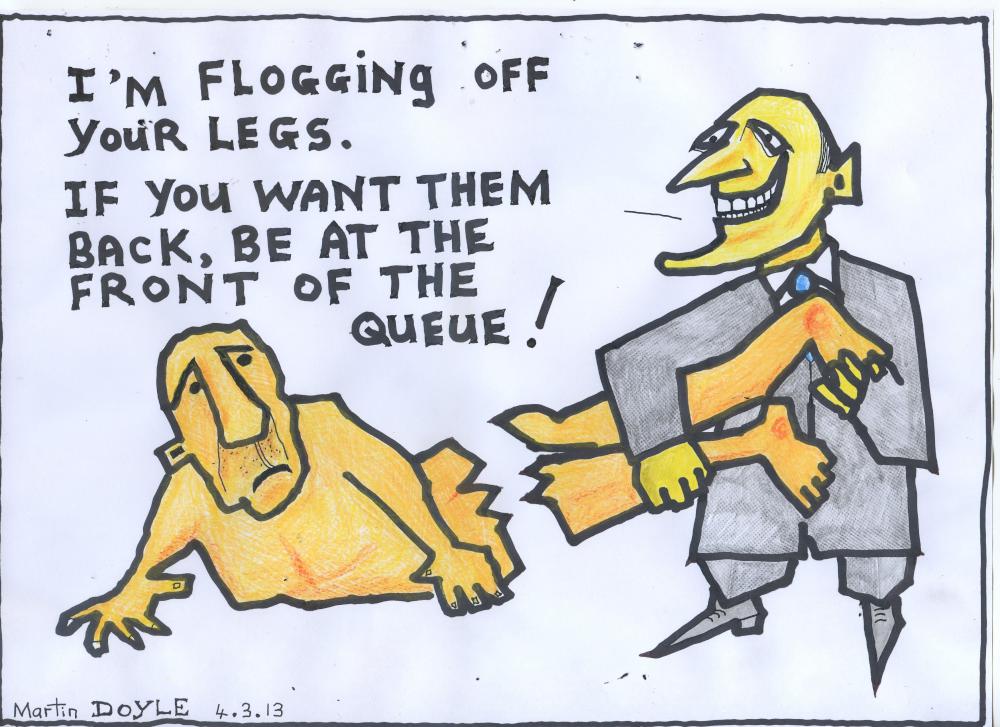
Cartoon by Martin Doyle - Click for big version
Later today we expect Prime Minister John Key to kick off the final countdown to the sale of a 49% stake in Mighty River Power.
As he does so the level of acrimony we can expect in political debate will rise. (Acrimony = "harsh or biting sharpness especially of words, manner, or disposition" )
Which is not to say that there are two sides to this debate - however much the cheerleaders say there are benefits to the NZ Capital Markets.
Bottom line this is not about benefiting anyone other than share-brokers, merchant bankers, company directors and investors.
It is not a democratically supported decision:
- a clear majority of the New Zealand public are opposed to this sale;
- a referendum will be held later this year; and
- the sale is taking place against the clear stated wishes of Maoridom - the Tiriti O Waitangi treaty partner;
There is no economic rationale for the sale i.e. no basis to believe - beyond blind faith and chauvinism - that this sale will result in any economic gain, either to the country, the government or us individuals as citizens and ratepayers:
- Treasury - using basic math - has told us that the deficit will increase faster as a result of these sales - due to the fact that the investment returns on the capital employed are substantially higher than the current cost of borrowing;
- We will all pay for it in higher electricity prices as private shareholders demand a higher return on their assets than the government would have been expected to (the government is moderated by fear of upsetting its voters - shareholders are not).
But the biggest negative in this sale is neither of the above.
If NZ sells down its electricity assets it will cut off a golden opportunity to pursue a bold and imaginative future.
NZ is in a position to become the first fully carbon neutral country. We could be the first smart energy country in the world.
We are already way ahead of the rest of the world in terms of renewable electricity. And we could get close to 100% on the electricity side of the equation - provided we have the right regulatory systems in place.
Yes we could.
But not if we sell the power companies.
Why?
Because:
1. We would almost certainly need to do a radical shakeup of the energy regulatory regimes in order to achieve this objective;
2. It would not be in the interests of the shareholders in the power companies for this to happen - they are powerful and rich and would oppose it - and then it would get too hard;Or if you are inclined to disagree with (2).
3. Taxpayers would be required to compensate the shareholders in the power companies to make it in their interests to consent. Best case scenario they will be enlightened and the Govt. would only need to sweeten a reform package. Worst case - NZ signs a Trans Pacific Partnership agreement with investor state enforcement provisions in it and we have to pay a direct financial penalty to the shareholders.
This is 1987 all over again. A privileged elite is bulldozing through a policy against our wishes which enriches the personal short-term financial interests of a few at the expense of us all.
In short, we are being ripped off.
- Alastair
Thompson | 500 Words 4/03/2013 8:59:58
a.m.
Alastair Thompson
Scoop Publisher
Alastair Thompson is the co-founder of Scoop. He is of Scottish and Irish extraction and from Wellington, New Zealand. Alastair has 24 years experience in the media, at the Dominion, National Business Review, North & South magazine, Straight Furrow newspaper and online since 1997. He is the winner of several journalism awards for business and investigative work.
 Keith Rankin: Clipping The Ticket; Solving Hormuz, In Context
 Ian Powell: Inhumanity Of US Economic Sanctions Against Cuba – Infant Mortality And Starvation; Time To End NZ’s Silence
 Ramzy Baroud: Subjects Of Empire - Breaking The Cycle Of Arab Dependency On US Elections
 Peter Dunne: Dunne's Weekly - The Pragmatic Food For Fuel Deal With Singapore
 Eugene Doyle: After Israel’s Brutal Attack On Kiwis, Our Government Does Nothing
 Keith Rankin: Has Sweden Become A De Facto Apartheid Narco State?