
 Scoop has an Ethical Paywall


Greenpeace & scientists team up to search for Māui dolphin
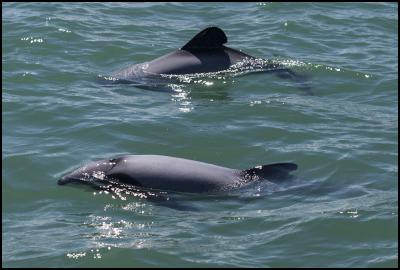
Greenpeace teams up with scientists to search for Māui dolphin
Greenpeace New Zealand has teamed up with researchers at the University of Auckland in an effort to discover more about the critically endangered Māui dolphin, including where they go in winter.
The project was launched yesterday, and the team have already spotted three Māui - almost 5% of the entire global population.
Best estimates show there are only about 63 left, and even catching a glimpse of one is rare. Although scientists have information about the preferred habitat of Māui dolphins in summer, very little is known about where they go in the colder water months.
Leading the collaboration with Greenpeace is Senior Lecturer at the University of Auckland’s School of Biological Sciences, Dr Rochelle Constantine. She is being assisted by PhD student of the Institute of Marine Science at the University of Auckland, Olivia Hamilton.
Hamilton says research shows Māui dolphins closest relative, Hector’s dolphins, are travelling outside of their normal habitat in winter, away from protected waters.
“If Māui are doing the same, they may be moving outside of the current sanctuary into areas where there are human related threats,” she says.
“With so few Māui left, we need to gather all of the information we can about their distribution in order to understand how we can best protect the population".
Greenpeace will be taking the researchers out in inflatable boats through until the end of November, where they’ll be monitoring the seas between Manukau Harbour and Port Waikato.
The three Māui spotted yesterday were milling in one of their summer hot spots, in turbid waters close to shore, south of the Manukau Heads.
Greenpeace Executive Director, Dr Russel Norman, says it was the first time he’d ever seen a Māui.
“They are such beautiful creatures. They are tiny and surprisingly fast, and very distinctive with their Mickey Mouse dorsal fins and black and grey colouring. It was bittersweet realising that the three that darted around our boat for half an hour actually represent 5% of the entire global population of Māui,” he says.
Norman says the collaboration with University of Auckland researchers is a great opportunity to combine Greenpeace’s resources and ocean experience with expert scientific research and analysis.
“The fate of the world’s most endangered dolphin hangs in the balance,” he says.
“Their current protected zone is too small and only provides partial protection of where we know they like to be in summer. It doesn’t take into account confirmed sightings of the dolphins outside of that area, or the possibility that they can travel large distances - especially in colder water months.
“Net fishing has always been the biggest Māui killer, but they’re also coming up against new threats like seabed mining and seismic testing for oil.
“Being able to help gather more information about Māui so that we can demand better protection for them makes sense. We all need to pitch in wherever possible to give our Māui a fighting chance.”
Greenpeace is calling on the Government to extend the dolphin’s marine mammal sanctuary refuge to cover their full habitat range, issue a ban on net fishing, seabed mining, petroleum exploration and drilling from within the sanctuary, and ban seismic testing from within 20 nautical miles of the sanctuary's boundary.
Over 65,000 people have signed Greenpeace’s petition on the matter.
ENDS
Photo and video from yesterday’s Māui sighting available here.
 University of Auckland: Junk Food Designed To Make Us Eat More, Study Finds
 Spark: New Report Sets Out Outcomes-Led Approach To Lift Rural Connectivity Using The Right Mix Of Technologies
 Bill Bennett: Fixed Voice Rules Head For Deregulation
 UN Department of Global Communications: United Nations Proposes New Global Dashboard To Measure Progress Beyond GDP
 Banking Ombudsman Scheme: Fraud Check Delays Well Worth The Inconvenience, Says Banking Ombudsman
 Asia Pacific AML: NZ’s Financial Crime Gap - Beyond The 'Number 8 Wire' Mentality


