
https://www.scoop.co.nz/stories/AK2510/S00121/tauranga-marina-society-clarifies-position-on-sulphur-point-marina-dispute.htm
|
| ||
Tauranga Marina Society Clarifies Position On Sulphur Point Marina Dispute |
||
The long-running dispute over Tauranga Marina Society has generated heated claims on social media and in the courtroom. Allegations of profiteering, secrecy, and mismanagement have polarised the debate. But when Lobby for Good sat down with members of the Tauranga Marina Society (TMS) and examined the legal framework, what emerged was a case study of how unclear governance can fuel mistrust and costly headaches.
The Tauranga Marina at Sulphur Point was built in the early 1980s. At the time, Tauranga Harbour Board needed space for a new container port and was pursuing construction of a harbour bridge linking Tauranga and Mount Maunganui. To construct the bridge and reclaim land, moorings and yachts in the upper harbour had to be relocated.
The solution was a floating marina, funded not by ratepayers but by the sale of berth licences to boat owners. According to the Society, no council money was used.
Today, Tauranga City Council (TCC) owns the land, car park, green space, and rock wall flanking the marina. Licence holders own the floating structures under a License to Occupy model (LTO). TMS is contracted to manage, operate, and develop the facility, with an obligation to provide affordable facilities for boat owners.
For decades, the Society ran under a constitution that still referenced the long-defunct harbour board. A new constitution was adopted in 2016 following work by a member-led group. That version capped TMS’ ownership of berths at 10 percent and required berth holders to also be Society members.
The legal foundation lies in the Bay of Plenty Harbour Board (Sulphur Point) Vesting and Empowering Act 1981. It authorised exclusive berth licences of up to 21 years, including renewals, and gave the harbour board powers to regulate fees and transfers. Once that board was dissolved, a gap in oversight lingered until 2015.
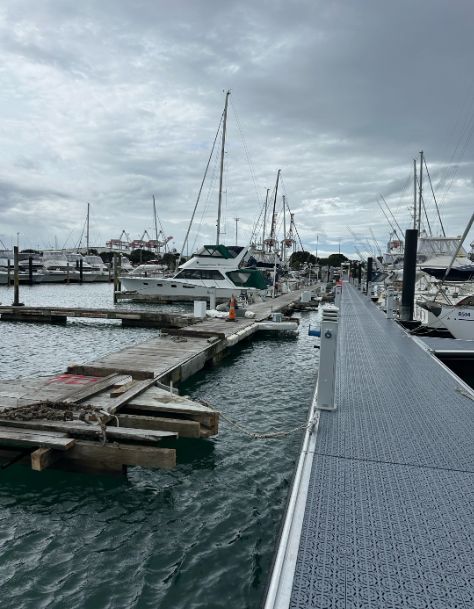
By the mid-2010s, engineers warned the timber pontoons from 1982 were nearing the end of their life, with a 2017 storm breach making the problem urgent. The Society launched a multimillion-dollar rebuild using 100% recyclable aluminium and poly carbonate supplied by a French manufacturer (Poralu Marine) constituting floating pontoons secured by steel piles.
Licence holders were required to contribute funds. One such license holder, Doug Owens, while initially supportive, has accused TMS of acting like a private business, profiting from berth license sales, and using undersized or second-hand piles.
The committee rejects this. Independent engineers, they say, certified the piles, and an external audit confirmed the first pier rebuild came in under budget.
The TMS committee Chairperson frames the project as both necessary and in the public interest:
“It wasn’t built for one person’s convenience. It was about solving multiple problems, clearing the shipping channel, reducing a 26-kilometre round trip, and supporting Tauranga’s growth.”
The TMS committee also notes that while Doug’s father, Sir Bob Owens, strongly supported the marina’s development, he likely did so, in part, due to business interests and landholdings associated with the port that would benefit from the construction of the Tauranga Harbour Bridge.
The committee credits John Palmer (chief engineer) and John Mason (Port Manager) as other key figures who reshaped Tauranga’s harbour.
The TMS Committee is adamant TCC never owned the floating structures:
“They were built and funded by TMS and have never appeared on council’s books.”
Committee members say councillors “all turned white” when they learned, in 2015-16, that a full rebuild would cost up to $20 million.
Consequently, council then ceded responsibility for the structures to TMS.
Currently, TMS holds about 35 of the marina’s 560 berths, some of which are leased to boat-owners as a form of internal investment.
To prevent speculative trading and inflated prices [berths in Whitianga now reach $450,000 compared to LTO berth licenses at Sulphur Point costing about $100,000] TMS decided in the new constitution that the society would manage berth transfers directly. Licences may be transferred when a boat and berth are sold together, but statutory declarations must be signed confirming transactions are legitimate. The maximum number of berths currently controlled by any individual is three.
The management committee believes it has taken all reasonable steps to close loopholes allowing side deals to be done between current and prospective license holders, but concede the checks and balances largely rely on the honestly of all involved parties.
Disagreement between Owens and TMS extends to interpretations of the recent High Court ruling.
Representatives of TMS say the judge ruled in favour of TMS, with the society awarded reimbursement of some costs. TCC, as co-defendant, was not awarded costs and may face additional financial liability as proceedings continue, leaving ratepayers exposed to further liabilities.
Owens says the court dismissed the interim order and declined the strike-out application, instead directing the trustees to provide a more detailed statement of claim (lodged on 24 September 2025). Under the judgment, he says both TMS and TCC must now file their statements of defence within ten days of that filing. Unless further interlocutory applications are made, the matter will proceed to a High Court hearing.
Owens says he is awaiting evidence from TMS, including details of $2.9 million in berth transactions (with $2.4 million drawn from maintenance fund investments), alleged breaches of clause 7.3 of the resource consent through the use of corrodible materials, failure to provide mandatory annual reports to Council, and the issuing of licences in TMS’s name despite not owning the marina.
TMS pushes back on a number of these claims, pointing out TCC has a representative who is part of the TMS committee who receives all financials and reports along with full financial declarations; denying corrodible materials were used in the construction of the new floating structures; and contending TMS owns the floating structures as opposed to the “marina” owned by TCC constituting the car park, green spaces and rock wall.
Impartial observers note the core issue is not about boats, but governance. When assets straddle the line between public and private ownership, confusion is inevitable.
The Committee insists TMS has future-proofed the marina, ensuring it remains cost effective and transparent for at least the next four decades.
The Chairman stresses that TMS is a not-for-profit organisation, generating surpluses only to fund maintenance and upgrades.
“We provide a massive public service with no cost to the ratepayer. We haul out hundreds of boats from the harbour for servicing, support the Coastguard and local industries – we have an average of 30 contractors working on the hard stand at any one time, provide facilities for Sailability, school boat servicing to Matakana Island, all sorts.”
With the rebuild nearly complete and a new chair soon to be elected, the Society says it wants people to know more about what they do and how they can join. TMS sees itself as a guardian not only for berth holders but for the wider community and remains committed to open communication.
“We encourage the public to come down, spend some time here and make the most of the public facilities.”
Attached images: to the left, previous structures; to the right, the newly completed structures.
Home Page | Auckland | Previous Story | Next Story
Copyright (c) Scoop Media