A smash-hit family
exhibition from Scienceworks in Melbourne will touch down in
Kirikiriroa Hamilton this month, as Air Playground opens at
Te Whare Taonga o Waikato Museum and Gallery on 31 October
2025.
Hamilton will be the first city in New Zealand
to host Air Playground, which explores the invisible but
powerful world of air. On tour from Museums Victoria after a
successful run at Scienceworks in Melbourne, the hands-on
exhibition has captivated people of all ages with its
playful approach to science and discovery.
Visitors are invited
to step into a world of fun and discovery to explore the
science of aerodynamics through ten large-scale interactive
experiences including:
Squish: Embark on a
full-body experience as you squish and squash a giant
jumping inflatable sculpture. It’s like a giant hug from
the air as you learn about how gases move in the soft
container underneath and around you.
Fly: Experiment
with air resistance by crafting different paper plane
designs and launching them to discover which plane can fly
the furthest and why. It’s an aviation enthusiast’s
dream come true.
Whoosh: Brace yourself for a
whirlwind of excitement as you ‘whoosh’ scarves through
a tangle of air tubes and try to catch them as they are
ejected high above and drift down towards you, cushioned by
the air like a parachute.
Te Whare Taonga o
Waikato Museum and Gallery curator Jon Primmer said kids
will love Air Playground’s colourful, immersive blend of
entertainment and education where learning is as exciting as
it is enlightening.
"Air Playground is not
only a celebration of the wonders of the atmosphere but a
fun-filled day out for families to explore and learn through
play."
Don’t miss this new opportunity to
embark on a journey of scientific exploration, discovery and
fun. Engage your senses, spark your curiosity and let
science blow you away.
Air Playground opens at Te
Whare Taonga o Waikato Museum and Gallery on 31 October 2025
and runs until 19 April 2026. This is a ticketed exhibition,
with tickets on sale now at tewharetaonga.nz
Note
For
te reo Maaori, Te Whare Taonga o Waikato Museum and Gallery
uses double vowels (uu) in place of vowels with a macron
(ū) to represent a long vowel sound. This spelling approach
is the preference of tangata whenua in Hamilton Kirikiriroa
and Waikato iwi for te reo Maaori words. Artists’ titles
are shown in their original
form.
FAQs
Where has
this exhibition come from?
Air Playground
was developed in-house by a team of science experts from
Museums Victoria.
What’s the exhibition
about?
Air Playground encourages
curious kids and families to actively experiment and play
with the amazing elemental force of air.
What
are some of the key exhibition experiences for
visitors?
Experience the science of
aerodynamics and the amazing invisible elemental force of
air through 10 fun-filled, interactive exhibits. Visitors
will have the opportunity to explore the science of
aerodynamics through experimental play: float objects in
mid-air, release material in a fast-flowing airstream and
launch your own paper plane design. Learn about the complex
physics of air by challenging your friends to an
‘aircade’ game, tinkering with the speed and direction
of airflow or collaborating to create a spinning, flapping
air show.
What will visitors
experience?
Whoosh
explores the force of air and how it can push, as
well as how has volume and air resistance can slow things
down. Visitors place fabric scarves into a tube system and
watch them whoosh through the tangle of tubes before
ejecting and slowly drifting to the floor. Visitors can
experiment with directing air flow and trying to predict
where the fabric will land.
Hover
examines how air flows around a ball’s curved
shape and traps it in a pocket of lower pressure. Two
colourful mounds hold beach balls hovering enticingly in
mid-air. A button activates air flowing out of surrounding
tubes so that visitors can experiment with balancing balls
and objects in the air flows.
Lift
asks visitors to test objects or create
contraptions that may lift into the air, hover, spin or
flutter when they fall – mimicking seed pods in nature.
Visitors can press a button to turn on the air flow and
experiment by adjusting the windspeed.
Swirl
asks visitors to work individually or
collaboratively to activate fans which blow air to direct a
ball around obstacles and into a goal. Visitors get a feel
for the chaotic way that air interacts with itself and
physical items around it.
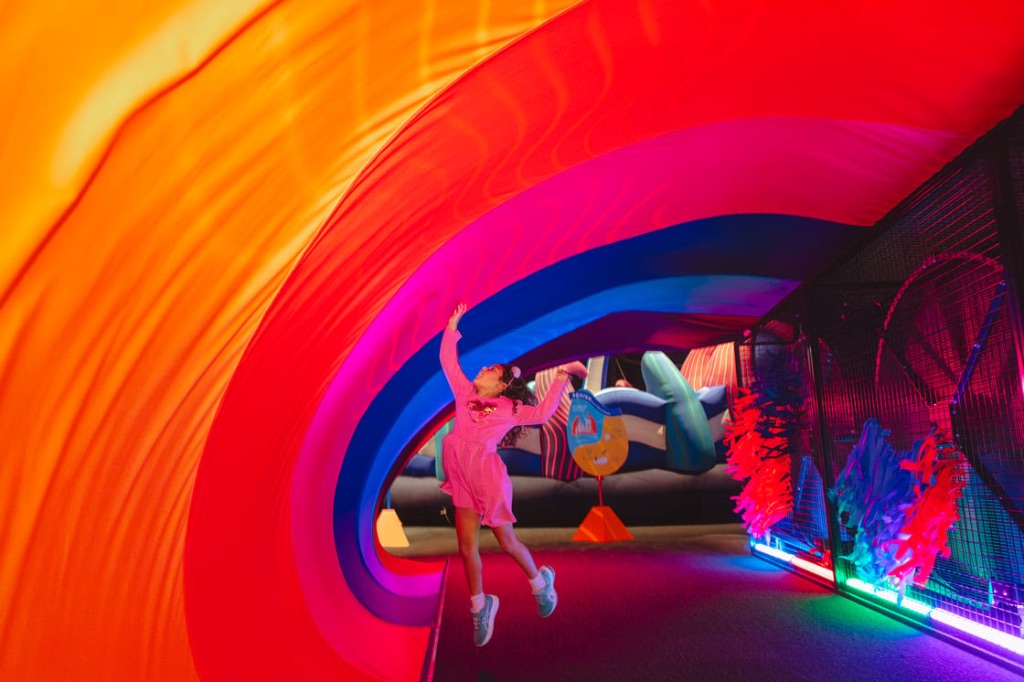
Squish
welcomes visitors into an inflatable sculpture,
showing that air is a gas and can inflate soft containers.
Visitors use their feet, arms, in fact, their whole body to
squish the giant inflatable – where does the air go when
they squish it? Visitors will discover how when you squash
air in a soft container, it doesn’t compress, it
displaces, creating wobbly, bouncy
fun!
Float experiments with the
pull of gravity against air pressure, showing how a ball
interacting with a low-pressure pocket will stay in place.
Visitors suspend a ball in the air flow which they activate
by pressing a button, manipulating the air stream to float
the ball through a goal.
Puff tests
how air has mass and can push objects, even uphill! Visitors
work quickly individually or collaboratively to pump puffs
of air in time to move a ball up a hill. Like mini-golf, the
aim is to get the ball to the goal before it gets stuck or
rolls back down.
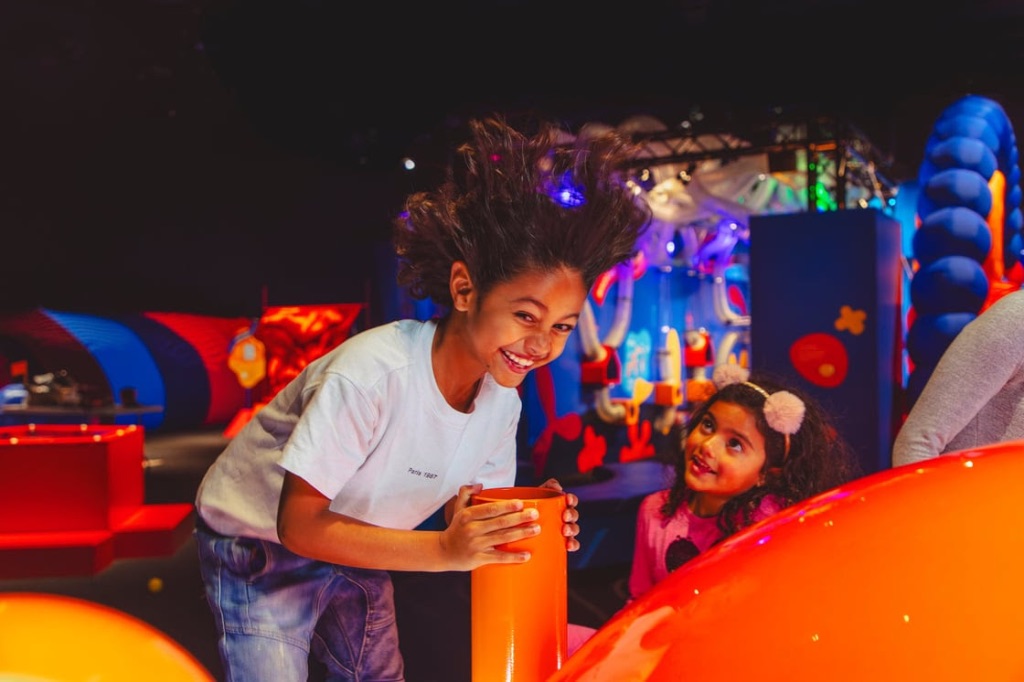
Gust generates a
high-volume air flow environment using large industrial
fans. Visitors can feel the wind through their hair as they
learn about the difference between mechanically generated
wind and natural wind, which is created by the Sun unevenly
heating up the Earth.
Flow delves
into how diverting air flow can change air pressure.
Visitors connect pipe pieces in different configurations.
When they activate the air flow with a button, they can use
soft fabric tubes or small balls to help visualise how this
flow changes. Challenges include constructing a spinner or a
launcher.
Fly explores why a folded
plane flies better than a flat piece of paper. Visitors
follow illustrated guides or create their own paper plane,
discovering how shape, weight centring and surface area all
affect how a plane glides. Visitors can choose to go for
distance, for a target or for tricks. Every plane thrown
creates a mass display of paper planes which builds up over
the course of the exhibition.
Who is
this exhibition designed for?
The exhibition
is designed for families with children aged 6–10, however
there are many exhibits with open-ended creativity which
appeal to visitors of all
ages.