
https://www.scoop.co.nz/stories/AK2601/S00613/strengthening-hawkes-bays-telemetry-network-to-keep-data-flowing.htm
|
| ||
Strengthening Hawke’s Bay’s Telemetry Network To Keep Data Flowing |
||
Hawke’s Bay Regional Council is strengthening the region’s rainfall and river level monitoring network to improve resilience during severe weather events.
“After Cyclone Gabrielle, our communities didn’t ask for big promises. They asked for stronger systems that are better equipped to work under pressure,” says Regional Council Chair Sophie Siers. “This telemetry upgrade programme is part of us delivering that.”
The need for these upgrades became clear during Cyclone Gabrielle, when 34 monitoring sites were damaged or went offline, limiting the council and communities’ ability to track river levels and rainfall. “This is the council learning from Gabrielle. We’re building infrastructure that’s harder to break and quicker to recover,” says Siers.

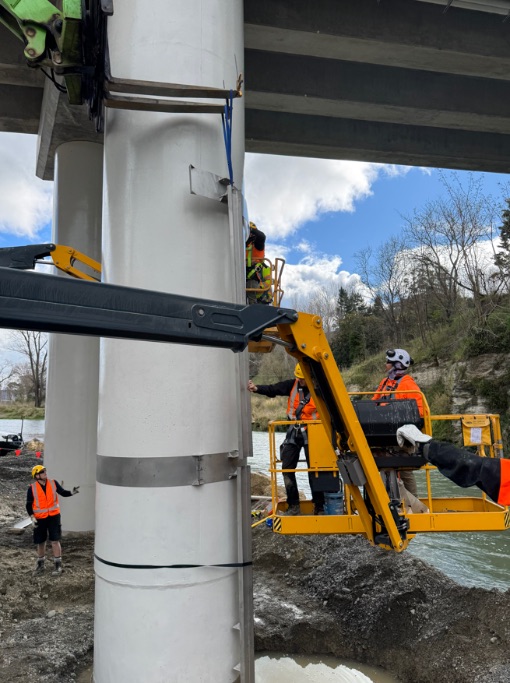
On track for completion by July 2026, the programme has already upgraded 21 of 42 priority telemetry sites, and another six are over 80 percent complete. These upgrades will make the network more robust, with additional sensors and communication pathways, ensuring critical data remains available as long as possible.
“This is the kind of work that builds real resilience,” says Chair Siers. “It’s technical, it’s often invisible, and it matters enormously when severe weather hits.”
The strengthened network will provide more accurate, timely data to strengthen flood forecasting, risk assessment, and public information during extreme weather. “The telemetry network is the backbone of catchment monitoring leading into and during weather events,” says Deputy Chair Jerf van Beek.

It equips us to see risk building earlier, give clearer advice, and make stronger decisions, and empowers community decision-making. This programme is about making sure that information is far more likely to stay available when it matters most.”
Priority sites are spread across 15 rivers and five streams throughout Hawke’s Bay, including several in remote locations and five accessible only by helicopter. “These remote sites can provide the earliest indication of what is coming downstream,” says van Beek. “They are difficult to access, but their reliability is critical, and the effort is absolutely justified.”
These upgrades are a part of Regional Council’s Flood Resilience programme which is a $256.5 million investment into better protecting Hawke’s Bay when severe weather hits. Much of the funding for this programme comes from the Government’s North Island Weather Events (NIWE) programme, which allocated $209 million to Hawke’s Bay with Regional Council contributing $47.5 million.
“That funding carries a responsibility,” says Siers. “Our job is to turn it into real protection on the ground: stronger systems, better data, and greater confidence for our communities.”
“No system is ever completely immune to disruption,” adds van Beek. “But this programme significantly strengthens our ability to support Hawke’s Bay when conditions are at their toughest.”
Communities can access this strengthened network through the HBRC Extreme Weather Hub at https://www.hbrc.govt.nz/extreme-weather-hub/
Key facts:
The telemetry network uses remote sensors to send regular data to the council and the Extreme Weather Hub.
The telemetry network is comprised of over 190 sites monitoring:
Our sensors return over 20 million pieces of data a year.
River level sites record every five minutes, with data transmitted hourly. Rainfall sites record every 15 minutes during rain and transmit hourly.
Learn more: https://www.hbrc.govt.nz/hawkes-bay/projects/telemetry-upgrade/
Home Page | Auckland | Previous Story | Next Story
Copyright (c) Scoop Media