Vibration
from tools and machines can be transmitted into workers’
hands and arms. Workers can be permanently harmed if they
regularly and frequently use hand-held power tools and
machines, especially for long periods of time.
Workers
can develop hand-arm vibration syndrome (HAVS) or carpal
tunnel syndrome (CTS) if they regularly and frequently use
hand-held power tools and machines, especially for long
periods of time.
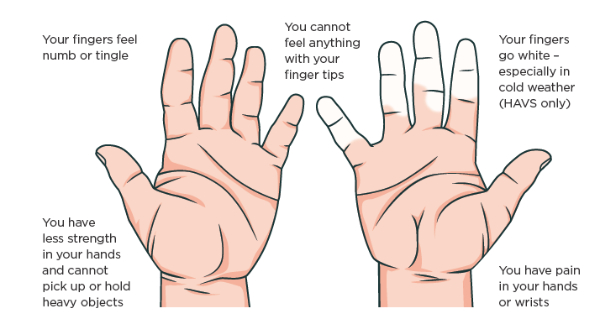
What are symptoms of HAVS and
CTS?
The symptoms can come and go, but with continued
exposure to HAV, symptoms can become prolonged or permanent.
This could happen after only a few months of exposure, but
in most cases it will take a few years.
As a result,
workers could experience pain, distress and disturbed
sleep.
HAV could also make existing hand injuries or
illnesses workers have worse.
People who are exposed
to noise and vibration at the same time are more likely to
lose their hearing than people who are exposed to noise
alone.
If the symptoms are ignored, the damage can
become permanent and disabling. As a result, workers may not
be able to do simple tasks like opening jars or using a
phone. Workers may have to stop working with vibrating
equipment if they can no longer safety handle
tools/machines.
How can you work out if exposure to
HAV is something you need to deal with?
Different
power tools and machines produce different amounts of
vibration. Power tools and machines that are older or not
well-maintained usually vibrate more.
The use of power
tools and machines – typically high vibration ones – is
linked to HAVS and CTS. These include using hand-held or
hand-guided tools
like:
HAVS and CTS are seen in industries such
as forestry, metal working, demolition, road repair,
construction, heavy engineering and foundries.
There
are many factors that can influence the effects of exposure
to HAV. These include:
the condition of the power
tool/machine
the vibration intensity
the
duration of exposure (time/day, frequency)
the
temperature the work is being carried out
in
operator technique (for example, how hard the
worker grips the power tool/machine)
operator health
and medical history (including if they
smoke).
To work out whether your workers are at
risk, think about:
the power
tool/machine
how the work is organised
the
task
your workers.
There is a
recommended maximum daily amount of HAV that workers should
not exceed.
We recommend that workers have
a maximum daily exposure limit of 5m/s2 (8 hour
average).
We expect you to put
control measures in place if your workers
are exposed to ‘the exposure action value’ of
2.5m/s2 (8 hour average) or more.
The
power tool/machine
What is the vibration
level of the power tool/machine? See the
manufacturer’s user manual or
specification.
Is the power tool/machine
regularly maintained? There is greater vibration
when power tools and machines are not well
maintained. Blunt tools mean tasks take longer, meaning
more exposure to vibration.
Is it a heavy
hand-held power tool/machine? Tighter grip is
needed for heavier power tools and machines. Gripping too
tightly increases the chances of developing HAVS or
CTS.
Does a large area of the hand contact
the power tool/machine? The larger the areas of
contact, the more vibration workers are exposed
to.
Does it have a well-insulated
handle? Poorly insulated handles mean workers
are exposed to more vibration.
The
task
Is the power tool/machine the right
one for the task? Using the wrong power
tool/machine can mean work takes longer, increasing exposure
to vibration. Using over-powered tools expose workers to
higher levels of vibration.
What is the
vibration level for the task and how long does the task
take? See the manufacturer’s user manual or
specification for vibration data. The higher the vibration,
the greater the risk.
What is the hardness
of the material the power tool/machine will contact (for
example, is it concrete, is it wood, is it soft
soil)? The harder the material, the more
vibration.
Does the task involve workers
lifting power tools overhead or other awkward
postures? Tighter grip is needed for awkward
postures. Gripping too tightly increases the chances of
developing HAVS or CTS.
How the work is
organised
How long are your workers
exposed to the vibration? How many hours within
the shift involve operating the power tool/machinery? How
often do your workers take breaks? How long are they
exposed to high levels of HAV versus lower levels? How
often do they operate the power tool/machine? Every
day? The longer workers are exposed to vibration, the
more chance of developing HAVS or CTS.
Is
the work in cold environments? Cold increases
the chances of developing HAVS or CTS.
Your
workers
Do your workers always use the
right power tool/machine for the job? Using the
wrong power tool/machine can mean work takes longer,
increasing exposure to vibration.
Have they
been trained how to properly use the power tool/machine? Do
they have poor technique (awkward postures) or grip the
power tool/machine more tightly than
needed? Gripping more tightly than needed
increases the chances of developing HAVS or
CTS.
Are they being exposed to HAV above the
recommended levels? The Health and Safety
Executive (UK) has tools to help work out whether workers
could be being exposed to HAV exceeding the exposure action
value (2.5m/s2 (8 hour average)). These tools
are:
Have
workers previously reported symptoms of HAVS or CTS? Have
you asked workers recently if they are having any early
signs?
Do they
smoke? Smoking decreases blood circulation and
increases the chance of HAVS.
How is their
general health? Medical conditions such as
diabetes and arthritis, and injuries such as frostbite
increases the chances of developing HAVS or
CTS.
How can you manage the health and safety
risks from HAV?
You must first try to
eliminate a risk so far as is reasonably
practicable.
If it is not reasonably practicable to
eliminate the risk, it must be minimised so
far as is reasonably practicable.
If you need to
manage the risks from HAV, you could:
reduce the
amount of vibration workers are exposed to
reduce
the time workers are exposed to vibration (over each shift,
over the time they work for you)
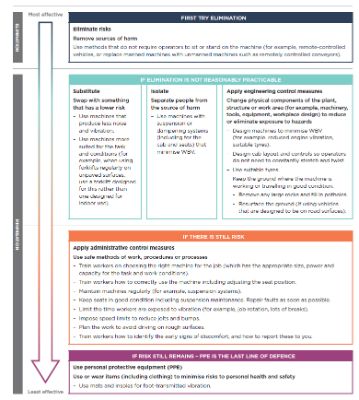
You can use the
hierarchy of control measures to help you to work out the
most effective control measures to use.
Control
measures should remain effective, and be fit-for-purpose,
suitable for the nature and duration of the work, and used
correctly.
With your workers, regularly monitor and
review control measures to confirm that the measures are
effective.
However you should immediately investigate,
and review your control measures when:
the
control measure does not control the risk, or
a new
hazard or risk is identified, or
workers report
symptoms of HAVS and CTS to you, or
you receive
exposure monitoring or health monitoring results that show
your workers are being harmed or at risk from HAV (Section
4), or
there will be a change in the workplace or
work (for example, new equipment, new or changed work
processes, increased workload, extended hours or
additional/changed shifts), or
your workers or their
representatives indicate a review is necessary or request
it.
Use the results of these reviews to
continually improve how you manage health
risks.