WBD & Disney Earnings: Can Legacy Giants Survive On Their Own?
Thursday, 9 November 2023, 6:58 pm Article: Parrot Analytics
The two largest companies by corporate demand share
report earnings on Wednesday, facing similar fundamental
issues heading into 2024 and beyond.
Disney and Warner
Bros. Discovery (and its predecessors) have diligently
followed Wall Street’s shifting moods over the last half
decade. Disney chased Netflix’s streaming subscriber
growth-at-all-costs business model and was handsomely
rewarded at first before the bill came due in
2022.
WBD’s very existence is the result of an
attempt to create a Netflix competitor by combining the
media assets of then-AT&T’s WarnerMedia (née Time
Warner) under streaming-focused CEO Jason Kilar, with those
of then-Discovery Communications.
As of November 2023,
Disney‘s market cap sits at less than half of its peak
valuation from March 2021, and WBD is valued roughly the
same as the Hulu platform.
If any two companies in the
industry are relatively ‘strike proof�� it should be
Disney and WBD. They have the most in-demand libraries to
keep streamers as fresh as possible, and access to the most
popular live sports.
But with massive debt loads,
shrinking linear TV businesses, and cracks appearing in
previously untouchable franchises, both companies have put
virtually everything on the table to get their media and
streaming arms to consistent profitability. Once golden
geese such as ESPN, NBA rights, premium scripted content
exclusivity, and more are now up for sale.
Heading
into 2024, the Magic Kingdom and Dream Factory are being
forced to wake up and smell the pixie dust.
Hulu
Deal
Disney’s
recent announcement that it will carry out its 2019
agreement to buyout Hulu should end up costing the company
north of $9B, at a time when cost cutting is the name of the
game.
In terms of content, Disney presumably
bringing Hulu into Disney+ makes sense from a scale
perspective. Disney+ and Hulu combined would easily overtake
Netflix as the platform with the most total catalog demand
— including all TV series and movies available — with US
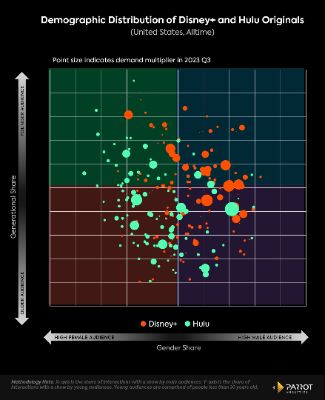
audiences. Parrot Analytics audience demographic data shows
that Hulu and Disney+ originals would combine well to form a
true four quadrant service.
While the price tag is
high, the Hulu buyout will result in increased synergies for
Disney. According to Parrot Analytics, integrating key Hulu
originals and additional library content into the Disney+
app could prevent around $500 million in at-risk churn
revenue, and add an additional $750 million in advertising
revenue.
However, it’s also fair to wonder how a
combined single service app may affect churn, which the
Disney bundle is effective at
mitigating.
Warner Bros. Discovery
WBD’s
raison d'etre, Max, serves as one example of how to
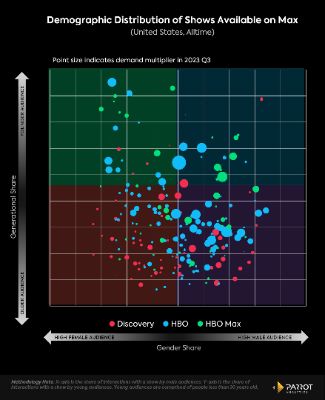
integrate massive content libraries into one app. Combining
Discovery originals onto the old HBO Max platform has
created a four quadrant service that is second only to
Netflix in terms of total catalog demand with US audiences.
However, subscriber growth for Max has plateaued and even
ticked down in Q2 2023.
After building a walled
garden streaming service, WBD is now back to licensing out
some of its premium content, including HBO Originals and DC
films, even to Netflix.
These moves will help
WBD’s bottomline line, and have increased demand for the
licensed content, but it may also be pulling consumers back
to Netflix and help it further its lead over the
field.
How To Leapfrog Disney?
Corporate
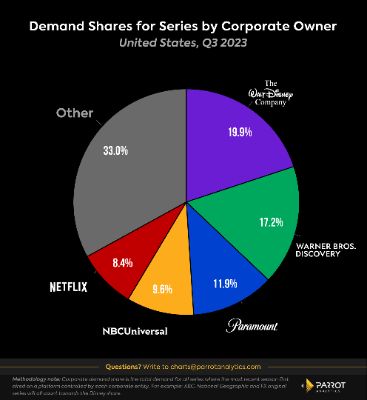
demand share assesses the long-term viability of the top
media companies as they look to consolidate their original
content’s availability exclusively onto their own
platforms, and can effectively help value a conglomerate’s
legacy and library content in aggregate.
Since the
Discovery-WarnerMedia merger went through in April 2022,
Disney and WBD have been the top two media conglomerates in
corporate demand share. Disney has historically been the
biggest slice of this pie chart. These two companies alone
account for 37.1% of the demand for all TV content with US
audiences as of Q3 2023.
WBD’s most
straightforward path to leapfrogging Disney in this category
is to join forces with a competitor. A combination with
either NBCUniversal or Paramount Global would put either new
entity ahead of Disney in Corporate Demand
Share.
While the Hulu buyout should improve
Disney’s streaming business, Disney may be arming Comcast
with the funds to make an industry-shifting acquisition.
Comcast CEO Brian Roberts made failed attempts to acquire
both Disney and 21st Century Fox. Regulatory hurdles aside,
could the third time for Roberts finally be the charm when
it comes to Warner Bros. Discovery?
Go-To
Streaming Home
Demand
for original series drives subscription growth, and library
content is key for customer retention, an increasingly
crucial element of all streaming strategies as the market
matures and consumers are offered more choice and easier
ways to cancel than ever.
Library content will also
be a crucial short-term asset as Hollywood’s labor strikes
prolong, with new shows and movies likely to run dry in into
early 2024 and beyond.
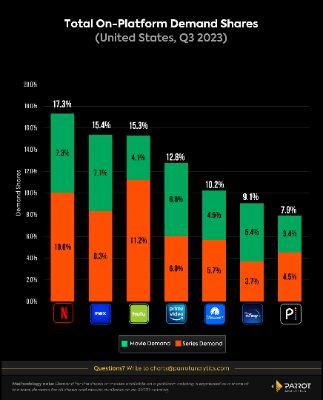
There is a clear ‘Big
Three’ in terms of general entertainment platforms.
WBD’s Max just edge’s out Hulu for second place behind
Netflix in this category.
That said, once Hulu
(15.3%) and Disney+ (9.1%) are combined, that new Disney
streamer should easily top both Netflix and Max when it
comes to total on-platform demand for
content.