New Zealanders Have Some Concerns Around COVID-19 Vaccinations
Sunday, 14 February 2021, 4:53 pm Press Release: Research New Zealand
The topic:
As the Pfizer COVID-19 vaccine has
been provisionally approved for use in New Zealand, we
thought it would be timely to look at New Zealanders’
Covid behaviour and whether they are willing to be
vaccinated against COVID-19.
Our first poll for
2021 surveyed n=1,003 New Zealanders, 18 years of age and
over was completed between 4 and 7 February 2021. We asked
two questions in order to:
Measure whether New
Zealanders are willing to be vaccinated against COVID-19,
and their reasons why, or why not.
Gauge whether New
Zealanders are following recommended health guidelines to
avoid the spread of COVID-19.
The questions were
introduced as follows:
The Pfizer COVID-19 vaccine
has been provisionally approved for use in New Zealand (for
those over 16 years), with initial batches expected to
arrive by the end of March.
The Prime Minister
Jacinda Ardern has said those most at risk of contracting
COVID-19 would receive the vaccine first, with the broader
community vaccination rolled out from the middle of this
year.
The main findings of this poll
are:
Willingness to be vaccinated is relatively
low:
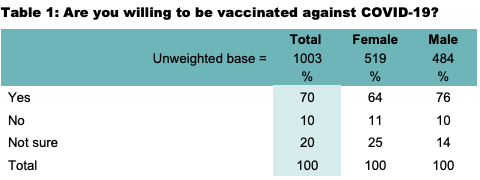
Overall, seventy percent of respondents
stated they were willing to be vaccinated against COVID-19,
ten percent were not willing to be vaccinated, and twenty
percent were unsure.
Those willing to be vaccinated
(n=696) indicated their main reasons were that the
vaccination is the best way to protect themselves (69%), and
others (67%) from COVID-19.
Those unwilling to be
vaccinated (n=101) reported their main reasons were concern
about the potential long-term effects of the vaccine (59%)
and wanting to wait and see how the vaccine has affected
those who have had it (44%).
Just two-thirds
regularly use a tracking app, and fewer use face masks on
public transport:
Relatively high percentages of
New Zealanders stated they wash their hands frequently
(92%), always practice safe coughing and sneezing (88%), and
always stay home when they are unwell
(87%).
However, relatively lower percentages
reported other ‘keeping safe’
behaviours:
Officials and experts have recently
encouraged New Zealanders to use tracking apps. However,
just over two-thirds of all respondents stated they always
keep track of where they’ve been (through the NZ Covid
Tracer app or keeping a record of your visits).
This
survey was undertaken while New Zealand is at Alert Level 1
and the use of masks or face coverings is mandatory for
people travelling on passenger flights throughout New
Zealand, and people travelling on public transport services
in, into and out of the Auckland region (and the drivers of
small passenger service vehicles in Auckland). Three-fifths
of all New Zealanders said they always wear a mask on public
transport (57%), although this was 82% of
Aucklanders.
Aucklanders are above average in terms
of their ‘keeping safe’ behaviours:
In comparison
to all respondents across the country, Aucklanders more
frequently stated they:
Always wear a mask on
public transport (82% compared with 57% for all
respondents).
Always keep track of where they've
been (76% compared with 68% of all
respondents).
Key results
Willingness
to be vaccinated against COVID-19
Overall, seventy
percent stated they were willing to be vaccinated against
COVID-19, ten percent were not willing to be vaccinated, and
twenty percent were unsure.
There was a significant
difference between females and
males:
Significantly fewer female respondents
reported they were willing to be vaccinated with under
two-thirds willing (64%) compared to over three-quarters of
males (76%).
The difference is due to a higher level
of uncertainty amongst female respondents with a quarter not
sure if they would be willing to be vaccinated (25%)
compared to 14% of males.
Key
results: Reasons for willingness to be vaccinated against
COVID-19
Respondents who stated they were willing to
be vaccinated were asked what the main reasons are for their
willingness to be vaccinated. The key results are as
follows:
Over two-thirds stated it (being
vaccinated) is the best way to protect themselves (69%) and
others (67%) from COVID-19.
Around three-fifths said
we need to vaccinate a high percentage of the population
(70- 80%) to achieve herd immunity (61%) and the benefits of
having the vaccination outweigh any downsides
(57%).
Half were willing to be vaccinated because if
enough people get vaccinated, it will help us to re-open our
borders (54%), they trust the NZ government officials'
COVID-19 advice (53%), New Zealand's economic recovery will
be quicker, if we all get vaccinated (49%), and COVID-19 is
mutating and likely to get worse (47%).
Older
respondents (aged 55+) were significantly more likely than
younger people to agree with all the reasons to be
vaccinated that were presented. Please refer to Table 2
overleaf.
Female respondents were more likely
than males to say they were willing to be vaccinated
because:
It's the best way to protect myself from
COVID-19 (74%) compared to 64% for males.
COVID-19
is mutating and likely to get worse (54%) compared to 42%
for males.
Key results – Main reasons for
unwillingness to be vaccinated against
COVID-19
Respondents who stated they were not willing
to be vaccinated (n=101), were asked the main reasons why.
The key results are as follows:
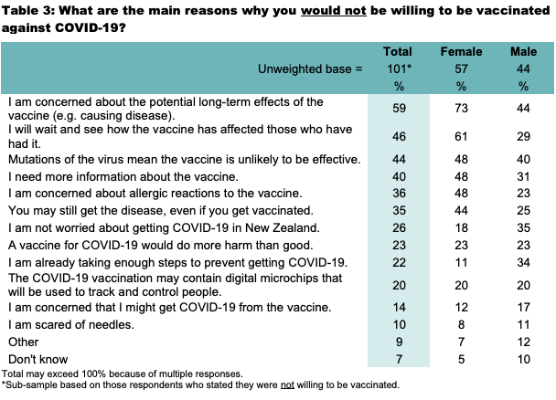
Three-fifths of
those not willing to be vaccinated against COVID-19 stated
they were concerned about the potential long-term effects of
the vaccine (59%). Half (46%) will wait and see how the
vaccine has affected those who have had it, and slightly
less (44%) thought mutations of the virus mean the vaccine
is unlikely to be effective.
Around two-fifths
stated they need more information about the vaccine (40%),
they are concerned about allergic reactions to the vaccine
(36%), and that you may still get the disease, even if you
get vaccinated (35%).
There were several significant
gender differences (please refer to Table 3
below):
Female respondents were significantly more
likely than males to state they would not be willing to be
vaccinated because they:
Are concerned about
long-term effects of the vaccine at 73% (compared to 44% of
males).
Will wait and see how the vaccine has affected
those who have had it at 61% (compared to 29% of
males).
Are concerned about allergic reactions to the
vaccine at 48% (compared to 23% of males).
Males
were significantly more likely than females to state they
would not be willing to be vaccinated, because they are
already taking enough steps to prevent getting COVID-19 at
34% (compared to 11% of females).
Key
results – whether New Zealanders are following COVID-19
safety guidelines.
The key results are as follows on
Table 4.
There are some significant gender
differences:
Males were significantly more likely to
have reported they were willing to be vaccinated against
COVID-19 at 76% compared to 64% of females.
Female
respondents were significantly more likely than males to
have stated they:
Always stay home when they are
unwell at 90% compared to 84% of males.
Regularly
clean surfaces that get touched frequently at 74% compared
to 65% of males.
Older respondents (aged 55+)
were significantly more likely than younger respondents to
have reported that they:
Wash their hands
frequently at 96% (compared to 88% of 18-34 year olds and
91% of 34 to 54 year olds).
Always stay home when
they are unwell at 95% (compared to 81% of 18-34 year olds
and 84% of 34 to 54 year olds).
Always keep track of
where they’ve been (through the NZ Covid Tracer app, or
keeping a record of your visits) at 76% (compared to 66% of
18-34 year olds and 61% of 34 to 54 year
olds).
Comment:
“While the
majority of New Zealanders appeared willing to be vaccinated
against COVID-19 at 70%, according to experts this is
probably not enough to develop herd immunity and protect our
communities. These results show that almost a third will
require more information about the long-term safety of the
vaccine, before being willing to be vaccinated themselves.
This is concerning as not everyone is always following the
COVID-19 safety guidelines to prevent the spread of the
virus."
"The results also revealed some
interesting gender differences. Less than two-thirds of
women were willing to be vaccinated compared to
three-quarters of men. Women reported more concern about
potential long-term effects and allergic reactions from the
COVID-19 vaccine, while some men reported they are doing
enough already. Perhaps women are more cautious, or men more
confident? This could be an interesting debate - but does
indicate that the public require more information and clear
communication about the safety of the COVID-19
vaccine.”
Research New Zealand Managing
Partner, Emanuel
Kalafatelis.