

https://www.scoop.co.nz/stories/GE2509/S00055/melanoma-awareness-month-check-your-skin-save-your-life.htm
|
| ||
Melanoma Awareness Month: Check Your Skin. Save Your Life |
||
“Skin cancer is by far the most common cancer in New Zealand, with eight out of every ten cancers being diagnosed as skin cancer,” says Andrea Newland, Chief Executive, Melanoma New Zealand.
“New Zealand has one of the highest incidence rates of melanoma in the world, and the highest death rate. But melanoma can be preventable, and if recognised and treated early enough, it is almost always curable. Unfortunately, too many people aren’t checking or protecting their skin, and we want to change that.”
There are around 7,200 diagnoses of melanoma and 300 lives lost to melanoma in New Zealand annually.
During last year’s awareness month, together with widespread, vital education about melanoma prevention and early detection, we held nationwide spot check events and found 132 suspicious lesions, including 47 suspected melanomas.
In partnership with Melanoma New Zealand sponsor La Roche-Posay, free skin cancer spot checks will be available this October in regional centres across the country.
“As part of our global La Roche-Posay public health awareness campaign, Save Your Skin, we’re proud to work with Melanoma New Zealand to educate consumers about the harmful effects of UVA and UVB rays as well as provide complimentary sunscreen for protection and skin cancer spot checks for early detection,’’ says Hamish Polson, L’Oreal Dermatological Beauty, New Zealand Market Director.
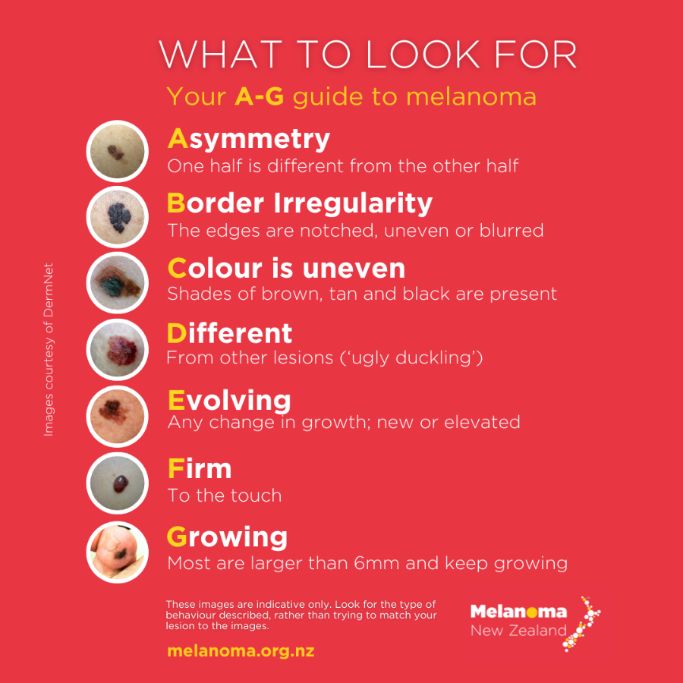
“Our goal this Melanoma Awareness Month is to provide free spot checks nationwide, as well as widespread education encouraging good habits such as self-checking using the A-G method, using sunscreen daily, seeking shade and covering up,’’ says Hamish.
All events are 10am-4pm | No appointment necessary | First-come, first-served | Up to 3 spots checked | Further event details here
Auckland
3
October: Westfield Manukau
4 October: Westfield St
Lukes
5 October: Westfield Albany
10-12 October:
Westfield Newmarket
Hamilton
3-5
October: Chartwell Shopping
Centre
Tauranga
17-19 October:
Fraser Cove Shopping
Centre
Wellington
10-12 October:
North City Shopping Centre,
Porirua
Christchurch
17-19
October: Westfield
Riccarton
Dunedin
24-26 October:
Meridian Mall
Our free spot checks are conducted by Melanoma New Zealand’s skin cancer Nurse Educators. The nurse will examine up to three spots on your skin using a dermatoscope – a handheld skin surface microscope. The process is quick and simple and doesn’t hurt at all. In most cases, the nurse can provide reassurance that there’s nothing to worry about. However, if a spot of concern is found, such as a suspected melanoma, basal cell carcinoma, or squamous cell carcinoma, the nurse will guide you on the next steps to take and send notes to your GP to assist with further review.
Please note, spot checks are a great way to engage in conversation about skin cancer and the importance of early detection and protecting skin, but it is not a full body skin check, and a diagnosis is not provided at the time. Regular full body skin checks by a GP, dermatologist, nurse dermoscopist, surgeon or plastic surgeon are still recommended.
“It’s essential for New Zealanders to develop good sun habits from an early age. As you get older, the build-up of UVR exposure over your lifetime leads to damaged skin and an increased likelihood of melanoma. Make it part of your regular health routine to check your skin regularly so you’re aware of any changes,” says Andrea.
“Look for a spot, freckle or mole that is new or that has changed in colour, shape, or size, looks different from others (i.e., an ‘ugly duckling’), is sore, itchy or bleeds, or is firm, growing or becomes raised quickly. If you have a lesion you’re concerned about, you should seek medical advice as soon as possible.”
Use SLIP, SLOP, SLAP, SEEK, SLIDE as a reminder of how to protect your skin and eyes:
Refer to our A-G guide to melanoma (below) to know what to look for when you’re self-checking your skin, or watch our video guide here.
Melanoma New Zealand is a charity that champions melanoma prevention, detection and patient care. For more information, please visit: melanoma.org.nz.
Melanoma New Zealand does not receive government funding. An important part of what we do is securing donations to help fund our work. To support Melanoma New Zealand, please visit melanoma.org.nz/donate.
For over 40 years, La Roche-Posay has worked with dermatologists throughout the world to develop skincare products for the most sensitive skins and the brand is proud to have the number one dermatologist recommended sunscreen in New Zealand*. For more than 15 years La Roche-Posay has been conducting a public health awareness campaign, Save Your Skin, which aims to educate consumers about the harmful effects of UVA and UVB rays as well as provide sunscreen for protection and skin checks for early detection. La Roche-Posay globally has provided over 500,000 free skin screenings in thirty-five countries and has handed out millions of free sunscreen samples.
Locally in New Zealand, La Roche-Posay is proud to support Melanoma New Zealand to help achieve this goal. La Roche-Posay sponsors an additional Nurse Educator, an A-G skin check guide, and the operating costs to run one of the Melanoma New Zealand Spot Check Vans to provide free spot checks, samples and education across the country.
*Based on a survey conducted among NZ Dermatologists, Pharmacists and General Practitioners by IQVIA, between November 2024 and February 2025.
Home Page | General | Previous Story | Next Story
Copyright (c) Scoop Media