
https://www.scoop.co.nz/stories/HL2002/S00178/what-spark-thinks-about-its-fixed-wireless-broadband.htm
|
| ||
What Spark thinks about its fixed wireless broadband |
||
Last week Spark announced its first half results for the six months to December 31. It is a solid report showing strong revenue growth.
Spark looks to be heading on the right track. Yet there is an interesting angle on one of the company’s strategic moves.
Nine paragraphs into the
market release there is this quote from CEO Jolie
Hodson:
“We made a deliberate decision to limit wireless broadband sales in the lead up to the Rugby World Cup, as a conservative measure to ensure customers had a great viewing experience while we introduced our new streaming service. Our capacity was more than sufficient, so we expect this to be a one-off and connection growth to return to trend in the second half.”
Investors love that.
Downplaying fixed wireless broadband in the run up to the Rugby World Cup made sense. Although fixed wireless broadband should be able to give customers enough bandwidth to watch high definition streaming video, that’s not always the case in practice.
Unlike fibre, which has consistent and predictable performance, fixed wireless broadband performance varies from place to place. In some cases it also varies at different times of the day.
Fixed
wireless broadband bandwidth is shared. So if a lot of
people connect at once, speeds can drop. The Rugby World Cup
saw data traffic peak across the nation. That put pressure
on more marginal fixed wireless broadband
connections.
There are others who say their service does not do an adequate job with streaming video.
One common
complaint is that wireless broadband speeds are not
consistent. In some cases speeds vary in a regular pattern
over the course of a day. Others say they get intermittent
slow downs.
There was no conservatism about selling fibre broadband to customers in the run up to the Rugby World Cup.
The message is clear: Spark knows fixed wireless broadband is a lower quality product. It knows customers get a better experience on fibre.
That said, fixed wireless broadband is often an acceptable alternative for customers living in areas that are not served by fibre. It is the main technology for Rural Broadband Initiative customers.
Again, going by user anecdotes, some people
who can’t get fibre find fixed wireless performs better
than their local copper broadband service. Others do better
with a fast copper connection.
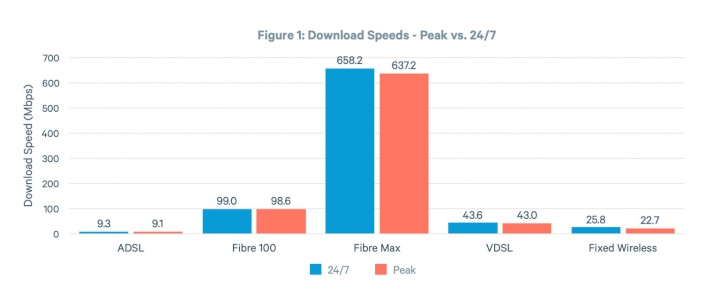
Customers with a 100 mbps fibre plan saw average download speeds of 99mbps. During peak time the dial barely moved. Samknows reported peak speeds at 98.6 mbps.
With fixed wireless broadband the average speed is
25.8 mbps. At peak times this drops to 22.7 mbps. That’s
not a huge drop, but it squares with the anecdotal evidence
that some customers see big drops while others see little or
no drop.
SamKnows found nine in ten fibre connections had latency below 20 ms. In comparison 95 precent of fixed wireless connections had latency of over 30 ms. The average latency is around 50 ms.
Of all the latency tests
performed on Fibre connections, 92% were below 20ms. At the
other end of the chart, 95% of Fixed Wireless latency
results were above 30ms.
SamKnows’ summary
says:
“…many fixed wireless connections will experience issues with latency-sensitive applications such as video calls and gaming.”
In three years it never
wavered. You can read about my fixed wireless experience in
this post. The speed was never anything like as fast as the
VDSL2+ connection.
“Households with multiple user should consider fibre, if available, for the most reliable performance.”
For many Spark customers fixed wireless broadband is the right product. But let’s not pretend it isn’t an inferior product to fibre. Spark is willing to let its investors know that.
Disclaimer: I edit The Download magazine for Chorus as a contractor. It covers the company, the telecommunications industry and fibre broadband. These are my views and not those of Chorus.
What Spark thinks about its fixed wireless
broadband was first posted at
billbennett.co.nz.
Home Page | Headlines | Previous Story | Next Story
Copyright (c) Scoop Media