
https://www.scoop.co.nz/stories/HL2605/S00046/on-classic-childrens-books-badgers-parting-gifts.htm
|
| ||
On Classic Children’s Books: Badger’s Parting Gifts |
||
Every Friday, Werewolf is re-publishing some essays about classic children’s book, that I began writing in 2009. This essay on Badger’s Parting Gifts has been slightly updated:
Maybe the only thing worse than the ‘adults being wacky’ kind of children’s book is the sort of story that sets out to preach an explicit moral lesson to its captive audience. The result can end up hammering into children that we shouldn’t judge people by their skin colour, destroy the earth to make a buck, or disobey the Lord. Worthy sentiments, no doubt. Yet you’d hope that children might be spared from dogmas disguised as entertainment, for a while at least.
In defence, it could also be argued that every good story contains some elements of a moral lesson. In the New Yorker magazine a few years ago, Judith Thurman pointed out that the family unit in the Little House books of Laura Ingalls Wilder has always carried a lot of unspoken political freight: “[They are] a poster family for “Republican values” voters: a devoted couple of Christian patriots and their unspoiled children; the father a heroic provider and benign disciplinarian, the mother a pious homemaker and an example of feminine self-sacrifice.” Which is true but also …all but irrelevant to their qualities as stories.
That factor – is the story good enough to carry the burden of the moral ?- is crucial. It helps to explain why most of the race-and-gender assertive, climate conscious or Christian storybooks never find much of an audience beyond the children of the already converted. All of which makes Susan Varley’s Badger’s Parting Gifts a fairly extraordinary exception.
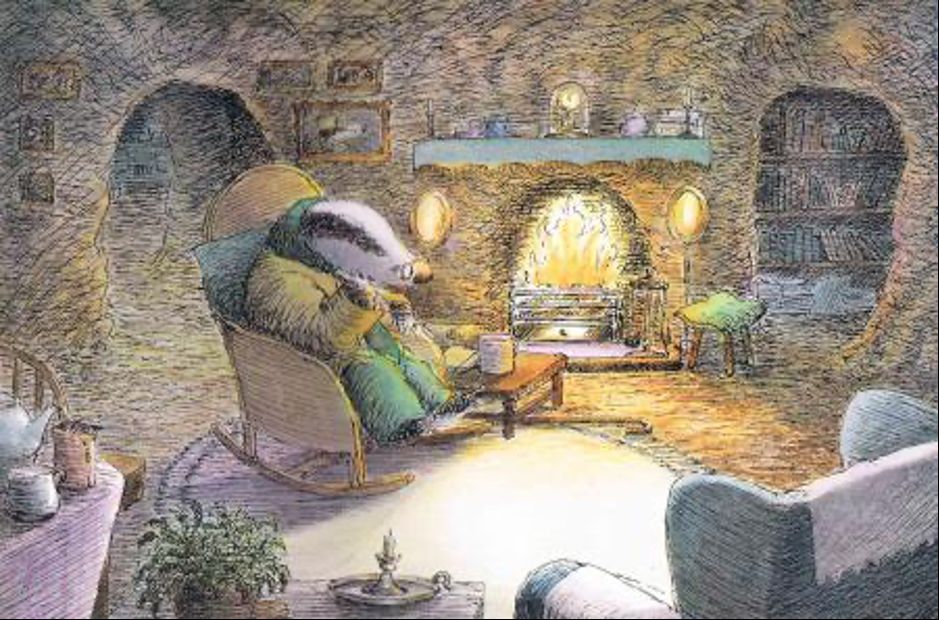
Certainly, a hefty moral is being imparted in this book: death is final, and what endures are the memories of the departed held by the living. Yet the story and the illustrations are up to the task. By story’s end, the ‘message’ flows directly and naturally from the narrative. Yes, people die, and sometimes for the very old (this book suggests) death can be a release.
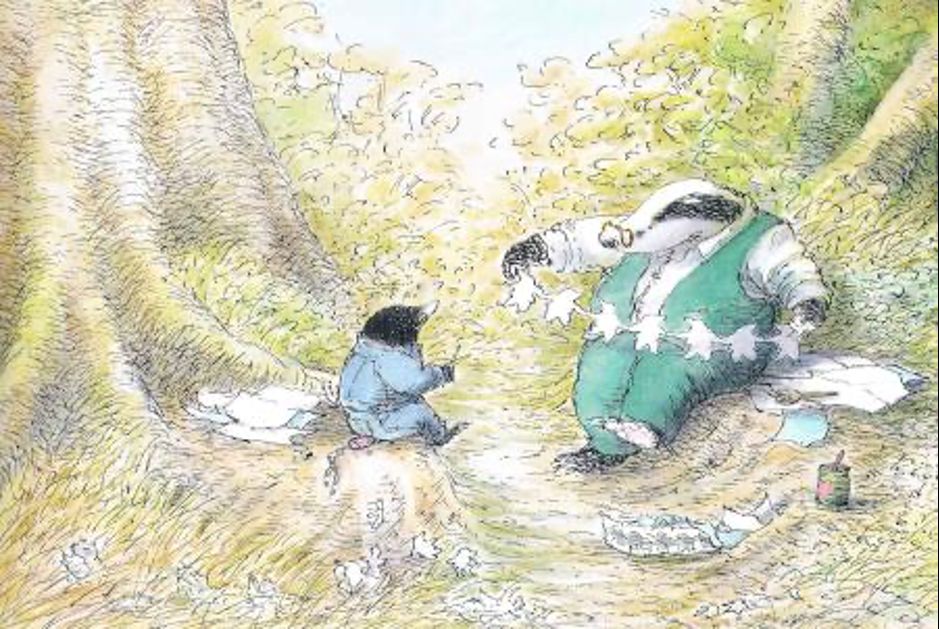
Badger though, lives on in the memories and in the ‘gifts’ of experience he has passed on to his young friends. Thanks to Badger, one of them has learned how to make paper dolls, another to skate, another how to knot a tie. These may not be the earth-shaking accomplishments that change society, but they are the kindnesses that burn brightly in the memory.
Pretty weighty topics for a four to eight year old audience? Well, maybe so. But an awareness of death (and the anxieties it generates) are part of a child’s consciousness from an early age. Given that the boomer generation had its own children relatively late, it is quite likely that their grandchildren will lose their grandparents correspondingly early. In that situation, I can’t think of a better book to allow children an opportunity to talk about their grief, and anxiety. The gently amusing illustrations hit just the right note of comfort, and re-assurance.
Quite unconsciously, the book recommends itself for that purpose by its portrayal of consolation as being a social experience. It is only in the Spring, after the animals have had time to deal with their sorrow, that they join together to share their recollections of Badger, and can come to terms with his passing.
True, Varley’s book may lack the savage sense of loss evident say, in Michael Rosen’s Sad Book, illustrated by Quentin Blake. That book was inspired by the author’s response to the death of his son. While powerful, Rosen’s book is really about parental grief and depression. It is not so much for, or even about, children.
Reportedly, Badger’s Parting Gifts has sold over four million copies, and has been translated into sixteen languages. Even though the book is entirely secular in tone and content, its gentle humanism is also – apparently – quite compatible with many religious traditions. Arguably though, the reason that the book continues to be accessible to people from so many different backgrounds is precisely because it is not didactic.
Interestingly, some readers of a Christian persuasion seem inclined to read into the narrative that Badger’s good deeds must have earned him a reward in the afterlife. A decade ago, when the British reality television celebrity Jade Goody was dying, she told the Daily Mirror and the Sun that she was reading Badger’s Parting Gifts to her children, to help them cope with her eventual death. Goody claimed that the book ‘tells about Heaven and where people go.’ While I hate to argue with the departed, it doesn’t do that at all in my copy of the book.
Similarly, a young boy interviewed by British television in 2019 explained how - after his father died - it had helped him to read Badger’s Parting Gifts with his family. He, too, tended to interpret it in Christian terms, in that he felt the book had shown him that people who died “were up in Heaven, and that they feel better now.” As his mother explained, Badger’s Parting Gifts had helped her son to value his memories of his father, and that it was OK not to feel guilty about being happy again. As Varley indicates in the same interview, people can bring their own interpretations to her text.
Susan Varley was born in Blackpool in 1961, which means that she wrote Badger’s Parting Gifts at the pretty astonishing age of 23. Since then, she has illustrated dozens of books for a diverse bunch of writers, including Martin Waddell and Louis Baum. She also collaborated with Jeanne Willis – who wrote the Dr Xargle books – on the very popular The Monster’s Bed.
Another Varley/Willis joint effort, called The Long Blue Blazer, is worth checking out. In this book, a new child at school is unwilling to remove his blazer. His reluctance to do so has a totally unexpected reason. Finally, the child gets to take off his blazer and fly back (like E.T.) to his home among the stars.
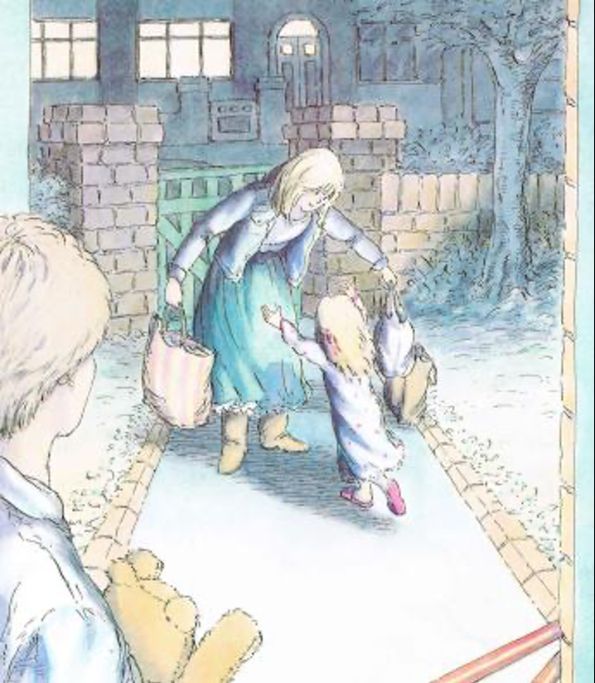
Ultimately, my favourite Susan Varley book would have to be After Dark, written by Louis Baum and illustrated by Varley in 1990. The set-up of the characters here is extremely simple: there is a working mother, an indifferent boyfriend in the basement fixing his bike, and a small child waiting upright in bed for her mother to return home from the supermarket.
Baum and Varley deftly fleshed out these three characters, and the different rhythms of their night. On various pages we see the mother doing her shopping, and then passing a pub where people are having a good time. She pauses to watch a more affluent woman through a lighted window, and passes by an old couple holding hands on a bench. All of these images of other lives are juxtaposed with those of the wide awake and waiting child, who keeps moving ever closer to the front door.
The gravitational pull between the two main characters – played off against the inertia of the boyfriend – is perfectly realised, and Varley’s lovely, blue pastel shaded drawings in pencil and watercolour, are sketchily appropriate. The sketchiness serves to convey that this is just another night for a small family, getting by in a large world that has other concerns.
In all three books – Badger’s Parting Gifts, The Long Blue Blazer and After Dark – anxiety is a common factor. Badger worries about how his friends will cope without him, the new boy at school worries about revealing a shocking secret about himself if he removes his long blue coat, and the little girl worries that her mother will just never, ever get home from the supermarket.
In each case, the resolution is touching and amusing, which is something any didactic author should keep in mind. Because when you’re out to impart a message, a touch of humour can go a long way towards ensuring that your young audience will want to read your tract more than once.
Previously: The Moomins books by Tove Jansson
Next Friday: Goodnight Moonby Margaret Wise Brown
Home Page | Headlines | Previous Story | Next Story
Copyright (c) Scoop Media