Friday, 30 April 2021, 4:54 pm Press Release: NIWA
Outlook Summary
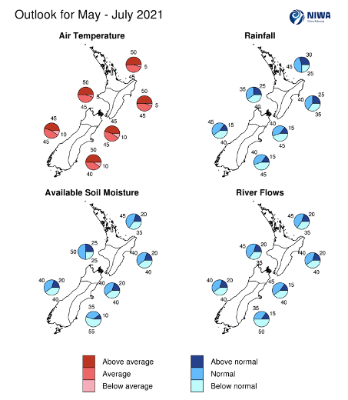
Rainfall is
about equally likely to be below normal or near normal in
all regions of Aotearoa New Zealand except the north of the
North Island, where near normal rainfall is most likely.
It’s possible that long dry spells continue over the next
three months.
While rainfall events will occur over
the next three months, their frequency may be reduced
compared to normal. Groundwater and dam level recharge and
increases in river flow and soil moisture will likely be
less pronounced than normal.
Temperatures are very
unlikely to be colder than average for the three months as a
whole. Above average or near average temperatures are
favoured for all regions except the east of the South
Island, where above average temperatures are most
likely.
While frosts and cold spells will occur
occasionally, they are generally expected to be
brief.
Air pressure is predicted to be higher than
normal to the east of the country. This is expected to be
associated with more westerly and northeasterly quarter
winds than normal.
La Niña transitioned to ENSO
neutral conditions in the equatorial Pacific Ocean during
April as the sub-surface ocean continued to warm. For more
information, see the Background.
Coastal sea
surface temperatures (SSTs) ranged from 0.6 to 1.3˚C above
average during April. Many areas experienced marine heatwave
conditions, as described in the Background.
Soil moisture
levels and river flows are most likely to be near normal in
the north and west of the North Island, below normal in the
east of the South Island, and about equally likely to be
near normal or below normal in all other
regions.
Regional predictions for May – July
2021
Northland, Auckland, Waikato, Bay of
Plenty
The table below shows the probabilities (or
percent chances) for each of three categories: above
average, near average, and below average. In the absence of
any forecast guidance there would be an equal likelihood
(33% chance) of the outcome being in any one of the three
categories. Forecast information from local and global
guidance models is used to indicate the deviation from equal
chance expected for the coming three-month period, with the
following outcomes the most likely (but not certain) for
this region:
Temperatures are about equally
likely to be above average (50% chance) or near average (45%
chance).
Rainfall totals are about most likely to be
near normal (45% chance).
Soil moisture levels and
river flows are most likely to be near normal (45%
chance).
The full probability breakdown
is:
Central
North Island, Taranaki, Whanganui, Manawatu,
Wellington
Probabilities are assigned in three
categories: above average, near average, and below
average.
Temperatures are about equally likely to
be above average (50% chance) or near average (45%
chance).
Rainfall totals are about equally likely to
be below normal (40% chance) or near normal (35%
chance).
Soil moisture levels and river flows are
most likely to be near normal (45-50%
chance).
The full probability breakdown
is:
Gisborne,
Hawke’s Bay, Wairarapa
Probabilities are assigned
in three categories: above average, near average, and below
average.
Temperatures are about equally likely to
be above average (50% chance) or near average (45%
chance).
Rainfall totals are about equally likely to
be near normal (40% chance) or below normal (35%
chance).
Soil moisture levels and river flows are
equally likely to be near normal (40% chance) or below
normal (40% chance).
River flows will likely be slow
to recover since there is a lag between soil moisture
replenishment and an increase in river
flows.
Meteorological drought re-emerged during
April in northern Hawke’s Bay and coastal Gisborne
according to NIWA’s
New Zealand Drought Index.
The full
probability breakdown is:
Tasman,
Nelson, Marlborough, Buller
Probabilities are
assigned in three categories: above average, near average,
and below average.
Temperatures are equally
likely to be above average (45% chance) or near average (45%
chance).
Rainfall totals are about equally likely to
be below normal (45% chance) or near normal (40%
chance).
Soil moisture levels and river flows are
about equally likely to be near normal (40-45% chance) or
below normal (40% chance).
The full probability
breakdown is:
West
Coast, Alps and foothills, inland Otago,
Southland
Probabilities are assigned in three
categories: above average, near average, and below
average.
Temperatures are equally likely to be
above average (45% chance) or near average (45%
chance).
Rainfall totals are about equally likely to
be near normal (45% chance) or below normal (40%
chance).
Rainfall deficiencies will continue to be
possible in the hydro lake areas.
Soil moisture
levels and river flows are equally likely to be below normal
(40% chance) or near normal (40% chance).
The
full probability breakdown is:
Coastal
Canterbury, east Otago
Probabilities are assigned in
three categories: above average, near average, and below
average.
Temperatures are most likely to be above
average (50% chance).
Rainfall totals are about
equally likely to be below normal (45% chance) or near
normal (40% chance).
Soil moisture levels and river
flows are most likely to be below normal (50-55%
chance).
With the end of growing season, there will
be less soil water uptake by plants, meaning that soil
moisture can recover during rainfall events.
River
flows will likely be slow to recover since there is a lag
between soil moisture replenishment and an increase in river
flows.
The full probability breakdown
is:
Graphical
representation of the regional
probabilities