Disney Earnings: The Case For Keeping Hulu [Parrot Analytics]
Thursday, 9 February 2023, 6:06 am Press Release: Parrot Analytics
Disney reports its first earnings of 2023 with on-again,
off-again CEO Bob Iger back in the saddle as the company
stands at a fundamental strategic crossroads.
Some of
the questions facing this century-old institution include:
whether to shutter linear channels, whether to license
content to competitors to juice revenue, where to debut
animated movies, what happens to ESPN, and what to do about
Hulu.
To mention nothing of certain activist
investor demands.
Despite all the outside noise,
Parrot Analytics continues to view Disney as one of the
best-positioned players to monetize the demand of its
streaming and linear content, especially if it holds onto
Hulu and buys out Comcast’s remaining stake in the
platform.
Above all else, Disney remains the market
leader in corporate demand share — which serves as a proxy
for both long-term streaming success, and short-term
licensing revenue potential.
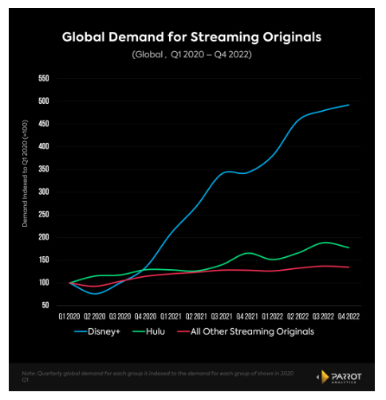
Demand for original
series on Disney+ has driven Disney’s global streaming
success over the last three years. Since early 2020, the
global demand for Disney+ Originals has grown 380%. This has
helped lead to a 390% increase in global subscribers over
the same time, showing the key link between demand for
original series and SVOD subscription growth.
However,
as the US and global streaming markets approach a potential
saturation point, subscriber retention will be equally
critical to the long-term viability of today’s
entertainment giants. This is where Hulu comes into
play.
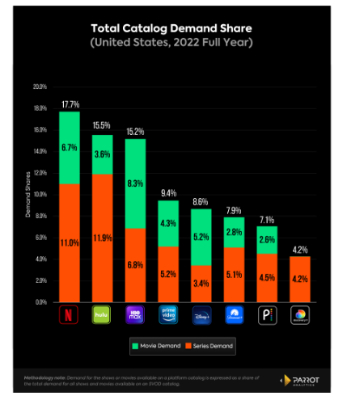
Hulu should be a key part of Disney’s
strategy because it accounts for the most in-demand TV
catalog of any other streaming service with US audiences,
even beating out Netflix. Hulu is in second place in
total catalog demand (TV & movies), and when
combined with Disney+ would beat out both Netflix and a
potential combo of HBO Max and Discovery+ for first place.
This library content is exactly the kind of material that
drives subscriber retention.
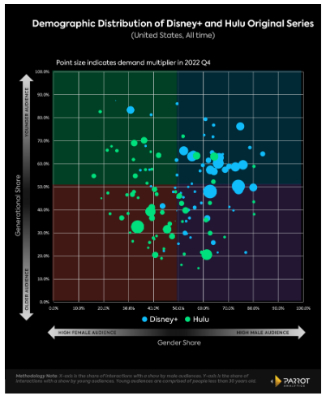
Furthermore, Hulu
fills in the audience demographic gaps that Disney+
currently lacks: namely, older and more female audiences.
The two platforms combined would create the ultimate
four-quadrant service.
Regardless of whether Disney
shifts Hulu into a tile on the Disney+ app or keeps it as a
standalone piece of the Disney Bundle, the data is clear:
demand for both exclusive and licensed content on Hulu
provides immense short and long-term value to the Disney
streaming and entertainment
empire.
Demographic Data: Four-Quadrant
Service
Looking
at the audience for both Disney+ and Hulu originals paints a
clear picture of two complementary platforms that, combined,
have something to offer everyone.
While Disney+’s
flagship Marvel and Star Wars series have audiences that
skew younger and male, many of Hulu’s most in-demand
originals appeal to an older and more female
audience.
Disney+ and Hulu combined create the
proverbial ‘four-quadrant service’ that
today’s entertainment leaders are
chasing.
Corporate Demand Share: US,
2022
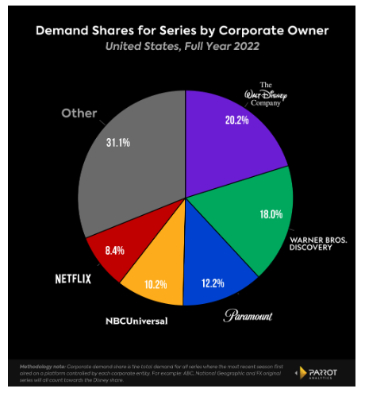
Corporate
demand share assesses the long-term viability of the top
media companies as they look to consolidate their original
content’s availability exclusively onto their own
platforms.
However, with Wall Street’s mandate to
focus back on profits, this view of the entertainment
landscape can also be used to assess which companies have
the most valuable content to license out, rebooting one of
the original revenue streams in the TV business. It can
effectively help value a conglomerate’s legacy and library
content in aggregate.
As the leader in corporate
demand share, Disney stands to earn the
most additional revenue if and when it decides to
sell off content to competitors.
Disney was the only
legacy media conglomerate to increase its corporate demand
share in 2022. The changes for the top five US media
corporations from 2021 to 2022 were:
Netflix: 7.7% to
8.4% (+0.7%)
Disney: 20.1% to
20.2% (+0.1%)
NBCUniversal:
10.8% to 10.2% (-0.6%)
Warner
Bros. Discovery: 18.9% (WarnerMedia +
Discovery) to
18.0% (-0.9%)
Paramount
Global: 13.4% to
12.2% (-1.2%)
Total
Catalog Demand Share (TV & Movies Combined):
US, 2022
As
the global and US streaming market approach saturation
levels, subscriber retention will be increasingly crucial to
the future viability of major streaming
services.
Catalog content drives customer retention,
and assessing the total catalog demand
share (all TV and movies available on a platform)
is a good indicator of which SVODs consumers are most likely
to use as a
default ‘streaming home.’
This chart
shows why Hulu is such a crucial asset to Disney’s
streaming endgame: there is more demand for Hulu’s TV
catalog than that of any other in the business, even
Netflix.
While Netflix currently leads this
category, a hypothetical combo of Hulu and Disney+ would
easily be number one (24.1%), well ahead of
Netflix’s 17.7%, and even outpacing a potential HBO
Max-Discovery+ combined SVOD at
19.4%.
Total Global Demand for Streaming
Originals: Disney+ & Hulu vs All
Others
Note: Jan-Mar 2020 to Oct-Dec
2022
When
it comes to demand for streaming original series — a key
leading indicator of subscriber growth for SVODs — Disney+
has been the runaway leader in growth over the last three
years.
From the Jan-Mar 2020 quarter to Jul-Sep 2022
quarter, the total global demand for Disney+ Originals grew
379.8%. Over the same time period, Disney+’s global
subscriber count increased from 33.5M to 164.2M, a 390.1%
gain, showing the remarkable link between demand for
original content and SVOD subscriber growth.
Hulu Originals have grown at a more modest
pace, up 78% since Jan-Mar 2020. That is still more than
double the rate of growth for originals from all other
streamers, 34.6%.
On top of bridging the audience
demographic gap, Hulu also has the ability to both bring in
new subscribers with its originals, and keep them in the
Disney streaming ecosystem with its vast
catalog.
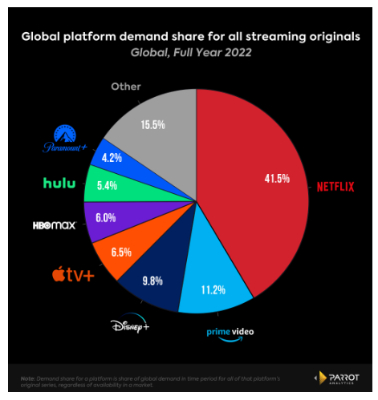
Global Streaming Original
Demand Share Full Year 2022
Disney+
has been the fastest-growing streamer in global demand for
streaming originals two years in a row, growing from 3.6% in
2020 to 7.4% in 2021 to 9.8% in 2022.
Over the last
three years, no streaming service has gained more global
market share than Disney+. From the Jan-Mar 2020
quarter (Apr-Jun 2020 for HBO Max) to Oct-Dec
2022:
Disney+ grew from 4.2% to
10.2% (+6.0%)
Apple TV+
grew from 3.8% to
6.4% (+2.6%)
HBO Max grew from
3.3% to
4.8% (+1.5%)
Paramount+ grew
from 4.1% to 4.2% (+0.1%)
Hulu
shrank from 5.8% to
5.3% (-0.5%)
Amazon Prime
Video shrank from 11.8% to
11.1% (-0.7%)
Netflix shrank
from 55.7% to
39.6% (-16.1%)
In
the Oct-Dec 2022 quarter, Disney+ reached a new milestone
with a record 10.2% global demand share. This was the first
time it hit double digits, and the first time Disney+ has
been within one point of Amazon Prime
Video (11.1%) globally.
Based on their
current trajectories, Disney+ will likely leapfrog Amazon
Prime Video for second place in global originals demand in
2023.
This chart also shows the benefits of
combining Hulu and Disney+. Together they would account for
15.2% of the global demand for original content, far ahead
of Prime Video for second place behind
Netflix.