|
Werewolf: Bullet Points Will Solve All My Problems
Thursday, 19 November 2009, 1:56 pm
Article: Lyndon Hood
|
- So now it turns out (who
knew?) you can get into trouble for making indirect threats
on the Internet.
Not that I want to turn these columns
into a series of disclaimers, but I feel I should clarify
some of the things I’ve said about Larry Baldock.
Like
that bit where I speculated about punching him in the face.
Please, dear reader, do not punch Larry Baldock in the face.
As to whether the discussion was appropriate in the first
place, I mantain any debate which contains Larry Baldock has
already left the bounds of good taste.
- If more
defence is required, I’ll claim I was being ironic.
- I’ve been toying with the idea of an automatic
satire generator. It would save me the trouble of writing
the stuff myself. To tell the truth I actually enjoy doing
that, but it does take time, and inspiration is irregular
and fleeting. It would also spare me the burden of having to
take responsibility for what I say.
- I haven’t
actually had trouble with that either. Much.

- I was once directly accused of “an exercise in
poor taste” by Heather Roy over my write-your-own child abuse press release
piece. Which I think shows I accurately reflected my source
material. I’ll just point out that the ‘poor taste’
referred to here seems not to be literary: Roy’s mention
was effectively an endorsement, which suggests she has the
right idea about this. But the way she then carried on with
the very behaviour that earned her a mention in that column,
suggests she didn’t feel it correctly applied to her.
The Fabulist and the Animals<
by Ambrose Bierce
A Wise and
illustrious Writer of Fables was visiting a travelling
menagerie with a view to collecting literary materials. As
he was passing near the Elephant, that animal said:
“How
sad that so justly famous a satirist should mar his work by
ridicule of people with long noses—who are the salt of the
earth!”
The Kangaroo said:
“I do so enjoy that great
man’s censure of the ridiculous—particularly his attacks
on the Proboscidæ; but, alas! he has no reverence for the
Marsupials, and laughs at our way of carrying our young in a
pouch.”
The Camel said:
“If he would only respect
the sacred Hump, he would be faultless. As it is, I cannot
permit his fables to be read in the presence of my
family.”
The Ostrich, seeing his approach, thrust her
head in the straw, saying:
“If I do not conceal myself,
he may be reminded to write something disagreeable about my
lack of a crest or my appetite for scrap-iron; and although
he is inexpressibly brilliant when he devotes himself to
censure of folly and greed, his dulness is matchless when he
transcends the limits of legitimate
comment.”
“That,” said the Buzzard to his mate,
“is the distinguished author of that glorious fable,
‘The Ostrich and the Keg of Raw Nails.’ I regret to add,
that he wrote, also, ‘The Buzzard’s Feast,’ in which a
carrion diet is contumeliously disparaged. A carrion diet is
the foundation of sound health. If nothing else but corpses
were eaten, death would be unknown.”
Seeing an attendant
approaching, the wise and illustrious Writer of Fables
passed out of the tent and mingled with the crowd. It was
afterward discovered that he had crept in under the canvas
without paying.
- I might wish for reactions like that;
but frankly I wouldn’t enjoy it.
- NZ blog
satire accused of ‘going too far’ twice in seven
days:
Kiwiblog: Greens announce new emissions reduction
policy – abortion. Response to controversy: For the record.
Later, the three
paragraphs of “Smackathon planned” at The Standard
were apparently annoying. It was as if the sides of the
debate had only just realised they had a moral disagreement.
- You might guess what I make of that last one,
given that since then I have taken basically the same angle – that
smacking children might be fairly compare to striking
children with the intention of hurting them – and I had
done so previously too.

And Andrew
McMillian sent in this picture of Larry Baldock celebrating
the referendum outcome, which I think is rather good.
[Note: Image has been doctored.]
Now, it’s my
belief that, when it comes to satire, I should be able to do
anything I want. Therefore, this kind of thing must be okay.
- Re: the Kiwiblog piece, I commented on complaints that if it wasn’t funny it
couldn’t be satire. Then edited the comment and wrote
it here:
Actually, if you look at the history, satire
basically means abuse dressed up as literature. Usually
witty, which is not the same as funny. The expectation for
lulz is just an expectation, not a requirement.
Trust me,
I’m an expert.
I’ve been writing a bit about the sort
of things that might cause people not to appreciate (as
opposed to not to recognise) one’s satire, and I think
making a joke about abortion based on an burlesque
exaggeration of the fact – as opposed to, for example, the
way – they want to reduce emissions would probably do the
trick. Different assumptions.
I’m not presently in a
position to accuse anyone of writing satire that isn’t a
useful contribution to the debate [I was thinking of: Things The Emissions Target Is
Like]. Though I have to say the link between
malformed fetuses and abortion [David Farrar (DPF) cited
this post by Trevor Mallard on folic
acid and abortions as an example of termination in political
debate] is rather less tenuous than DPF’s.
- I’m not sure I hold with this ‘Going too
far’ business. But you should know you can stand by what
you say, and that includes the analogies you draw. The fact
something was satire is not, in itself, a defence against
the charge of being a wally.
- So if you
really want that justification I avoided earlier,
I’ll make things clearer by gross simplification
(apparently, that’s part of my job description). If
hitting children because you don’t like what
they’re do is okay, then it should be good enough when I
disagree with Larry ‘Impliments’ Baldock. And now here I
am having to explain that I don’t actually want you
to punch him in the face.

- Here’s some blog satire everyone can agree on.
- When
I made that referendum decision-making flowchart I
considered adding one for politicians for deciding what to
do with the result. Every path would have ended in “Do
Nothing”. So if anyone was actually surprised by
what happened, I hope in the future you will respect my
ability to claim prescience after the fact.
- The
simplest version of my satire machine would work by
rewriting the news of the day by placing it in some
unexpected context chosen at random. The result won’t
necessarily be satirical, but people seem to enjoy getting
the references so much that they don’t notice the
difference. And, statistically, it’ll probably throw up an
actual satirical point often enough.
- If you’re
having trouble with the idea satire needn’t be funny,
consider one of its purest forms: the editorial cartoon.
They’re more about distilled commentary than jokes.
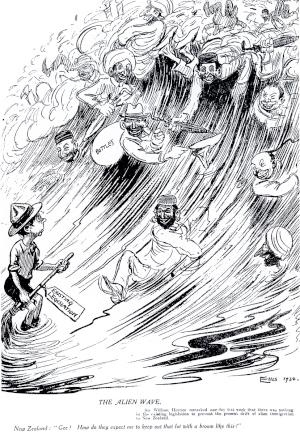
- This particularly
obvious when you’re confronted with a historical sequence
of New Zealand cartoons on the subject of the Asian menace
(As in Aliens At My Table, Manying Ip & Nigel
Murphy, 2005, file under immigration, historical
chastisement).
- The same things that usually work
in cartoons – oversimplification, use of received symbols
– are also just the thing for perpetuating poisonous
ideas.
- That said, I’ve been reading The
Kiwi Laughs (AH & AW Reed, 1961, JC Ried Ed.), an
anthology of New Zealand prose humour. It seems the editor
was hard pressed, prior to the 1920s, to find anything that
wasn’t more droll than LOL.
- And one can’t
help noting the natives seem to be viewed solely as a useful
plot device.
- That first of the postwar LOLs I
mentioned: A story from Frank Anthony’s Me and Gus.
- Though readers
might like to assess the timelessness of this, from
Punch-style magazine Motley in 1871: “A Few Plain
Rules For Persons Desirous Of Becoming Colonial
Politicians” (Page 1, Page 2).
- You may be aware
that our 8th Prime Minister’s 1889 novel Anno Domini 2000 – A Woman’s Destiny
imagined a New Zealand dominated by women. That’s not in
The Kiwi Laughs, but there is an extract from Edward
Tregar’s 1895 novel “Hedged with Divinities” where
there’s just one chap left in New Zealand and a lot of
ladies. This probably goes to show something.
- To
complete the list: satire needn’t be funny, jokes often
aren’t frivolous and just because something is satirical
or a joke does not necessarily mean it’s
okay.
 ● So now it turns
out (who knew?) you can get into trouble for making indirect
threats on the Internet.
● So now it turns
out (who knew?) you can get into trouble for making indirect
threats on the Internet.