
 Scoop has an Ethical Paywall


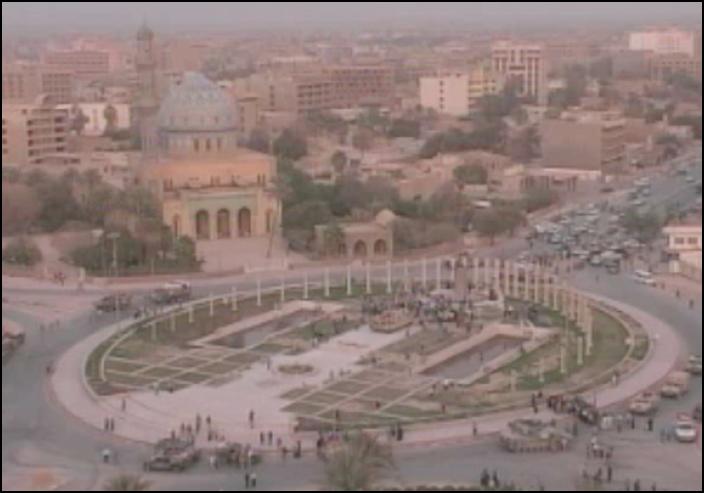
Image: A Wider Angle View Of The Fall Of Baghdad

Click For Bigger Version
The above image is a wide angle shot – source unknown – of the scene around the famous fall of the bronze statue in Baghdad, a scene hailed by US Defence Secretary Donald Rumsfeld as the equivalent of the fall of the Berlin Wall and purveyed on the front cover of 90% of the world's newspapers today.
Several striking differences to the fall of the Berlin Wall immediately come to mind from the above image.
1. The people who pulled down the Berlin Wall were not assisted by a US Army Bradley fighting vehicle.
2. The people who pulled down the Berlin Wall were not a small crowd being protected by three US Abrams tanks.
3. The people who pulled down the Berlin Wall outnumbered the journalists present at the event by the thousands, not by around 30, with a couple of hundred more watching tentatively from the edges of the square.
The following annotated version of the photograph – from Indymedia - makes the points above in a graphical manner.

Click For Bigger Version
Scoop
Scoop Independent News
Scoop is NZ's largest independent news source; respected widely in media, political, business and academic circles for being the place on the internet for publishing "what was really said", and for the quality of its analysis of issues.
 Ian Powell: Inhumanity Of US Economic Sanctions Against Cuba – Infant Mortality And Starvation; Time To End NZ’s Silence
 Ramzy Baroud: Subjects Of Empire - Breaking The Cycle Of Arab Dependency On US Elections
 Peter Dunne: Dunne's Weekly - The Pragmatic Food For Fuel Deal With Singapore
 Eugene Doyle: After Israel’s Brutal Attack On Kiwis, Our Government Does Nothing
 Keith Rankin: Has Sweden Become A De Facto Apartheid Narco State?
 Bruce Mahalski: Change In The Weather #194