
 Scoop has an Ethical Paywall


Pacific Leaders Announce Review Of RAMSI
Scoop Report: Pacific Leaders Announce Review Of RAMSI
By Selwyn Manning, Nadi, Fiji.
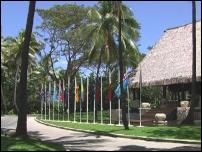 Scoop Report - Pacific leaders have
agreed to set up a taskforce to "expeditiously" review
RAMSI and report back to the foreign ministers of Pacific
Islands states. The move was one of the suggestions tabled
in a five point plan put forward by Solomon
Islands Prime Minister, Manasseh Sogavare.
Scoop Report - Pacific leaders have
agreed to set up a taskforce to "expeditiously" review
RAMSI and report back to the foreign ministers of Pacific
Islands states. The move was one of the suggestions tabled
in a five point plan put forward by Solomon
Islands Prime Minister, Manasseh Sogavare.
RAMSI is the Regional Assistance Mission to the Solomon Islands and was set up in 2003 to provide security to the people of the Melanesian nation.
Sogavare's five-point-plan called for:
The Pacific leaders, including those of Fiji, New Zealand, Australia, Papua New Guinea, Solomon Islands, and Vanuatu meet today seeking a solution to a clash between the Melanesian states and Australia.
The end result was a win this evening for New Zealand Prime Minister Helen Clark and host, Fiji's Prime Minister Laisenia Qarase. Both politicians were charged with sorting out the stand-off between Australia and the Melanesians.
Helen Clark said: "There is a very strong sense of Forum ownership. They (Pacific leaders) want it to work, they want it to work well. We discussed the five point proposal that the Solomon Islands government put on the table.
"What the leaders agreed to was that there should be a review… The leaders have agreed to a new consultative mechanism which cuts the Forum in on high level discussions about the direction of the regional mission, and that means on a quarterly basis there will be consultative meetings between the Solomon Islands government, the regional assistance mission, and representatives of the Pacific Islands Forum's troika."
The troika refers to the previous Pacific Islands chair, PNG's Sir Michael Somare, the current chair Fiji's Qarase, and the next chair, Tonga's Prime Minister Fred Sevele.
Helen Clark said all leaders believe it is timely to consider "where to from here" for RAMSI: "What are the benchmarks? Is there an exit strategy? What would constitute success? You need to define where you want to get to to know whether you have reached it."
She said the Solomon Islands was also keen to discuss "how soon it can begin to increase more rapidly the number of its nationals who are going into the inline positions in the public service… They believe they have the skilled and qualified people and would like to see more of those people come back in."
While it was a win for Helen Clark and Laisenia Qarase, it was a day of eating humble-pie for Australia's John Howard stating: “We don’t want to bully or push anybody around. People who step back and know how Australia behaves know that’s not true. I mean, it’s almost laughable to suggest that we’re behaving like a bully. “
Howard said Australia has injected $800 million into the Solomon Islands (including RAMSI contributions and Australian aid) and still regards the Solomon Islands and Papua New Guinea as colleagues.
Helen Clark said the mood around the Forum table was progressive. She added however there remains a coolness between Sir Michael Somare and John Howard.
"Obviously there has been a lot of rhetoric, I felt that really the Forum made it clear that it wasn't there to discuss bilateral issues between Forum countries. The Forum was there to look at what was of concern to the region. And everybody respected that so we didn't get in to bilateral argybargy, we got into what is legitimately the business of the Forum," Helen Clark said.
 Richard S. Ehrlich: Strait Of Hormuz Blockades & Thailand's Land Bridge
 Keith Rankin: 'I Am A Semite'
 Binoy Kampmark: Show Me The Money - A Loutish Administration Confronts A Craven Congress
 Ian Powell: Do Wellington Floods, Climate Change And Wealth Accumulation Equal “Suicidal Capitalism”?
 Ramzy Baroud: The Pendulum Swings - The Slow Death Of Europe’s Pro-Israel Consensus
 Dr Nasim: Poem From Gaza - Her Smile