
 Scoop has an Ethical Paywall


Colossal Squid "Not Nearly As Tasty As Hoped"
Scientists Report Colossal Squid "Not Nearly As Tasty As We Had Hoped"
Scoop Satire - well, humour of something anyway - by Lyndon Hood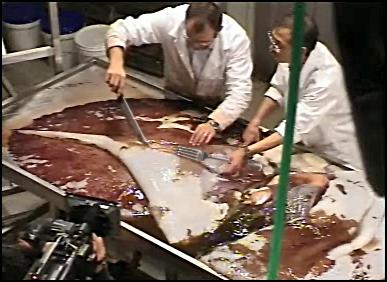
A CASE STUDY
Abstract:
The research team investigated the tastiness of the colossal squid (Mesonychoteuthis Hamiltoni). A complete specimen was dressed and prepared using a variety of traditional methods. All tests found the squid to be not delicious in any way.
Introduction:
On February 22, 2007, it was announced that the largest known Colossal Squid had been captured. The specimen was frozen and taken to the Te Papa museum in Wellington, New Zealand.
In late April 2008 the research team assembled with the intention of conducting anatomical and physiological investigation of the specimen. However, during the extended defrosting process it was discovered over a beer that all of the researchers were really quite curious about how the specimen tasted.
Various sizes of squid are used in local cuisines around the world and squid forms a popular component of a typical fisherman's platter. Researchers speculated that the meat of the colossal squid would taste "squiddy", "gamey" or "kind of more-flavourless, like how those overlarge chicken breast don't have much taste". It was also observed that there was "plenty of eating" on the specimen.
We therefore resolved to test the hypothesis that the squid would be delicious.
Method:
The specimen was divided into cuts and tested using various traditional squid preparation methods. Although some used relatively small pieces, other dishes proved problematic. The insistence that an authentic paella must contain at least one complete tentacle necessitated an unusually large oven. Similarly, the colossal squid ring required the construction of a colossal deep fryer.
On completion, the dishes were presented to a panel of subject/experimenters and assessed for flavour, texture and presentation.
Despite a high attrition rate due to medical emergencies, the team persisted in sampling various organs for several days in the hope the whole exercise would not prove a waste of time and the further hope that ammonia would prove to be an 'acquired taste'.
Results:
Results were disappointing.
No dish was rated as delicious or even bland, with almost all described as "unbearably horrible" or "actual, literal torture". However results are currently unclear with respect to the first trial dish - sashimi - as the test subjects have yet to regain the power of speech.
Prising the squid's sucker-hooks out of one's gums and tongue was agreed to be the most pleasant part of the experience, as the pain dulled the sense of taste.
With specific regard to the experimental colossal squid ring, one subject reported that no matter how much tartare sauce he put on it was still "like eating tractor tyres fried in caustic soda".
Psychological effects were also noted. While the eye - itself large enough to feed several people - had a comparatively non-unendurably flavoured fluid with the texture of a creamy soup, the subject reported difficult eating the dish because of "this enormous eye staring at me".
Despite the large international group of scientists invloved in the experiment, the overwhelming majority of the squid was left uneaten.
Discussion:
Overall, the colossal squid tasted even worse than a giant squid - something this researcher would not hitherto have considered possible. It also had a generally unpleasant texture, was extremely difficult to prepare and almost impossible to eat.
It has been agreed that the carcass will be left to marinate in public for an indefinite period, in the hope that, after the example of olives, the flavour and texture will soften with time.
It is however the opinion of this researcher that the remains should either be thrown out as not even good enough for fast food or fed to a sufficiently large cat. I know there's supposed to be a food shortage on and everything but I swear, even if this thing washed up in Brazil it would only be good for making footballs.
The failure to confirm the hypothesis is especially disappointing in light of ongoing success in taste-centred investigation of endangered species by the Institute of Cetacean Research.
Further research in the field of colossal squid tastiness is earnestly discouraged.
 Bruce Mahalski: Change In The Weather #194
 Binoy Kampmark: Dangers To The Fourth Estate - The 2026 World Press Freedom Index
 Richard S. Ehrlich: Strait Of Hormuz Blockades & Thailand's Land Bridge
 Keith Rankin: 'I Am A Semite'
 Binoy Kampmark: Show Me The Money - A Loutish Administration Confronts A Craven Congress
 Ian Powell: Do Wellington Floods, Climate Change And Wealth Accumulation Equal “Suicidal Capitalism”?