
 Scoop has an Ethical Paywall


Brochures Embarrass British Health Service
"Take Your Medicine" Kids Brochures Embarrass British Health Service
by Martha Rosenberg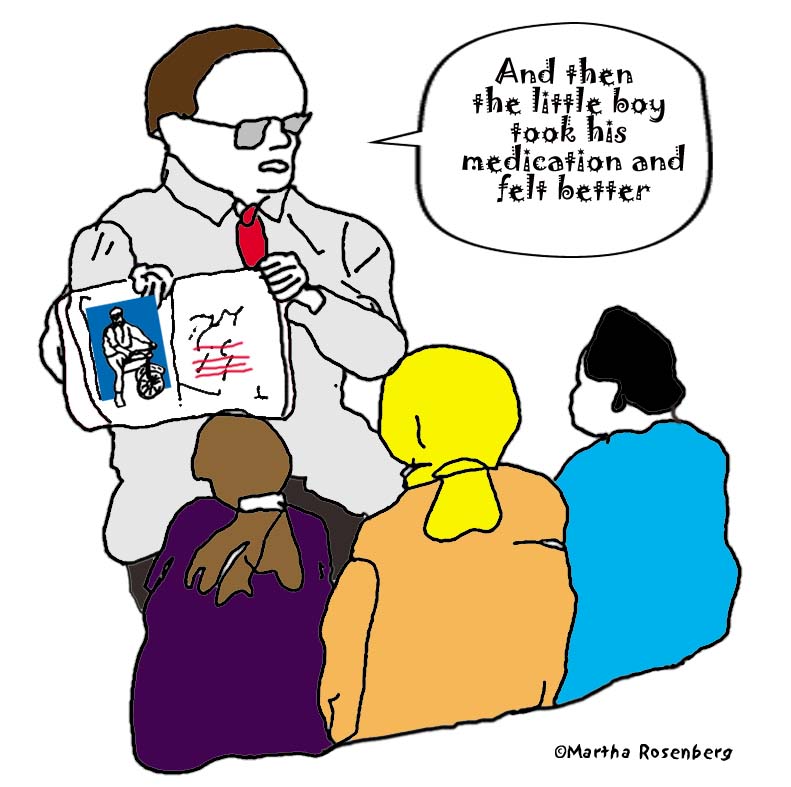
"Your medicine is called Olanzapine. Pronounced 'o-lan-za-peen,'" says the lime green kids' brochure for the antipsychotic Zyprexa, published by Britain's National Health Service (NHS). "Many children, teenagers and young people need to take medicines prescribed by doctors to help them stay well and healthy," says the text amid cartoons of happy children skating, roller blading and playing soccer.
Similar brochures educate children about "ris-perry-done" (Risperdal), another antipsychotic and "ato-mox-e-teen" (Strattera), an ADHD drug. But when mental health advocate Ben Hansen tried to "educate" US children further by posting the brochures on his web site bonkersinstitute.org, he got a love letter from the NHS.
"I have been informed that you are using our leaflets on your web-site," wrote Deputy Chief Pharmacist with the Central and North West London NHS Trust Sue Eccles in an email this month. "Our objective is [sic] provide written materials to support the verbal counselling given by healthcare professionals -- they are not meant to stand alone as sources of information," says Eccles requesting that only the "front page and our contact details," be shown.
Unfortunately, the NHS caught Hansen on a day he didn't take his meds. "We posted the NHS leaflets to stimulate public scrutiny of your agency," replied Hansen, who writes under the pseudonym Methodius Isaac Bonkers, MD. "We call upon the NHS to stop promoting harmful psychotropic drugs for children. In a spirit of full disclosure and transparency, we have now posted your letter as well."
No wonder Hansen's four-year-old site, the Bonkers Institute, is considered a leader in sunshine activism. Hansen's zeal for unearthing and posting pharma sleight-of-hand even landed him on the front page of the New York Times two years ago in an article called, "In Some States, Maker Oversees Use of Its Drug."
Twenty states take advantage of the Pharmacy Quality Improvement Project, a "free" program from Eli Lilly that shows states how to save money on…drugs from Eli Lilly. But Hansen, says the Times "obtained documents through a Freedom of Information request that showed a Lilly account executive had asked to take part in planning sessions and offered to have Lilly representatives brief doctors."
Lilly dropped the program in states daring to require doctors to seek permission to prescribe Zyprexa which at $300 a month is the single biggest drug cost for state Medicaid budgets according to the Times.
Hansen also received FOIA documents from the state of Michigan showing the number of psychiatric drugs prescribed to children under 6 and the number of Medicaid patients on 5 or more psychiatric drugs but they did not name the drugs.
How does pharma vault a drug only indicated for the one percent of the population with schizophrenia and four percent with bipolar disorder to be the biggest line item in the Medicaid budget? As in your tax dollars? Just good off-label marketing--promoting a drug for a non-FDA approved use which is illegal in the US.
And speaking of non-approved uses, how can Britain's National Health Service produce a brochure for kids taking Zyprexa when kids are not supposed to take Zyprexa? "ZYPREXA is not for patients who are under 18 years," says the prescribing information. "Keep out of the reach and sight of children."
Are the healthy, active kids shown in the cartoons "befores" since 30 percent of Zyprexa patients gain 22 pounds or more, 16 percent, 66 pounds or more and some gain over 100 pounds according to Lilly's own published data? Zyprexa "may make you feel like eating more food," says the NHS brochure in what might be considered classic British understatement. "If this happens, try not to eat more than usual and talk to an adult or your doctor about this." Any questions?
And how about Zyprexa's notorious soporific effect or zombie factor? "It is a good [sic] to take olanzapine at bedtime, as it can make some people feel sleepy," says the brochure.
Hansen's war on pharma disease mongering comes from first hand experience. He was misdiagnosed with "bipolar disorder" and denied release in a Michigan hospital after a reaction to the death of his father and a suicide of a friend on the same day. "The psychiatrist refused to treat me without drugs," says Hansen and "I was held in the hospital involuntarily for the next 39 days, totaling a bill of $23,000."
Take one look at the Bonkers Institute's gallery of vintage psychiatric drug advertising, the Nearly Genuine and Truly Marvelous Mental Medicine Show--one of the best on the web--and you see the roots of today's pediatric bipolar/depression/ADD/ADHD "epidemic" decades ago. Thorazine syrup was given for vomiting in kids, antidepressants for bedwetting and Ritalin for "mischief" and "juvenile pranks." Like the NHS brochures, kids are shown happy and playing with soccer balls.
ENDS
 Bruce Mahalski: Change In The Weather #195
 Keith Rankin: Haemorrhagic Plague?
 Eugene Doyle: Did The NZ Prime Minister Just Commit Treason?
 Binoy Kampmark: Ted Turner - The Devil Behind Cable News
 Keith Rankin: Clipping The Ticket; Solving Hormuz, In Context
 Ian Powell: Inhumanity Of US Economic Sanctions Against Cuba – Infant Mortality And Starvation; Time To End NZ’s Silence