
 Scoop has an Ethical Paywall


Writers and Readers Week: Neil Gaiman
Neil Gaiman: All About Stories
Article by Lyndon Hood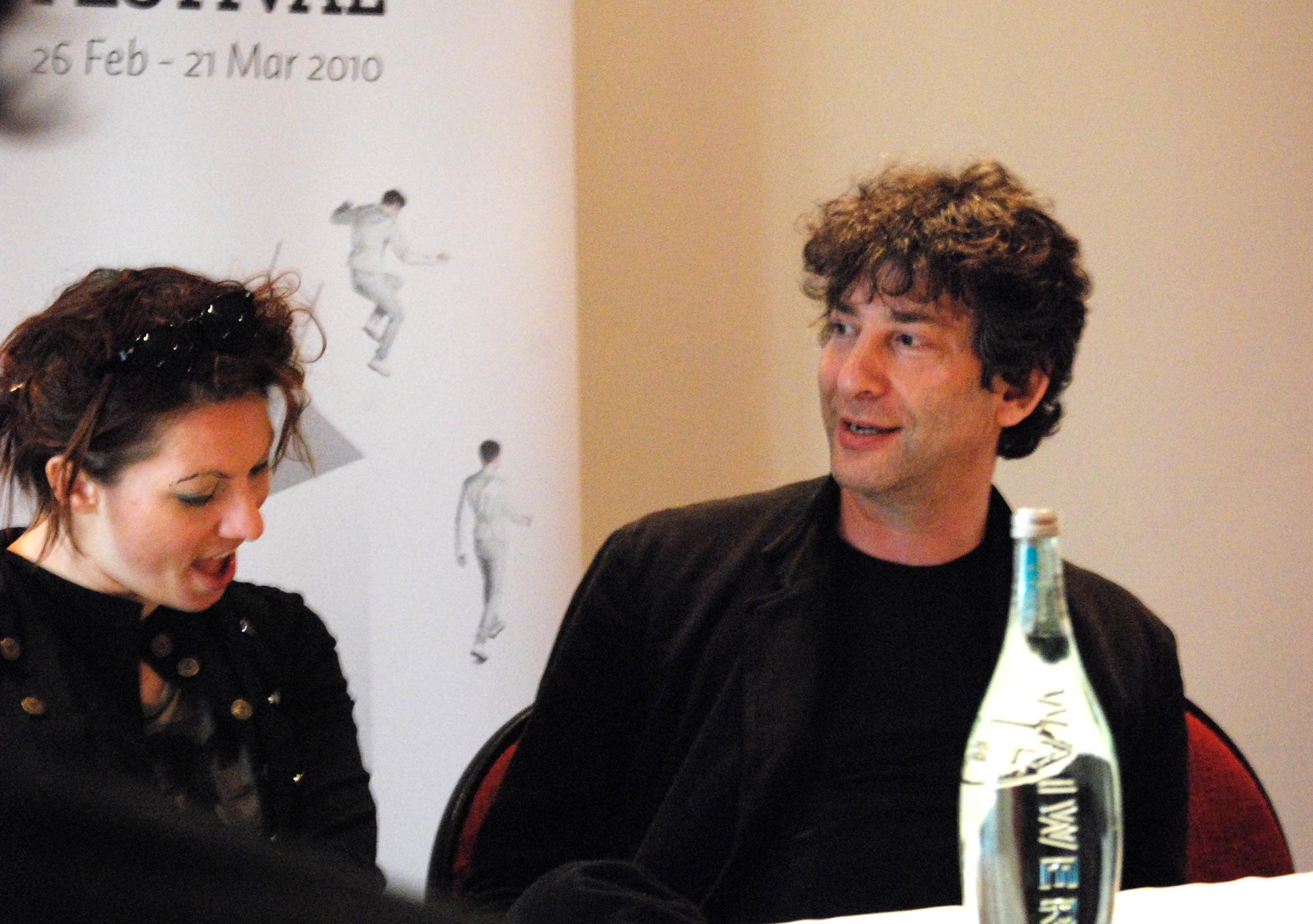
Click to enlarge
Gaiman at Friday's press conference
Town
Hall Talks: Neil Gaiman
In conversation with
Kate De Goldi
NZ Post Writers and Readers Week
13
March 2010
There will have been some some surprise from Neil Gaiman's fans that his main talk at Writers and Readers Week didn't quite fill the Wellington Town Hall – after all, Richard Dawkins had to be moved to the Michael Fowler Centre, and then sold that out.
They might, however, have expected what happened afterwards. Much of his audience moved directly to wait for book signings, more than filling the Town Hall's foyer. The perhaps slightly startled response from staff sent the overflow both into Civic Square and to an extended queue back through the corridors. It was enough to keep Gaiman signing books for three hours after his early-evening session ended. And it would seem to confirm his commonly-cited 'rockstar author' status.
Earlier, compere Kate De Goldi had opted for another musical analogy, inspired by his "playful literary genius" to introduce him to a highly apprecitive audience as "the Amadeus Mozart of postmodern fiction".
Gaiman opened by reading three poems. The first was Locks, which he described as the nearest thing he has to a Credo, opens "We owe it to each other to tell stories...". The second, awaiting publication, was a browningesque nightmare monologue in an English seaside resort titled My Last Landlady.
The last poem (Rehlig Odhrain), which Gaiman had never read publicly before, rhythmically told the tale of the often-buried Saint Odhran (or Oran); a legend which Gaiman says he discovered in "delighted horror". Buried alive to keep Saint Columba's chapel in Iona from repeatedly collapsing, Oran returns from the dead to delare there is no heaven or hell and "nor is God as you imagine"; in response Columba buries him again.
These, as De Goldi pointed out, displayed recurring themes in Gaiman's work: the use of fairytale and mythic structure, the dead remaining present, and gods which are not what we imagine. Gaiman later said that he had discovered that, for all its detail, his work was about stories and the importance of stories; justifying his description as a postmodern writer.
Under De Goldi's questioning, Gaiman described how he had inadvertently become a specialist in Edwardian literature, and G.K. Chesterton in particular, due to the limited selection of his school library. He also described being given an edition of Shakespeare when he was twelve and "nobody told me they that were good for me and that you weren't meant to read these things; so I read them" and has returned to A Midsummer Night's Dream in his work.
On writing stories to commission, he said that all art need boundaries to chafe against, and the specific requests are what makes him productive. In (re)creating the Sandman for DC Comics, making a world that "just metastatised" – Gaiman appreciated De Goldi's turn of phrase – he said that at the time he needed something that let him go anywhere: because he knew he'd have to produce a new story for it every month.
Describing an approach to writing that seems to reflect his own approach, he talked about C.S. Lewis and the Narnia stories, which inspired Gaiman's love of Greek myth, and also introduced him to English giants, werewolves and other such creatures. "If it is [a Christian allegory], it's a pretty bad one: what it actually is... is C.S. Lewis putting everything he loved into it."
Taking audience questions, he said that there had been plans for a set of Sandman books based around regional myths, with one based on Polynesian stories: he say he loved what he read and thinks of coming back to the project.
Gaiman has written in a range of genres and in just about every form of literature from comics to screenplay, novels and pop-band fanbooks (the only exception seems to be stage plays). He described giving advice to aspiring writers:
Okay: You have to write. And some people look at me as if I'm keeping the secret from them, I should be telling them, 'What you do, is you slaughter the goat, and at your door at midnight there will come three rappings on the door. Do not open it. Then there will come five rappings on the door. Now open it. Stephen King, J.K. Rowling and myself will be standing there in robes...'
Write, finish it, publish it, and don't wait for it to be published before writing and finishing the next one. "And somewhere in there you become a writer."
Gaiman concluded by reading a passage from American Gods. After which the audience applauded loudly, and broke for the signing table.
Out-Link: Neil Gaiman blogs on Wellington visit
Other reports:
Neil
Gaiman: The Amadeus Mozart of post-modern fiction «
Christchurch City Libraries Blog
Earlier: Audio
& Images: Neil Gaiman and Amanda Palmer
TV3
Video: UK
writer Neil Gaiman visits Wellington for
festival
Arts Festival website: Town Hall Talks: Neil Gaiman, Once Upon A Time
Scoop
Full Coverage: Arts Festival
2010
 Bruce Mahalski: Change In The Weather #195
 Keith Rankin: Haemorrhagic Plague?
 Eugene Doyle: Did The NZ Prime Minister Just Commit Treason?
 Binoy Kampmark: Ted Turner - The Devil Behind Cable News
 Keith Rankin: Clipping The Ticket; Solving Hormuz, In Context
 Ian Powell: Inhumanity Of US Economic Sanctions Against Cuba – Infant Mortality And Starvation; Time To End NZ’s Silence