
 Scoop has an Ethical Paywall


75 Years Of Christchurch International Airport (18 Dec 1950 - 18 Dec 2025) - New Zealand's First International Airport
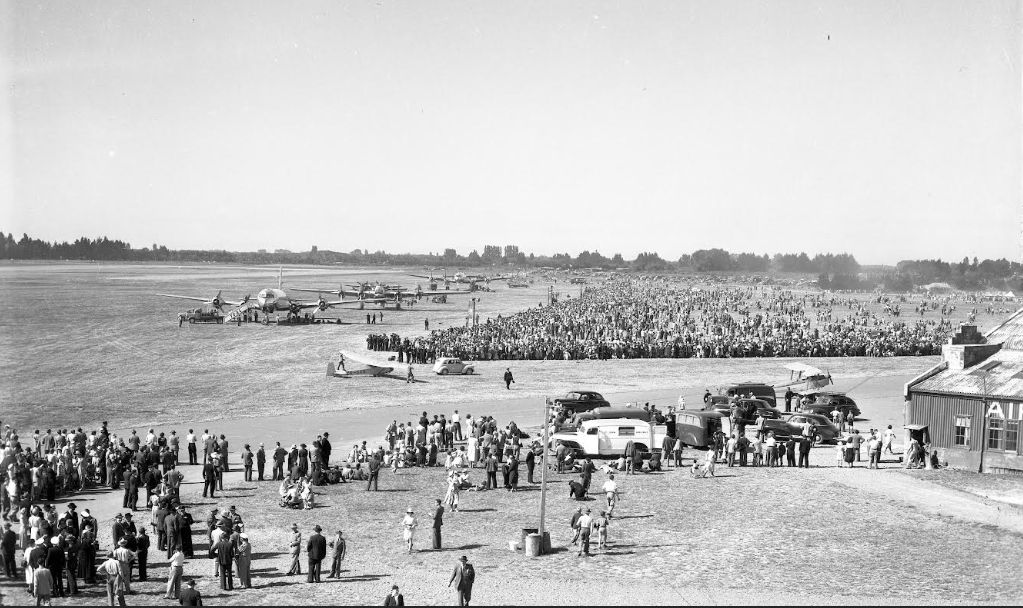
18th December 2025 is the 75th anniversary day since Christchurch International Airport was opened as New Zealand’s first international Airport
Aviation historian and President of the Aviation Historical Society of New Zealand Richard Waugh describes the airport’s early development and milestone opening which changed New Zealand international communication patterns forever
The opening declaration of Prime Minister Sidney Holland, on 18 December 1950 - 75 years ago - changed the local municipal aerodrome to become Christchurch International Airport, the first international airport in New Zealand, and a milestone day for New Zealand. The pronouncement of the airport’s new status signified important post-war progress for both international and domestic air travel.
Beginnings
With foresight, the Christchurch City Council had decided in the mid-1930s, as the pioneering airlines were getting underway around New Zealand, that a municipal aerodrome should be established for Canterbury. Wigram had a military focus and it was considered the combined military and civil operations there would increasingly become incompatible.
A detailed study of all the options was prepared by City Engineer Mr A. R. Galbraith, and resulted in land at Harewood being chosen because it had good approaches, a gravel base, room for expansion, and yet was close to the city.
Most of the Harewood site was owned by the Waimakariri River Trust. An initial block of 205 hectares was acquisitioned under the Public Works Act by joint agreement. Tenders were called in late 1936 and by 1937 much levelling and sowing had been completed. Boundary fencing, some drainage and small car and bus parking area were in place by the following year. By late 1939 a modest wooden terminal building was erected, along with a transmitter building and masts and a distinctive circular road just off the main entrance area. Additional land was purchased and plans were made to build a large hangar.
Wartime
The declaration of war on 3rd September 1939 meant a change of plan with the new (and unopened) aerodrome being taken over by the Government for defence purposes. It was soon decided to transfer the civil scheduled air services of Union Airways Ltd, the main trunk operator of the time, from Wigram to Harewood, as from 8 April 1940. Lockheed 10A Electra ZK-AFD Kuaka flew services that day, although an unofficial landing at Harewood by an Electra had been made on 14 April 1939 when Wigram was closed by fog. Remarkably at the time, the other alternate landing place for the twin-engined airliners, had been New Brighton beach!
On 18 May 1940, Bob Semple, the Minister of Works of the Labour Government, officially opened Harewood Airport, with Lockheed Electra ZK-AGJ Kahu being the prominent aircraft on the tarmac. With plans to use the new Harewood Aerodrome for Air Force flight training, over the next eighteen months the spartan aerodrome witnessed much busy activity. Four large hangars were constructed, along with a prominent water tower (still evident today), fire section garage and many smaller wooden buildings and accommodation barracks. By June 1940 the new RNZAF station at Harewood was completed and with the establishment of the No.3 Elementary Flying Training School and soon the Recruit Training School. The new station hosted several thousand young men and women during the war years.
With the end of World War Two, RNZAF Station Harewood was disbanded from 1 October 1945. At the same time an RNZAF passenger service was inaugurated between Whenuapai, Auckland, and Harewood using RNZAF Dakota (DC-3) aircraft, an aircraft that was to become synonymous with the airport for the next 25 years.
Post War developments
During the war Union Airways continued with their regular Lockheed Electra and Lockheed Lodestar services, and then the first night landing at Harewood with a Lodestar on 11 April 1946. From this time, Airwork (NZ) Ltd and the Canterbury Aero Club began their business activities at Harewood. Looking to the future, Christchurch City Council resolved to purchase more land for the aerodrome and especially with the prospect of eventual international flights. It was a farsighted, yet logical plan, as air services were expanding around the world.
In New Zealand, the Government nationalised all the pioneering private airlines to form the New Zealand National Airways Corporation (NAC), which officially took over all scheduled services from 1 April 1947. NAC established an engineering base at Harewood from 1948 and it progressively became the airline’s chief maintenance base, and fully so from late 1953. South Island Airways from February 1953 inaugurated pioneering regional airline services from Harewood to South Canterbury, North Otago and the following year to Nelson.
A key development at Harewood in 1949 was the work of completing two sealed runways, as the grass runway had limitations especially as aircraft were getting larger and heavier. Runway lights were also installed.
International Airport
With Government approval and consistent with developmental plans for Harewood, it was decided to develop the aerodrome to international airport status. It was recognised that Harewood was an ideal site with newly sealed runways, and the excellent legacy of many wartime buildings, including large hangars and other facilities being available.
The Prime Minister, Mr Sidney Holland, was guest of honour for the opening public ceremonies on Monday 18 December 1950. In one advertisement in The Press, the event was heralded as ‘The Greatest Air Event in the History of New Zealand’ - which may have been an exaggeration - but nonetheless the opening of New Zealand’s first international airport was an important transport and economic milestone. Mr Holland remarked, “This is a great day for Christchurch, for Canterbury, and for New Zealand in general”, he said.
It was recognised that international airways linked countries and nations, telescoping distances. International flights advanced travel tourism and trade and brought people together in new ways. Mr Holland also remarked, “Today we end the isolation of the South Island.”
The Mayor of Christchurch, Mr R.M. Macfarlane MP, paid tribute to the city council’s foresight in developing the Harewood site. He reported that to bring the aerodrome up to international standard had cost £400,000 with the council raising a loan for half that amount.
Overseas aircraft at the international airport opening were a QANTAS Lockheed Constellation L-749, a British Commonwealth Pacific Airlines DC-6 and a Royal Australian Air Force Avro Lincoln. The large aircraft were swarmed around by the large public attendance of many thousands of people. The DC-6 had flown over from Essendon, Melbourne, that same day in a flight time of four hours and 35 minutes.
First International Flights
Ironically, at the time of the declaration of the new Christchurch international airport status, there were no regular international scheduled flights! Planning was underway but it took several more months before the first international service was inaugurated on the 29 June 1951, with a direct Christchurch to Melbourne once-a-week service. The service used a QANTAS DC-4 Skymaster, under charter to TEAL, New Zealand’s overseas airline. Three years later TEAL introduced its own 56-passenger DC-6 pressurised aircraft and services were established from Christchurch to Sydney twice a week and to Melbourne once a week.
While these early international flights may seem modest, they were very important and aspirational. The declaration on 18 December 1950 of the new international airport status for Christchurch continues to reverberate to this day. In 2025 there are now 140 international arrivals and departures every week from Christchurch and well over 6 million passengers annually using the airport, an indispensable economic and social facility for the city and province.
 Gordon Campbell: On Children’s Book Classics - The Moomins
 Nelson City Council: Mayor Welcomes Auditor-General Decision Not To Prosecute Councillor
 Johnnie Freeland: Ko Tātou Tātou - Climate Action In Aotearoa Begins With Relationship
 Zero Waste Network Aotearoa: Container Return Scheme Bill Would Double Recycling Rates And Put Money Back In Households
 Wellington City Council: Statement From The Wellington Mayoral Forum On Options For Regional Governance Reform
 MUNZ: TAIC Report On Kaitaki Incident Gives Shocking Picture Of Decline Of NZ Maritime Infrastructure
 Greenpeace: New Climate Report Yet More Reason To Reduce Dairy Herd


