
 Scoop has an Ethical Paywall


Illegally Excavated Marble Bust To Be Returned To Italy Following Loan Agreement
Te Herenga Waka Victoria University of Wellington’s Classics Museum has found itself involved in an international hunt for antiquities illegally dug up in Italy and sold on the black market—including one in the University’s possession since 2003.
While the Italian Government is formally accepting the bust on Monday 9 March, it has agreed to let it stay in New Zealand for another four years to allow emerging scholars to learn more about Roman antiquities. Members of the public will also have a chance to visit this extraordinary piece—and learn more about its story—at the Classics Museum on the Kelburn Campus.
Believed to date from the Antonine period, AD 96192, the bust of the head of an unknown Roman woman, was bought from a London dealer, who is a regular supplier of antiquities to the University’s Classical Studies museum. The University did not suspect it was illegally supplied.
Associate Professor of Classics, Greek & Latin, Diana Burton, says revelations about the illicit find were only unearthed when Italian authorities matched a polaroid of the bust to an image stored on the University’s database—a recently introduced digital storage system for the Museum.
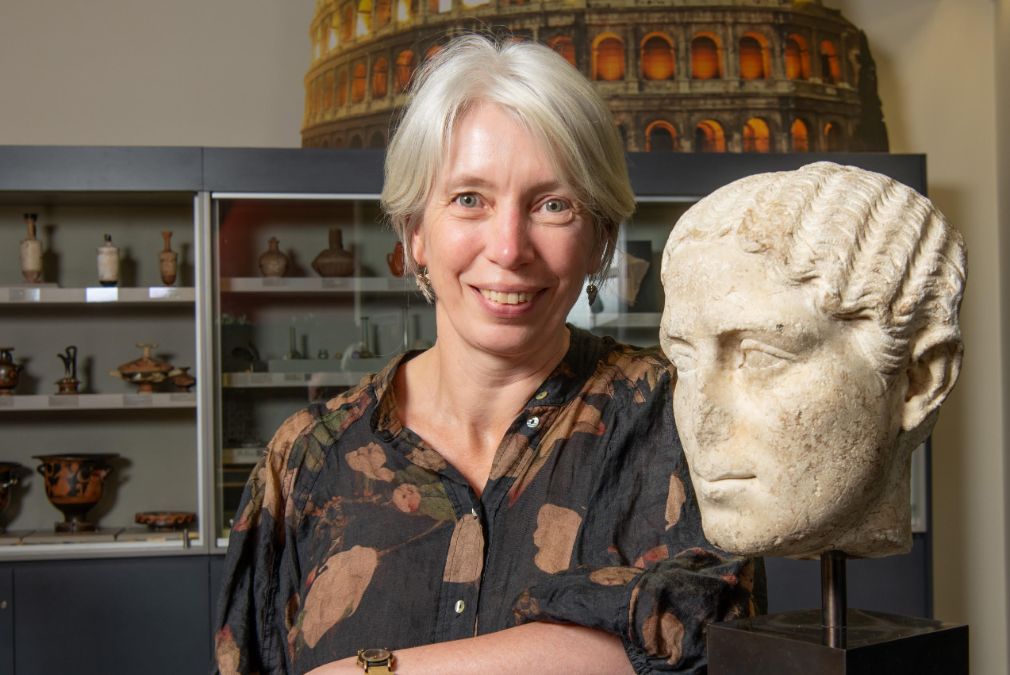
“I only put it together a few years ago when I first became curator, to make the Museum and its collections more accessible to researchers and anyone else who was interested,” Dr Burton says.
The Italian government has agreed to loan the bust back to the museum for another four years, when it will then be returned to Italy, and replaced by the loan of another Roman artefact.
Interest from the Italian authorities was piqued once the match was made from the seizure of a large hoard of images of artefacts—some still stained with dirt.
“A significant number of museums, particularly in the US, have had to return artefacts to Italy, in exchange for long-term loans of other objects,” Dr Burton says.
“Locally in Australasia, several university collections have also returned items or are in the process of returning them. In other words, this is a widespread phenomenon.”
The illegal excavators in Italy would have taken the photos as a way of proving a piece’s authenticity, she says.
“By doing so they can try and get a better price and show it’s not a replica or forgery.”
A process to formalise provision for governments to request the return of illegally traded artefacts was established by UNESCO (United Nations Educational, Scientific and Cultural Organisation) in 1970, through the Convention on the Means of Prohibiting and Preventing the Illicit Import, Export and Transfer of Ownership of Cultural Property. New Zealand did not sign till 2007 —after the University had acquired the bust.
“On the one hand, I’m obviously not happy that we ended up with a black-market object in our collection,” Dr Burton says.
“But we are delighted to be able to return it, and I’m also excited about it as a teaching tool—I have been teaching the black market in my ancient art courses for almost 30 years, and it’s fascinating to see it happening on our doorstep.”
Head of School at the School of Social and Cultural Studies, Professor Simon Mackenzie who specialises in criminology, says many museums and collectors around the world have been required to repatriate looted cultural objects.
“Sometimes these have been acquired in ethically or even legally problematic circumstances, sometimes it’s a middle ground where the person or entity should have inquired more into the history of the object but didn’t, and sometimes it’s simply that the illicit origin of the object was genuinely unknown to all parties.”
The restitution forms part of strong cultural relations enjoyed between Italy and New Zealand, which were further strengthened by the recent 2025-2030 Executive Programme of the Bilateral Cultural Agreement, which promotes academic, scientific and museum cooperation between the two countries.
The Italian Ministry of Culture expressed its gratitude to Te Herenga Waka and the Embassy of Italy for the collaboration that made this outcome possible, reaffirming the shared commitment to the protection and enhancement of cultural heritage.
Italian Ambassador Cristiano Maggipinto will visit the Classic Museum at the Kelburn campus at 6pm on Monday 9 March, as part of a formal handover ceremony. The Director-General for European and International Affairs of the Italian Ministry of Culture, Mariassunta Peci, will join the ceremony online.
 Whakarongorau Aotearoa: International Nurses Day - Healthline Nurses Help 800 New Zealanders A Day
 NZ Psychological Society: Remembering The Past Guides Our Future
  New Zealand Olympic Committee: Motherhood In Focus For Wāhine Toa Graduates Ahead Of Mother's Day
 Early Childhood New Zealand: Budget 2026 Must Protect The Future Of Quality Early Childhood Education
 Creative New Zealand: Aotearoa Manu Take World Art Stage As 61st Venice Biennale Opens
 Country Music Honours: 2026 Country Music Honours Finalists Announced