
 Scoop has an Ethical Paywall


Otago Nursing Students Collaborate On Welsh Skin Cancer Project
A group of Otago Polytechnic Nursing students has played a pivotal role in a new community-led approach to tackling rising skin cancer rates in a small village in North Wales.
A UK pilot ‘Sunguarding’ initiative launches this month in Trearddur Bay, led by the Melanoma Fund in partnership with the Isle of Anglesey County Council.
The sun safety project is built on international research conducted remotely by nine third-year nursing students from Otago during a community clinical placement, under the guidance of Professor Jean Ross who has long-standing ties to the region.
Last year, the Bachelor of Nursing students were invited to undertake a community engagement project in Trearddur Bay. They gathered and analysed data on the coastal community, identified key issues, and consulted with local stakeholders.
Their findings revealed a significant gap in public understanding about UV exposure despite decades of public messaging. The group highlighted the need for visible, community-led interventions that shift sun safety from passive awareness to everyday behaviour.
Dunedin based graduate Monique Hingston (22, Miss), who now works at Mercy Hospital, says the project transformed her understanding of sun safety and New Zealand’s approach to the skin cancer prevention.
“Messaging like the “no hat, no play” and “slip, slop, slap and wrap,” she says.
“And just the normalisation of seeking shade and applying sunscreen - even if it’s something I hated doing as a kid!”
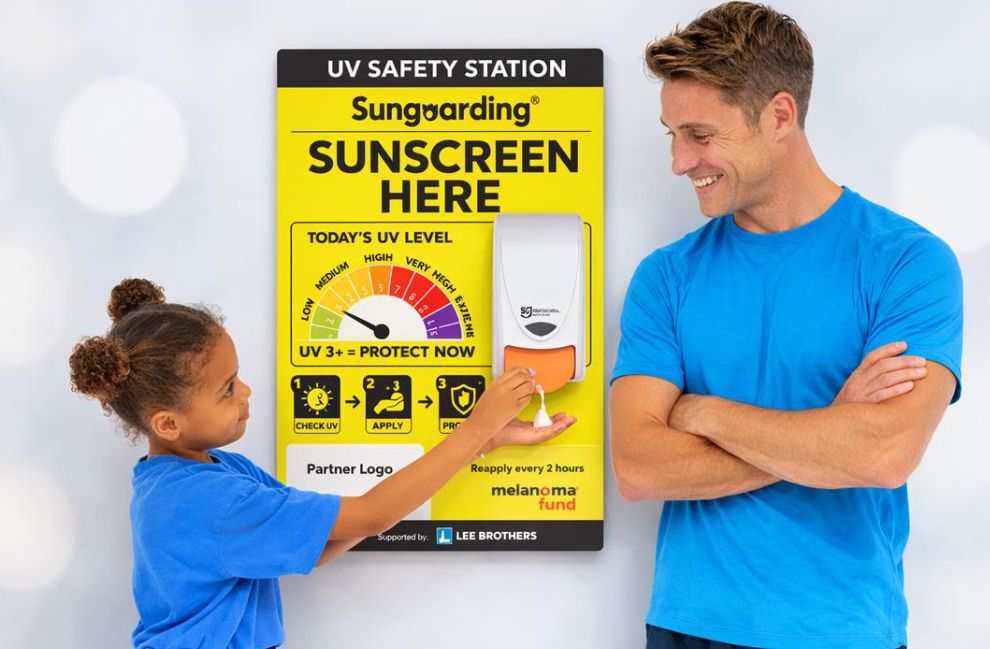
At the heart of the Welsh pilot is a colourful UV Safety Station which will overlook the beach in the seaside town, featuring a free SPF30 sunscreen dispenser and clear UV guidance, alongside other options like colour-changing UK reactive wristbands.
The Otago nursing students designed the Sunguarding campaign signage and posters in partnership with the council and Melanoma Fund.
Teifi Jones, Destination Development Officer for the Isle of Anglesey, notes that Trearddur Bay draws large numbers of families and beachgoers during the peak summer season.
“So our staff who patrol the beach will be out there speaking to members of the public, and just reminding them about keeping safe in the sunshine and the risks of UV,” he says.
Melanoma Fund CEO Michelle Baker says the initiative is designed to make UV risk more visible within the coastal community and encourage immediate behaviour change among beachgoers.
“Skin cancer remains the most common cancer in Wales, yet many people still fail to respond to UV risk in real time,” she says.
“We don’t have an awareness problem, we have a behaviour problem, which we aim to address with our Sunguarding programme.”
Graduate Maria Mckeen (21, Miss), who works alongside Monique at Mercy Hospital, says the project taught her being a part of meaningful change doesn't have to be limited to our own physical spheres or circumstances.
“For me, it really emphasised the impact nurses can have beyond a clinical setting,” she says.
“Contributing to prevention and health promotion on a broader scale and impacting the lives of others whom I will most likely never meet.”
Despite the challenges of distance and time zones, the students says the Trearddur Bay community embraced their work.
Monique, as the main point of contact for the Dunedin-based group, often fielded calls and messages at odd hours.
“That included my first interaction with Councillor Keith Roberts (Isle of Anglesey County Council) which saw me taking a surprise video call while I was in pyjamas,” she laughs.
Cr Roberts first spotted the students’ idea on Facebook and immediately recognised its potential.
“The proposal was received with open arms and I believe this project will benefit not only the people of Anglesey, but everyone who visits our beaches including seasonal tourists,” he says.
“If we educate the children, the parents will become educated as well. It’s a movement in the right direction.”
Professor Jean Ross from the School of Nursing says she is proud of the students’ extensive research and resources.
“What makes this project different is that the response is visible, practical, and led at community level. That’s where real change happens,” she says.
The Anglesey pilot will be evaluated over the northern summer to measure behaviour change among beachgoers, schoolchildren, and outdoor workers.
Designed as a scalable model with potential for national rollout across the UK, Professor Ross believes the Otago students’ solutions could also prove useful in New Zealand once the pilot demonstrates its value.
(* Full list of 2025 Bachelor of Nursing students who contributed to the project:
Ella Herbert, Monique Hingston, Ruby Jary, Sophie McElligott, Maria McKeen, Arana McLachlan, Lucy McLellan, Olivia McPherson, and Liyona Theres)
 Race Unity Speech Awards: Students’ Vision For A United Future - Embrace Our Differences
 Commonwealth Foundation: Commonwealth Short Story Prize 2026 Regional Winners Announced
 Doc Edge Festival: World Press Photo And Doc Edge Comes To Auckland In Landmark Exhibition Merger
 Whakarongorau Aotearoa: International Nurses Day - Healthline Nurses Help 800 New Zealanders A Day
 NZ Psychological Society: Remembering The Past Guides Our Future
  New Zealand Olympic Committee: Motherhood In Focus For Wāhine Toa Graduates Ahead Of Mother's Day