
 Scoop has an Ethical Paywall


Unprecedented Times
It’s often said, “It is impossible to say where we stand in relation to our own crisis. Perhaps the worst is yet to come; perhaps we’ve already sailed through.”
However that’s mistaken, and deeply misleading. It attests to the fact that avoidance and denial still rule in the mainstream media and academia.
People who are aware of the world as it is see the way things are, and the way things are going. They also see that without radical change within and without, humankind will continue in the same direction.
Why are intellectuals the last to grasp that during unprecedented times, history can provide little or no guide? Is it because they are so invested in accumulated knowledge over direct perception, in idea over insight, in “perspectives” over truth and actuality?
By definition, the fact that the human crisis is unparalleled means that there has been a deep rupture with the past, and previous history does not significantly pertain to the present.
That doesn’t mean we can’t learn by studying history, just that a higher level of insight is required during the unique “polycrisis” facing humanity in the present age.
What makes the present time unparalleled? First and foremost, man has never threatened the basic balance and biodiversity of the entire Earth before. The so-called march of civilization, with our deeply conditioned ideas of progress in the West, is running up against the reality of a degraded, decimated planet, threatening ecological collapse.
Second, globalization, in both the neoliberal economic sense of the term that the current US president is trying to reverse, and in the interconnected reality generated by technology and travel, has produced a lawless global society.
Historically, new insight has been the wellspring of expanding knowledge, which is a good and necessary thing. But no amount of knowledge will be sufficient to meet the polycrisis, because the ecologically harmonious and economically equitable application of knowledge requires a higher order of insight and intelligence in human beings. That’s also why Artificial Intelligence cannot save us, but without an awakening of insight and true intelligence, can only make things worse.
The state of insight, which occurs during methodless meditation, is a different thing altogether than the insights that expand knowledge in a given field.
Throughout history, there have been a few human beings who have lived in a state of insight. That’s because psychological insight and the state of insight are not accumulative. It doesn’t matter how much insight and understanding one had in the past; it only matters what insight and understanding one has in the present.
That’s a tough row to hoe, but by doing the spadework within ourselves every day, we begin again, and grow in reverse, without realizing it. Short of illumination however, one can and does fall back into patterns of the past.
But even if illumination lasts for only a few timeless minutes after complete negation during undivided observation in nature, insight beyond the context of knowledge is the lodestar of the human being.
The survival of the individual and humanity requires the emergence of human beings of insight. The psychological, spiritual and ecological crisis of humankind is unprecedented, demanding an unparalleled response.
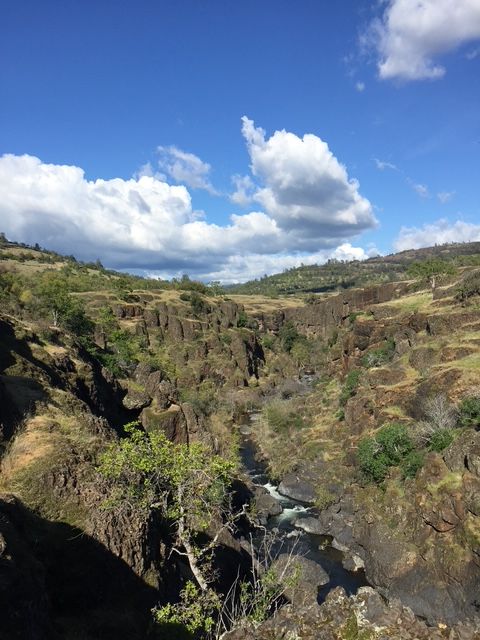
The hillsides are already browning; California could be in for another bad fire season. The orange poppies and blue lupines are gone, but buttercup, scotch broom, elegant brodiaea, yellow Mariposa lily, Ithurial’s spear and bluebottle are still in bloom.
A lone Canadian goose stood on the edge of the gorge less than 200 meters across from where I sat and honked for the better part of an hour. Perhaps I was sitting at its favorite perch, but its honking didn’t bother as it was nearly drowned out by the whitewater reverberating from below.
Vultures soared by at eye level so close that every feather and feature could be seen. They are strange birds, ever watchful and graceful, not at all like their image. In an hour and half, I saw only two people in the distance, plus three friendly college girls passing by on the rocky path to my left.
After nearly an hour, the accumulations of the past came to the surface. Non-judgmentally and non-reactively attending to them, the past dissolved, allowing one to be fully present with beauty in all-inclusive solitude.
Martin LeFevre
Martin LeFevre - Meditations
Scoop Contributor
Martin LeFevre is a contemplative and philosopher.
His sui generis “Meditations” explore spiritual, philosophical and political questions relating to the polycrisis facing humanity.
lefevremartin77@gmail
 Bruce Mahalski: Change In The Weather #195
 Keith Rankin: Haemorrhagic Plague?
 Eugene Doyle: Did The NZ Prime Minister Just Commit Treason?
 Binoy Kampmark: Ted Turner - The Devil Behind Cable News
 Keith Rankin: Clipping The Ticket; Solving Hormuz, In Context
 Ian Powell: Inhumanity Of US Economic Sanctions Against Cuba – Infant Mortality And Starvation; Time To End NZ’s Silence