
 Scoop has an Ethical Paywall


The Right Questions For A Planet On Fire
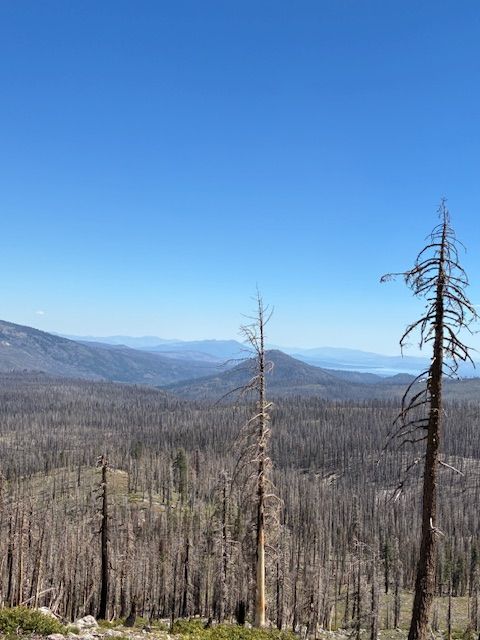
Four years ago the “Dixie Fire” burned nearly a million acres (half a million hectares) over a huge wilderness area extending into Lassen Volcanic National Park. It’s the second largest wildfire in California history, and it turned the national park from a pristine sanctuary into a multi-generational burn scar.
Lassen is one of the least visited national parks in the United States. Yet beyond seeing the aftermath of the fire, the future of the Earth, without a revolution in human consciousness, was painfully present driving through the park.
Gazing down upon the devastation from the highpoint of 2500 meters felt funereal. Forests for as far as you could see looked like matchsticks stuck in brown dirt. By the end of the day, the contrast between moments of shocking devastation and overwhelming beauty was almost too much to bear.
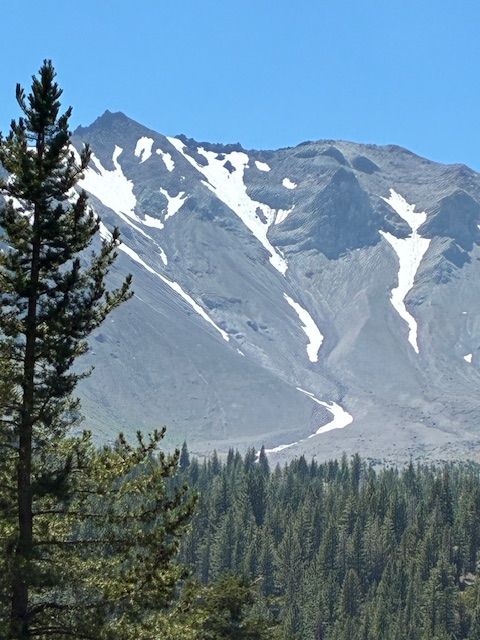
The moments of ineffable beauty included a magnificent, slender-winged hawk flying down a powerful mountain stream, and then returning and circling a half dozen times directly overhead. Or the sight of snow-streaked Lassen, with the few cumulus clouds casting fleeting shadows on its gray, bare face.
The bad signs outnumbered the good however. Such as a dozen souped-up road-racing cars, replete with numbers and insignias, roaring by repeatedly after stopping in large parking areas like Bumpass Hell before continuing their egregious road rally. Or dozens of Chinese tourists in rented vans stopping on the highway, or crossing it oblivious to everything but their chatter and photos.
Advertisement - scroll to continue readingThe misnomer of the Camp Fire two years before the Dixie Fire, which was also started by a faulty Pacific Gas and Electric power line, killed 85 people and incinerated the ironically named foothill town of Paradise in a single day. There’s now a distinction with little difference between a wildfire that destroys lives and property and one that burns up forests. Both result from and contribute to an accelerating planetary climate crisis that is devastating localities around the world.
Superficial diagnoses and prescriptions like Ezra Klein and Derek Thompson’s “Abundance,” which “forensically examines the ways the overlay of bureaucracy and compliance have hindered development in the United States,” sweep across porous and increasingly irrelevant borders in declining democracies.
To applaud America-focused wonks like Klein and Thompson, while lauding “in an Australian context” what “some of the wisest policy brains in the country have been saying in relation to the energy transition,” is to remain fixed in orbit around a Trumpian America, which is incrementally replicating a Putinesque putsch.
Clearly, “first there is a need to better define the core purpose.” But it’s myopic to then insist “crafting an agenda and an idea of the nation that is forward-looking is now the challenge.”
Though the phrase “existential crisis” has become a cliché when applied to America, Australia, New Zealand or any other national context, it’s apt when applied to humankind as a whole.
From that perspective, which must be the first perspective, it seems rather absurd to ask questions like, “What is scarce that should be abundant? What is difficult to build that should be easy? What inventions do we need that we do not yet have?”
Such questions have little to do with the core purpose of a nation, much less a global society and economy.
Even somewhat deeper questions like, “What sort of economy do we want? What comparative advantages do we have? How can we maximise our human capital and improve quality of life?” miss the mark by seeing the core purpose in terms of a single nation.
Besides, there is an insurmountable contradiction between “what kind of economy do we want?” and “how can we improve our quality of life,” and the profit and progress-driven mindset of “comparative advantages” and “human capital.”
Right questions seamlessly and non-separatively yield insight, understanding and right action. And insight doesn’t just lead to transformation. When allowed to be, and not applied to extending knowledge, insight is transformation. So what are the right questions?
What does it mean to be a human being when traditions have eroded into irrelevance and the billionaire bros openly pursue “AI singularity,” when computers plus robots cognitively and manually perform every job better than humans?
Does changing the basic, disastrous course of man require creating new authentically global (as contrasted with international) institutions, or will a non-organised psychological revolution percolate and transform national governments and international institutions?
And given that all people now irreversibly live in a global society, what will a true global civilisation look like?
One thing is certain – the polycrisis cannot be addressed, much less remedied within national contexts or international/multilateral conferences and agreements that are worth less than the paper they’re written on.
National frameworks have their place, but if “my country” continues to be psychologically, philosophically and politically primary, the fragmentation of the Earth, humanity and our diminishing nations will continue unabated.
Martin LeFevre
Martin LeFevre - Meditations
Scoop Contributor
Martin LeFevre is a contemplative and philosopher.
His sui generis “Meditations” explore spiritual, philosophical and political questions relating to the polycrisis facing humanity.
lefevremartin77@gmail
 Keith Rankin: Clipping The Ticket; Solving Hormuz, In Context
 Ian Powell: Inhumanity Of US Economic Sanctions Against Cuba – Infant Mortality And Starvation; Time To End NZ’s Silence
 Ramzy Baroud: Subjects Of Empire - Breaking The Cycle Of Arab Dependency On US Elections
 Peter Dunne: Dunne's Weekly - The Pragmatic Food For Fuel Deal With Singapore
 Eugene Doyle: After Israel’s Brutal Attack On Kiwis, Our Government Does Nothing
 Keith Rankin: Has Sweden Become A De Facto Apartheid Narco State?