
 Scoop has an Ethical Paywall


On How US Courts Are Helping Donald Trump Steal The Mid-Terms
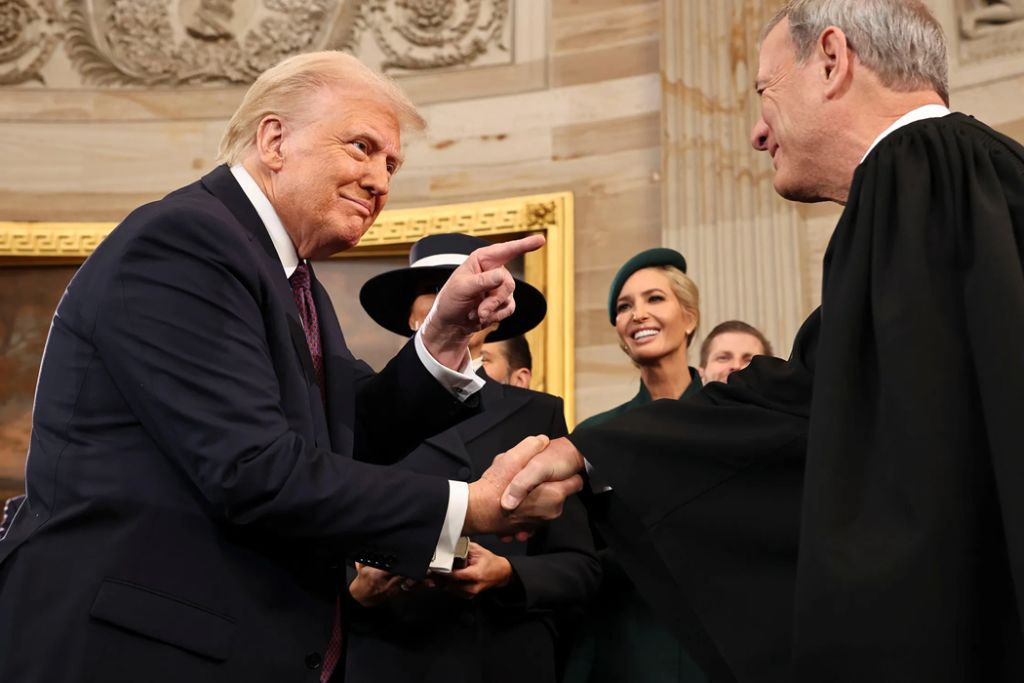
The world has been quietly hoping and praying that the Republicans will lose control of the lower House or Senate – or both – in November’s mid-term elections, since this would put restraints on Donald Trump’s abuses of power. Right now, Trump’s approval ratings are continuing to plunge, largely thanks to the war in Iran and rising petrol prices.
Unfortunately, the US Supreme Court has just handed the Republicans the tools to steal the midterm elections, regardless. In November, it will come down to whether voters dislike Trump enough to overcome the advantages that America’s highest court has just put at his disposal.
In a recent ruling called Louisiana v Callais the Court has completed its gutting of the US Voting Rights Act of 1965, which had been the main legislative achievement of the US civil rights movement. Thanks to the Callais ruling, Republican state legislators have now been set free to re-draw the boundaries of their congressional districts to benefit their own party, by (a) concentrating racial minorities into one district and/or (b) fragmenting them across several districts, however best serves the Republican cause. Historically, these minority groups have tended to vote for the Democratic Party.
As Stanford University professor Pamela Karlan told Slate magazine last week, the Supreme Court has moved the world away from a system where voters pick their representatives to one where the representatives pick the voters. Thanks to the Court ruling, the re-design of voting districts to better achieve racial fairness has been outlawed. At the same time, the re-designing of electoral boundaries to gain partisan political advantage has not only been allowed, but rewarded and enshrined.
The gerrymander wars
This corrupt process is called “gerrymandering.” In practice and in these midterm elections, it will enable the Republicans to draw the electorate boundaries in ways that dilute the voting power of blacks, Latinos, and Native Americans, all of whom are more inclined to vote centre-left. In the process, the court ruling will also inevitably reduce the ability of these groups to be represented by candidates from their own communities. Enhancing minority representation on Congress had been an explicit aim of Section 2 of the 1965 Voting Rights Act. The Spanish newspaper El Pais has cited some of Section 2’s signal successes :
...In 1970, there were around 1,500 African American elected officials nationwide; today there are more than 10,000. And that increased representation has allowed issues such as health, education, and infrastructure in historically marginalized communities to gain greater visibility on the political agenda.
Not any more. In its Callais ruling, the Supreme Court has significantly narrowed the scope of section 2 by re-interpreting its safeguards to apply only to proven cases of intentional discrimination, and not simply to cases where the effect of the electoral map design is unequal. Proving in court that the electoral map-makers had an explicit intention to exclude certain classes of voters creates an all but impossible burden of proof.
Not surprisingly, Donald Trump has expressed his delight on Truth Social: “Now, that’s the kind of ruling I like!” Furthermore:
In a message on Truth Social, U.S. President Donald Trump said he had spoken with Tennessee’s Republican governor, Bill Lee, who confirmed his intention to work hard to “correct the unconstitutional flaw” in that state. The message added that doing so “should give us one extra seat [in the House of Representatives], and help save our country from the Radical Left Democrats.”
The Bigger Picture
The Supreme Court decision ruling is part of a wider erosion of the right of Americans to vote. Especially in Southern states and in the Sun Belt, the potential voting power of poor, black and Latino voters had formerly been limited by tools like literacy tests and poll taxes. In the 21st century, it involves the closing of polling booths in minority communities, placing added restrictions on early voting and mail-in voting, imposing stringent photo ID identity checks, and erecting other bureaucratic barriers to deter and marginalise minority voters.
The Callais ruling is consistent with this direction of travel. Just over a decade ago in a related case called Shelby County v Holder, the majority opinion (written by Chief Justice John Roberts) scrapped the previous legal requirement that any significant re-drawing of electorate boundaries in states with a history of racial discrimination first had to be approved by the federal government.
Time have changed, Roberts blandly asserted, and prior safeguards against racial discrimination were no longer necessary. With the Callais ruling, Roberts has completed his long-held mission to dismantle the Voting Rights Act. As a young lawyer in Ronald Reagan’s White House, Roberts had lobbied (unsuccessfully) against Congress re-statement that the scope of the Voting Rights Act should not be determined by intentions, but by effects. Nearly 45 years later, Roberts has finally got his way, and has turned that legal test upside down.
Now, and Later
Probably, the full impact of the Callais decision will not be felt until the 2028 presidential elections. Even so, the ruling is having immediate effects. To enable Louisiana (a) to postpone its primary elections (originally planned for mid-May) and (b) to change its district boundaries in time for the midterms, the Supreme Court obligingly brought its Callais decision forward from the end of June, until now. With similar alacrity, the Court has also waived its usual precedent of a 30-day interim period between its rulings and their implementation.
With a stroke of the pen, the Supreme Court has legitimised the actions – for example - of the Republican legislature in Texas,. Over the past 12 months, Texas has re-drawn voting districts so that five Democratic congressional seats in Texas now no longer exist. Georgia and Tennessee have already announced their intentions to re-draw their midterm election boundaries, and Alabama and South Carolina are expected to follow suit. Florida’s legislature passed into law a new electoral map – one that allocates four more seats in Congress to the Republican Party - on the same day as the Supreme Court decision came down.
The ideology used to justify these tactical decisions is that the law should be “colour blind.” For example: according to conservatives, the law should consciously ignore the ongoing inequalities (e.g. in health, wealth and educational achievement) that have been created and exacerbated by the history of colonisation. In the US, this has meant preventing the law from trying to re-mediate the impacts of slavery and racial discrimination, and of the genocide committed against Native Americans.
The court’s six conservative justices appear to subscribe to this “color-blind” school of thought, which holds that the best way to promote equality is to prevent the inequities of race, gender, income and cultural background from being able to enter at the courtroom door. Led by John Roberts, the conservative majority on the Supreme Court bench have argued that it is time to move beyond the adjustments that may have been necessary in the distant past when injustice was rife – but which are allegedly no longer needed, in the modern era.
In New Zealand, much the same “colour blind” ideology is evident among our own centre-right political parties. The ACT Party and New Zealand First seem actively hostile to:
- affirmative action within the admissions criteria for educational institutions
- quota systems in public service employment
- health re-prioritisation aimed at redressing the blatantly unequal outcomes in Māori health and life expectancy
- our colonial history (and its ongoing effects) being taught in schools,
- the honouring of the commitments the Crown signed onto in the Treaty of Waitangi.
Ironically, the US Supreme Court has cited the success of affirmative action programmes as a reason to scrap them. When, in 2023, the Court struck down the affirmative admissions programmes at Harvard and at the University of South Carolina, Chief Justice Roberts cited the increased numbers of students from racial minorities achieved under affirmative action, as a reason to argue that these programmes were no longer necessary.
Footnote One: In theory, a tit for tat race to the bottom could now ensue, as Democratic states actively gerrymander their districts in response. In California, California governor Gavin Newsom has promoted a “fight fire with fire” response within the Golden State, in order to counter what Texas has done.
However, such moves are unlikely to deliver a net outcome of balance, let alone of favour to the Democrats. This same Slate article cited above explains why the Democrats are unlikely to prevail in any gerrymandering free-for-all. One reason being: in states governed by Democrats, the state laws are more likely to expressly forbid the kind of rampant electorate re-designs that the Republicans are now embarking upon.
Late last week for instance, the state Supreme Court in Virginia stopped the Democrats from re-drawing some district boundaries in the same fashion that Republicans are doing elsewhere. All up, the skewing of the electoral map for the midterms – and for the 2028 presidential election – seems bound to operate very much in favour of the Republican Party.
Footnote Two: Keep in mind that all of the gerrymandering moves cited above are in addition to:
- Trump’s announced plan to “nationalise” presidential and midterm elections, and thereby abolish the power of the states’ to run such elections, as granted to them under the US Constitution.
- the SAVE America Act, a piece of legislation recently approved by Congress. The acronym stands for the Safeguard American Voter Eligibility Act. If passed by the Senate, it will create new standards for participation in federal elections, focussed on voters having to prove citizenship, and present a birth certificate and/or stricter photo ID identification. Research by the Brennan Center shows that as many as 21 million Americans of voting age would not have access to such documents. Married women whose current surname does not correspond to the name on their birth certificate would also be placed at risk of having their vote dis-allowed.
Meaning - in the name of countering the bogus threat of mass illegal voting by immigrants, the SAVE America Act would dis-enfranchise tens of millions of US citizens – mainly poor, black and Hispanic. To Trump, that is the entire point. Earlier this year in Miami, Trump reportedly told a meeting that passing this law would not only “guarantee” a Republican victory in the mid-terms. It would also, Trump said, ensure that Democrats “probably won’t win an election for 50 years, and maybe longer.” Quite openly, Trump is planning to turn the US into a one-party state.
Footnote Three: In case you’ve ever wondered where the term“ gerrymander” came from, it originated with Elbridge Gerry the fifth US Vice-President. Gerry agreed to re-draw an electoral district to favour a political ally. Reportedly, the end result looked like a salamander, leading to the portmanteau term ‘gerrymander” to describe this type of political corruption.
Democracy is Coming
This guy had a point of view worth considering...even though his closing time arrived before the ship of democracy has managed to make port:
As Leonard also says: it looks like freedom but it feels like death, its something in between, I guess.
 Keith Rankin: Clipping The Ticket; Solving Hormuz, In Context
 Ian Powell: Inhumanity Of US Economic Sanctions Against Cuba – Infant Mortality And Starvation; Time To End NZ’s Silence
 Ramzy Baroud: Subjects Of Empire - Breaking The Cycle Of Arab Dependency On US Elections
 Peter Dunne: Dunne's Weekly - The Pragmatic Food For Fuel Deal With Singapore
 Eugene Doyle: After Israel’s Brutal Attack On Kiwis, Our Government Does Nothing
 Keith Rankin: Has Sweden Become A De Facto Apartheid Narco State?