
 Scoop has an Ethical Paywall


New Zealand In 'Big Trouble' Amid Growing Global Uncertainty, US-China Relations, Expert Says

Phil Pennington, Reporter
New Zealand is in "big trouble" amid growing uncertainty globally and in US-China relations, an expert on Indo-Pacific security says.
China's President Xi Jinping at the state visit of his counterpart Donald Trump said the two should be partners, not rivals, but also said missteps on Taiwan could push them into conflict.
Professor Thitinan Pongsudhirak told a Wellington seminar on Thursday the US had been an anchor but that had changed and New Zealand must find another way.
"New Zealand's in big trouble," Pongsudhirak said, saying America's pull to the right had put everyone off balance.
"You have to get back on your feet and find a new way."
Prime Minister Christopher Luxon in a pre-Budget speech on Wednesday said in the face of the current inflection point in world affairs he remained "relentlessly optimistic" New Zealand and its partners could remake an international order.
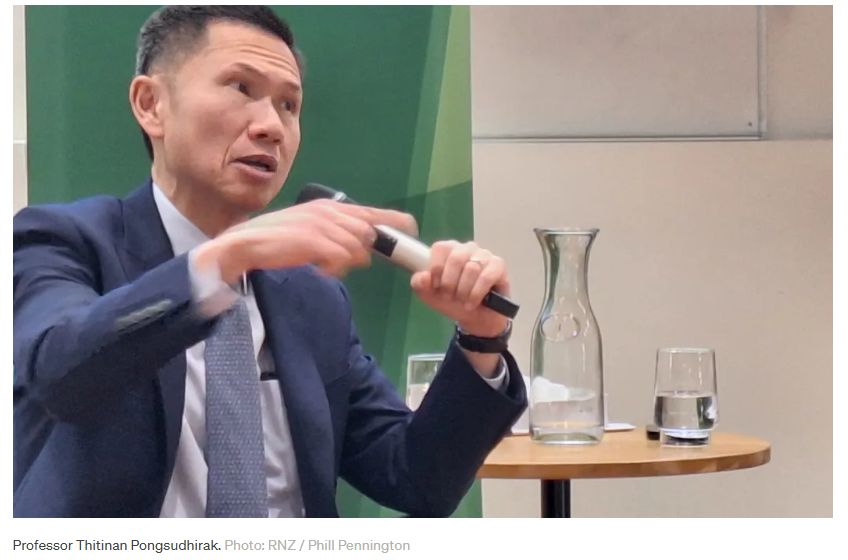
Pongsudhirak added at the seminar to nervous laughter that he didn't want to be alarmist. "We're all in trouble."
However, the likes of Thailand had the Association of Southeast Asian Nations (ASEAN) to fall back on, he said. ASEAN comprises Thailand, Indonesia, Malaysia, Philippines, Singapore, Brunei, Cambodia, Laos and Myanmar. Timor-Leste joined last year.
A "bold" step might be for New Zealand to ask to be admitted to ASEAN, or at least learn from it how to relate to China, as ASEAN members pivoted more towards Beijing in response to Trump remaking US politics, said the professor of International Relations visiting to mark the 70th year of diplomatic relations between NZ and Thailand.
He had become an ASEAN "booster ... because without ASEAN we would be in bigger trouble".
"New Zealand will need the ASEAN network more than before."
But at the same time, greater tension in China-US relations had increased division in ASEAN as they had not presented a unified stance, for instance, on the war in Iran.
Pongsudhirak said the international order had been well and truly broken, and a lot of the damage would not be repairable after Trump was gone since he represented the culmination of a nativist movement that had a long history and carried on.
A smart move was for countries to seek non-alignment through multi-alignment; someone in the audience suggested the Commonwealth as an option and he agreed, but added its members would need to do more.
Pongsudhirak expressed hope and scepticism that middle powers could unite to counter great power rivalry and the rupture in the international order, as Canada's Prime Minister Mark Carney urged earlier in the year in a speech that grabbed world attention.
Luxon said in his speech on national security that international relations were moving from an economic to a security focus with a priority on national resilience.
"China is assertively expanding its influence across the Indo-Pacific and beyond," Luxon said.
It was a "world where hard national interests are being pursued by hard national power".
The new multipolar system was on a foundation of international rules New Zealand must keep working to protect and "remake".
"In a more volatile world, some of our traditional friends and partners seem to be doing the same - forging new partnerships shaped by many of the values we hold dear, and their own support for the rules-based international order."
RNZ
New Zealand's public broadcaster, providing comprehensive NZ news and current affairs, specialist audio features and documentaries.
Radio New Zealand is a Crown entity established under the Radio New Zealand Act 1995. Radio New Zealand News are vital elements in our programming, providing impartial news and information to New Zealanders every day. Radio New Zealand (RNZ) provides listeners with exciting and independent radio programmes in accordance with the Radio New Zealand Charter.
 Gordon Campbell: On Pauline Hanson’s Rise, And The TOP Renaissance
 Inland Revenue: Watch Out For Scammers This Tax Season
 WIOG NZ: Australia Beats New Zealand To Win The Trans-Tasman Best Tasting Tap Water Title
 Hapai Te Hauora: New Online Gambling Laws Could Grow Harm While Claiming To Reduce It
 New Zealand Alliance Party: Alliance Party Firmly Opposes “Backdoor Privatisation” Of Kiwibank
 Taxpayers' Union: New Poll - Coalition Still Ahead; Luxon Regains 'Preferred Prime Minister' Top-Spot
 NZ National Party: Judith Collins’ Valedictory Speech

