
 Scoop has an Ethical Paywall


Is Work On Gender Equality And Human Right To Health Including Youth In All Their Diversities?
18 August, 2025
SHE & Rights Media Brief:
“In the last decade there has been a considerable change in how young people are being addressed in sexual and reproductive health and rights, but it is still miles away from where they get mainstreamed. Young people and youth still face a lot of discrimination when it comes to accessing dignified and non-judgmental care especially around contraception and safe abortion,” said Debanjana Choudhuri, Executive Director, Women’s Global Network for Reproductive Rights (WGNRR).
“Safe abortion services are so critical to sexual and reproductive health and rights (SRHR) justice for all. But what we have noticed is that when a young person goes in order to get the service, they are stigmatized. There is a high amount of taboo and stigma that is rallied around in order to create a very unsafe and a very vulnerable situation for young people,” added Debanjana.
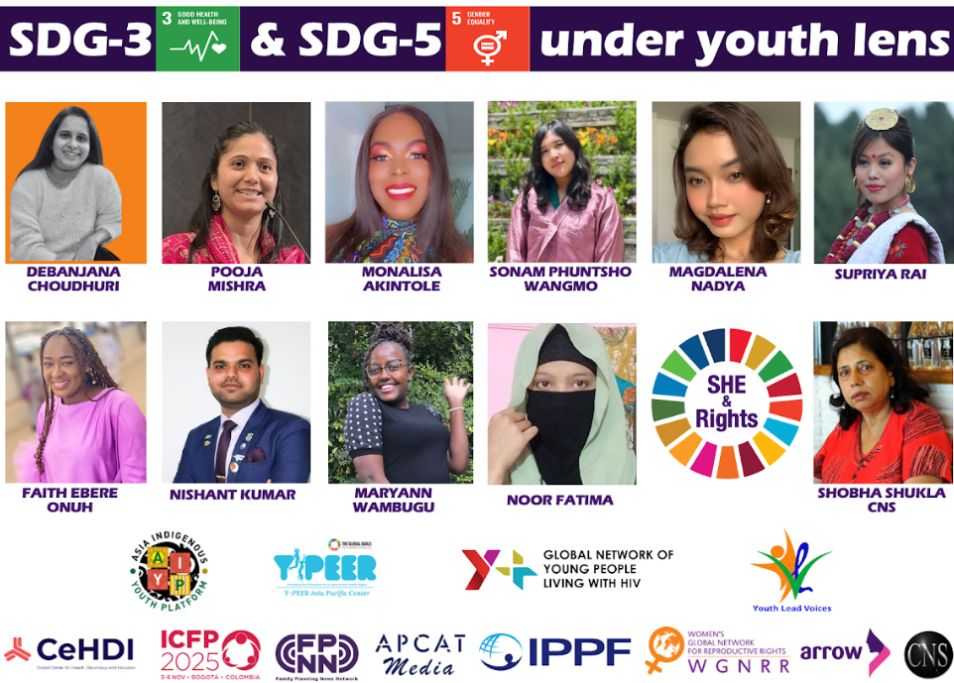
She was speaking at SHE & Rights (Sexual Health with Equity & Rights) session, co-hosted by Global Center for Health Diplomacy and Inclusion (CeHDI), Y+ Global (Global network of young people living with HIV), Y-PEER Asia Pacific, Asia Indigenous Youth Platform (AIYP), Youth Lead Voices, International Conference on Family Planning (ICFP) 2025, Family Planning News Network (FPNN), International Planned Parenthood Federation (IPPF), Asian-Pacific Resource and Research Centre for Women (ARROW), Women’s Global Network for Reproductive Rights (WGNRR), Asia Pacific Media Alliance for Health and Development (APCAT Media) and CNS.
“We have a cohort called Generation Change Makers – which is a group of young people across Philippines that has come together to question the laws that criminalize abortion, criminalize comprehensive sexual education and ask for changes and ask how so vocally and loudly that lawmakers need to listen to. In different pockets we have local SRHR dialogues where we try to address and bust the myths around SRHR, and deconstruct what SRHR means,” added Debanjana.
Comprehensive sexuality education: is it fully implemented?
“In most of the countries in the Global South, it is a reality that comprehensive sexuality education is not available in schools and there are certain regions where we cannot even call it comprehensive sexuality education because at times it is reduced to one biology class in school. We need to talk about comprehensive sexuality education right from school, in order to ensure that the individuals who are growing up to be adults, know what exactly is consent, what are their bodily rights, their bodily autonomy, their choice and they can take informed decisions on their sexual and reproductive health journey,” said WGNRR’s leader Debanjana Choudhuri.
Agrees Indonesia’s Magdalena Nadya, Youth Networker of International Planned Parenthood Federation (IPPF) for East and South-East Asia and Oceania region: “We have to strengthen comprehensive sexuality education and access to SRHR services. Policies alone are not enough. Young people, especially in rural or conservative areas, still face stigma and barriers. Young people are not only recipients of comprehensive sexuality education, but they are also co-designing and co-facilitating it whether it's in classroom or in social media platforms, utilising digital learning and campaigns which are making SRHR education more relatable and accessible.”
“In Indonesia, improvements on SDG-3 and SDG-5 are feasible, but only for some. For many, especially girls in rural or conservative areas, young people with disabilities or indigenous youth, access is still limited. Stigma, legal barriers like age restrictions, and a lack of youth-friendly providers continue to stand in the way,” said Magdalena.
“On SDG-5 (gender equality), progress is largely stagnated and there are huge gaps in data and indicators. Many girls continue to face early and unintended pregnancies, early marriages, and rising rates of gender-based violence and female genital mutilation or cutting, including technology perpetuated violence. In Indonesia, early marriage remains a major driver of adolescent pregnancy. We need to enforce legal age of marriage in Indonesia, but it must be matched with stricter implementation and the removal of marriage dispensations that still allow child marriage. We need to allow adolescents in Thailand to access SRHR services without needing parental or spousal consent. These changes protect young people's rights and promote safer, more equitable access to care,” said IPPF’s Magdalena.
Youth-led programmes have delivered results then why not fund them?
“United Nations Maternal Mortality Estimation Inter-Agency Group report titled “Trends in maternal mortality 2000-2023,” shows that biggest number of maternal deaths worldwide happened in Nigeria (28.7%). When it comes to healthcare funding, Nigeria is just investing 5% of the national budget allocation to health, which is very poor. Governments must increase domestic health financing (to over 10% as per Abuja Declaration). When we have invested in youth-led programmes, we saw results. Youth are not just the future but present too,” said Faith Ebere Onuh, Y+ Global (Nigeria), Gender Equality Fund Ambassador (GEF).
“Gender Equality Fund is implemented in Nigeria with support of Y+ Global (Global Network of Young People Living With HIV), and others, advocates for adolescent girls and young women and give them a safe space to talk about key issues affecting them when it comes to HIV, TB and malaria. Gender Equality Fund has invested in about 15 women-led organizations across six states of Nigeria. With this Fund, we have been able to do a whole lot more in six states in Nigeria on gender equality – despite funding cuts of US,” said Faith Onuh.
Nigeria and other countries in sub-Saharan Africa need to do much more to ensure that every child born to HIV positive parents is born free of the virus. We also need to ensure that every child or young person living with HIV knows their status, receiving lifesaving antiretroviral therapy and remains virally suppressed – and all young people have access to full range of HIV prevention options. “Young people need to start taking ownership of their health,” said Faith.
Stop The Gap between policies, programmes, implementation and what gets funded
“With a surge in skilled birth attenders from 41% in 2003 to 89% in 2022, there were enhancement in access to childbirth services. Also, there was a ripple effect in terms of reduced mother to child HIV transmission in Kenya,” said Maryann Wambugu, Chair, The PACT, Board member of Y+ Kenya and Network of TB Champions in Kenya.
“Another progress that we have been able to realize in Kenya is modern contraceptive use. In 2003 young people – or even young women - were not given the opportunity to choose whether they want to get children or get to space the births, but right now with the kind of investment that has been put in SRHR, we see positive changes. Young people better understand what contraceptive use is and myths and misconceptions are less prevalent than before. Another progress is decline in female genital mutilation or cutting - in 2003 it was at 38% but in 2024 it dropped to 15% - but this is still very high rate,” said Maryann.
Women’s political participation has upped in Kenya
“There has been an increase in representation of young women in politics. In one county of Kenya, we have a female governor, female senator and female members of parliament too. Kenya also got its first female Chief Justice of Supreme Court with Justice Martha Koome getting appointed on 21 May 2021. She is also the first woman to hold the position of President of the Supreme Court of Kenya,” said Maryann of Y+ Kenya. “In 2013-2014 financial year, health budget allocation was 5.5%. But in 2020-2021 financial year, we saw an increase to 11%. According to the Abuja Declaration the investment in health should be at least 15%.”
“We the young people are not just the face of HIV epidemic but also the force that can end it. When you invest in our health, you empower our choices and trust our leadership. We will not just save lives, we will secure our future, both our future and our present,” said Y+ Global’s Maryann.
Transgender peoples: Are they being left behind?
“Uganda has tried to progress towards delivering on SDG-3 and SDG-5, but needless to say, there has also been ‘not good progress’ made when it comes to various communities like my own (transgender peoples). I work with Uganda National Transgender Forum and do not see much progress happening for our community. There are certain youths left out of conversations. How will we address issues of youth in all their diversities if we only concentrate on the youth within the binary sector?” asks Monalisa Akintole, Forum Coordinator, Uganda National Trans Forum (UNTF) and part of Y+ Global (Uganda).
“Health and gender equality are not optional. They are prerequisites for peace, for prosperity, for sustainability. We do not get to do choose and pick on who gets to live, who gets to be dignified, who gets killed or who gets to have access to basic healthcare. We must ensure that youth in all their diversities are included. We can no longer be a ‘token’ within a system. If you are not going to stand with me, please do not invite me in spaces where you are just going to use me as a youth. Our policies that we bring on board should be respected. We are tired of systems and governments that kill youth who do not bend to the gender binary. We need to be respected as a whole. We all matter,” rightly emphasises Monalisa.
Commendable progress on gender equality and health in Nepal but challenges remain
“We see some commendable progress when it comes to youth health and wellbeing including those with disabilities, especially in reducing maternal and child mortality, expanding institutional deliveries, and improving HIV responses. In 2024, institutional delivery has reached 79.4%, maternal mortality dropped to 151 per 100,000 live-births and there is a notable increase in access to antenatal care and immunization services. Most important progress which we have done in Nepal is on integrating comprehensive sexuality education into Nepal's national curriculum offering young people a great win,” said Nishant Kumar, Coordinator of Y-PEER Nepal and Member, Working Group on Disabilities and 2030 Agenda.
“Due to rising awareness of SRHR we have also seen improvements in HIV responses like new infections are declining and more young people living with HIV are on treatment. Nepal is the only country in Asia Pacific region which has reduced number of new HIV infections by over 75% during 2010-2024. Mental health issues among youth are rising with the suicidal rates increasing to 18.1 per 100,000 people. Nepal healthcare remains underfunded with 4.62% of the national budget allocated to health - well below WHO’s recommended 10%. Out of pocket health expenditure has increased to 54.2% creating financial stress on already marginalized and vulnerable youth,” said Nishant of Y-PEER Nepal.
Persons with disabilities left behind
“Young people with hearing disabilities or deafness are having disproportionately more barriers in accessing health services – and challenges get compounded with lack of sign language interpreters as well as physical infrastructure poses additional blockages and challenges for all persons with disabilities. SRHR education for young people with hearing disabilities is extremely limited but our organization uses peer-to-peer education. That way we are trying to make them empowered, learn about their bodily autonomy, their rights, among others. Disparities in services between urban and rural areas also affect young people in Nepal. Rural youth still struggle to access basic health services like safe abortion, HIV prevention and mental health support, which are limited and stigmatized,” said Nishant Kumar of Y+ Nepal.
32.8% of girls are still married before 18 and adolescent pregnancy rate is 71.2 per thousand pregnancies. Both offline and online gender-based violence are concerning for Nepal. Programmes targeting child marriage and gender-based violence are gaining ground and there's a gradual reduction in adolescent pregnancy rates. Young people especially girls and women with disabilities or other gender diverse peoples or indigenous peoples are more challenged by child marriages and gender-based violence,” added Nishant Kumar.
In Nepal, the constitution mandates that 33.3% of parliamentary seats are reserved for women. Women receive significant tax reductions and exemptions for land registration taxes in Nepal.
“We have established mental health sharing circle, where young people express emotions through art, science and stories and we have also created accessible SRHR resources including manuals in sign languages. We are trying to make health facilities accessible to all. This means that sign language interpreters - braille and visual sign languages - and staff being trained in disability sensitive care. Disability must be mainstreamed into all gender equality policies not as a side note but as a core principle. We need services like hotlines, shelters, legal aid which must be provided with sign language interpretation and visual support too,” said Nishant.
Rohingya must not be left behind
“As a Rohingya women I want the world to see us not only as victim of conflicts but as the leaders of change. We carry these stories and the solution and the strategies, but we need you to trust us, resource us and work with us as equals. For too long, youth engagement has been treated like a checkbox. We are invited to panels to share our stories but not to shape the policies. We are praised for alliance but denied the resources to impact change,” said Noor Fatima, Specialist in Education Policy and Equity, Rohingya Maìyafuìnor Collaborative Network.
“In the Rohingya refugee communities, especially with whom I work, the progress on SDG-3 (health and wellbeing) and SDG-5 (gender equality) has been deeply uneven and fragile - there have been small but significant steps forward. Progress is slow and far from equal. It often does not reach the most vulnerable especially young Rohingya women and girls. For many of us, health and wellbeing are not just delayed rights but they are denied rights. Most refugee girls grow up without any structured knowledge of their bodies, reproductive health or mental wellbeing. Menstruation is still treated as something shameful. Mental health is ignored and our conversation about gender-based violence are almost non-existent. It is not because we do not care. It is just because the system around us never cared about us,” said Noor Fatima.
“Even when healthcare services existed nearby, the fear of being turned away, the lack of documents, or the language barriers deter many from seeking help. Pregnant women often go through their entire pregnancy without ever seeing a doctor. When you live in an environment where daily survival is the focus, wellbeing becomes a distant dream. When we talk about SDG-5 (gender equality), we must remember it is not only about having equal opportunities but also protection, education and leadership for women and girls. Yet Rohingya refugee women are still not treated as people worthy of full protection or participation,” added Noor Fatima of Rohingya Maìyafuìnor Collaborative Network.
Sparks of change
“Despite all these challenges, there are sparks of change which are often led by young people themselves. Through the Rohingya Women's Collaborative Network, we have created safe spaces where girls can openly discuss without fear or shame. We started trauma healing circles and peer-to-peer support network, so no young woman must carry her pain alone. We launched digital literacy programs in 2020 helping girls connect to online education, health resources and advocacy opportunities. We are also working on training young Rohingya women as community health advocates who share knowledge on hygiene, nutrition, mental health, administration, education and health in their own neighbourhoods. These are not just programs - these are act of survival, resilience and hope and they are women-led and Rohingya-women led – run mostly by those who survived all these struggles and sustained,” said Noor.
“Youth are not waiting for someone to give us a voice. We already have voices. What we need is that the world should listen to us. And when I say youth, I do not just mean those with passports and citizenships. I also mean refugee youth, stateless youth and displaced youths like us – the ones who have lived experience of broken system and who understand the urgency of fixing them because our life depends on it,” said Noor.
Youth Lead Voices makes a big difference
“I belong to a small Indian village. I got connected with National Coalition of People living with HIV in India (NCPI Plus) when I was just 20 years old. I joined as an outreach worker, and held multiple positions like a counsellor, programme coordinator, state officer and eventually rose over 10 years period to shoulder the responsibility as General Secretary of NCPI Plus. This journey is of self-empowerment and strengthening my innermost resolve and resilience – a transformation made possible through the consistent peer-led support and encouragement of my family – was phenomenal. This could be made possible because of strong network of people living with HIV, youth network mentorship, and peer-led system. It is not a one-time-process to make this transition happen to empower young women or the youth community for that matter,” said Pooja Mishra, National Youth Coordinator, Youth Lead Voices and General Secretary NCPI Plus.
There are over 1860 young people living with HIV and connected with Youth Lead Voices that have been virally suppressed since last one year – they stay healthy, and virus too will not spread to others because viral load is undetectable – and undetectable equals untransmittable as per the WHO. “Youth Lead Voices have played a proactive role in creating youth-friendly safe spaces where young people living with HIV can access psychological support, build leadership skills and overcome the stigma. These platforms enable honest conversations around HIV and help address mental health, gender-based violence and combat self-stigma. We must institutionalise peer-led mental health clinic including structured peer-led counselling and mental health support services within community-led centres to address the psychological impact and living with HIV among the youth,” said Pooja Mishra of Youth Lead Voices.
“Y-Peer Bhutan has been conducting many initiatives across Bhutan based on mental illness, SRHR among others. One such initiative of Y-Peer Bhutan is the Bhutan Youth National Forum on SDGs where a lot of people and young minds from different backgrounds and different regions came together to discuss various issues. In rural areas of Bhutan although healthcare is free (across Bhutan) yet there is stigmatisation in many instances. To fill such gaps, Bhutan Youth Development Fund is working,” said Sonam Phuntsho Wangmo, Part of Y-PEER Asia Pacific network from Bhutan.
Have we forgotten Indigenous peoples in SDG-3 and SDG-5?
“Increased representations of indigenous youth and women in youth council, federation and local government structures, partly due to constitutional quotas and capacity building programs with indigenous young women, are increasingly participating in decision-making processes in Nepal. There is a growing emphasis on combating gender-based violence, educations and economic empowerment programs have also helped bridge the gender gap. Indigenous youth organizations are actively educating communities on gender-based violence, early marriage and consent and combining legal literacy with cultural sustainability. At the regional level, youth leaders, feminist movements, and indigenous youth leaders across Asia are challenging gender norms, advocating for land rights, bodily autonomy and inter-generational equality, and policy shifts toward intersectionality. Regional institutions are slowly integrating intersectional approaches recognizing that indigenous youth face unique gender challenges,” said Supriya Rai, Executive Council Member of the Asia Indigenous Youth Platform (AIYP), Vice President, Youth Federation of Indigenous Nationalities of Nepal.
“Stronger gender inclusive youth networks, indigenous girls and LGBTQIA+ youth are becoming more visible in regional dialogues especially under the platforms like Asia Indigenous Youth Platform (AIYP) and other youth forums. AIYP is advocating for policies that promote gender equality ensuring that indigenous youth women have equal access to opportunities. Also, menstrual health improvements is a priority area. Youth lead campaigns have broken taboos around menstrual hygiene, promoting dignity kits and safe school environments for girls and others in indigenous regions or areas. Traditional healing is being recognized as complimentary health knowledge. Mental health is gaining visibility in indigenous youth dialogues, initiating conversation on trauma identity crisis and emotional wellbeing and mental health awareness. Community-based health outreach has expanded in indigenous communities,” said Supriya Rai of AIYP.
“Mobile and community-based health clinics in remote indigenous areas bring essential health services directly to the indigenous villages using youth lead mobile health and tele-medicine. Integration of traditional medicine with modern health system respect and recognize indigenous healing knowledge by creating legal frameworks to work alongside biomedical care. Youth-led mental health and well-being cycles establish peer support groups where indigenous youth can talk about mental health, trauma, cultural identity or healings. We have to increase investment in mental health of indigenous young people due to the rising rates of depression, suicide, anxiety and other mental health issues. It is necessary to provide additional resources and training,” added Supriya Rai of AIYP.
“Young people today are growing up in a world beset with social, economic, health, gender and climate crises, technological revolutions (and technology-facilitated gender-based violence) and manmade social upheavals. Not just gender equality but human right to health also needs a youth-led and youth centric approach in all their diversities and context so that we do not leave anyone behind,” emphasised Shobha Shukla, Lead Discussant for SDG-3 at the United Nations intergovernmental High Level Political Forum 2025 (HLPF 2025); CNS Executive Director and SHE & Rights Coordinator.
 Aotearoa Delegation of the Global Sumud Flotilla: The Global Sumud Flotilla Remains Undeterred As Over 30 Boats Depart For Türkiye
 UN Special Procedures - Human Rights: Israel Must Immediately Release Gaza-Bound Flotilla Activists, Say UN Experts
 IPMSDL: Condemn The Killing Of Children, Bombing In Manipur, And Violent Repression Of People’s Protests
 Médecins Sans Frontières: Three Years On, Outbreaks Everywhere - MSF Urges Boost To Sudan’s Vaccination Programs
 UN News: Uncertainty Continues Over Safety In The Strait Of Hormuz
 Australian Museum: Celebrate Sir David Attenborough's 100th Birthday With The Australian Museum