
 Scoop has an Ethical Paywall


Hidden Population Of Endangered Koalas And Greater Gliders Discovered Just South Of Sydney
Landmark multi-industry collaboration delivers first published large-scale abundance mapping of both koalas and greater gliders using modern thermal drone technology.
A pioneering study, published this month in Australian Mammalogy, has used modern thermal drone technology to uncover thriving yet previously under-reported populations of endangered koalas (Phascolarctos cinereus) and southern greater gliders (Petauroides volans) across the Illawarra escarpment and plateau.
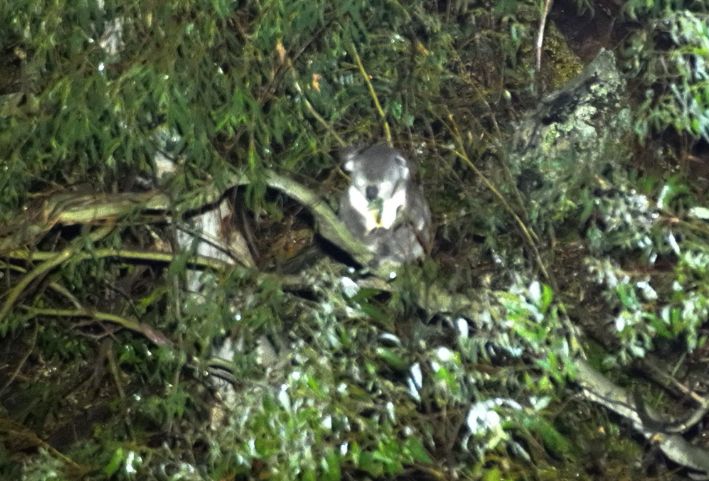
The project led by Jarrad Prangell and Kevin Fallon of Symbio Wildlife Park, represents the first large-scale abundance mapping of these two forest arboreal mammals in the region, providing crucial scientific baselines for long-term monitoring and conservation management.
First large-scale mapping using modern drone technology
The research model, designed by wildlife and drone pioneer Dr. Chad Beranek, and conducted over two years, applied spatiotemporally replicated night-time drone surveys across 47 systematically distributed sites, covering over 1,175 hectares of rugged terrain across the Illawarra Escarpment and Plateau. Each flight used thermal imaging, spotlight verification, and 4K aerial video, allowing Symbio to detect and identify heat signatures of koalas and gliders hidden high in the canopy, an innovation that makes previously inaccessible landscapes surveyable for the first time.
In total, 56 verified koalas and 127 southern greater gliders were confirmed, equating to modelled abundance estimates of 147 koalas and 195 gliders across the overarching survey area. Mean densities of 0.13 koalas per hectare and 0.17 gliders per hectare make this one of the most robust baselines yet recorded for the region.
“Modern thermal drone technology has revolutionised how we find and count cryptic wildlife,” said lead author Jordyn Clough of University of Wollongong’s - School of Science and Environmental Futures.
“In areas where spotlighting could take hours to locate a single animal, along with the associated hazards of access and safety, our drones can safely detect, verify and map respective species within just minutes, covering upwards of 25 hectares of land in around 20 minutes, which is unprecedented with historic, spotlight methods.”
The project was co-funded by Symbio Wildlife Park and GM3 through the GM3 Community & Environmental Investment Program and conducted under guidance and collaboration with Conservation Partners PTY Ltd, the research team from University of Wollongong’s School of Science and Environmental Futures, WaterNSW and DCCEEW’s Saving our Species Greater Glider team.
Despite being completely privately funded and not part of the Government’s overarching Koala Program, the findings will significantly contribute to the government’s understanding and management of the species across the Illawarra Escarpment, plateau, and beyond.
“This project shows what’s possible when collaboration, technology and conservation work hand-in- hand,” said Kevin Fallon, Senior Business Manager & Chief Drone Pilot at Symbio Wildlife Park.
“Together with all of our partners, we’ve delivered a scientific milestone right here on our doorstep, that identifies the Illawarra and the Southern Sydney Surrounds as critical strongholds for both koalas and southern greater gliders.”
“Especially now, following on from fires, floods, and threats of Chlamydia encroaching these important populations, having a better understanding for future species management programs is crucial as they provide a replicable baseline for all future monitoring programs to compare against.”
Dr Chad T. Beranek, who helped develop the drone-validation method, said this was a defining moment for wildlife monitoring.
“It’s the first peer-reviewed published instance of large-scale abundance mapping of two arboreal species simultaneously using thermal drones. This approach is safer, faster and more accurate, and it gives us data at a scale that was never before possible. It is likely many more species are suitable for this monitoring approach, exemplifying an exciting future for the application of drones in ecology”
Despite the first scientific discovery of a koala being in Mt Kembla and the Illawarra Range, with type specimens collected in 1803 by botanist Robert Brown in, as recently as 2016, much of the Illawarra escarpment region (including the Mt Kembla area) was believed to have lost its koala populations, perhaps even to local extinction. In fact, an article in Australian Geographic reported that eight koalas were sighted at Mt Kembla in 2016, at the time it was the first recorded sightings in more than 70 years.
The new thermal-drone survey confirms that not only do koalas remain in the region, but they are present in densities sufficient to merit recognition of the area as a conservation stronghold.Setting a benchmark for future conservation
Senior author Dr Katarina M. Mikac said
"the project demonstrates how thermal drone surveys and
statistical modelling can shape future conservation
decision-making.
“We can now monitor wildlife
across vast, steep and otherwise inaccessible forest
systems,” Dr Mikac said. “This is the future of
ecological research and a vital step in protecting
Australia’s endangered species.”
The findings suggest both species persist at low but stable densities, underscoring the ecological importance of the Illawarra’s protected bushland.
“These results reveal that the forests south of Sydney are far more significant for conservation than previously recognised,” Jordyn Clough said. “With modern drone technology, we’re finally seeing the full picture.”
Note:
Publication details:
Clough, J., Prangell, J., Fallon, K., Beranek, C.T., & Mikac, K.M. (2025). Abundance estimates of koalas (Phascolarctos cinereus) and southern greater gliders (Petauroides volans) on the Illawarra Range, New South Wales, from spatiotemporally-replicated thermal drone surveys. Australian Mammalogy, 47(3): AM25026. https://doi.org/10.1071/AM25026
Project partners:
University of Wollongong | Symbio Wildlife Park | Symbio Conservation Foundation | GM3 Community & Environmental Investment Fund | WaterNSW | Conservation Partners Pty Ltd
 Aotearoa Delegation of the Global Sumud Flotilla: The Global Sumud Flotilla Remains Undeterred As Over 30 Boats Depart For Türkiye
 UN Special Procedures - Human Rights: Israel Must Immediately Release Gaza-Bound Flotilla Activists, Say UN Experts
 IPMSDL: Condemn The Killing Of Children, Bombing In Manipur, And Violent Repression Of People’s Protests
 Médecins Sans Frontières: Three Years On, Outbreaks Everywhere - MSF Urges Boost To Sudan’s Vaccination Programs
 UN News: Uncertainty Continues Over Safety In The Strait Of Hormuz
 Australian Museum: Celebrate Sir David Attenborough's 100th Birthday With The Australian Museum