
 Scoop has an Ethical Paywall


John Laughland: Fill Full The Mouth Of Famine
Sanders Research Associates Ltd. provides international strategic planning and risk management services to both corporate and private clients. SRA also publishes a webzine available by subscription. Visit http://www.sandersresearch.com to get a good feel for the real deal.
Fill Full The Mouth Of Famine [1]
26th July 2004
John Laughland
Original URL
Perhaps the most striking thing about the news reports that Britain is thinking of sending troops to Darfur in Sudan is the silence on the matter which has emanated from the usual antiwar campaigners. Although the Guardian report on 22nd July said that a “humanitarian intervention” in Sudan would help retrieve Tony Blair’s reputation for moral action after the Iraq debacle—as if the solution to a bad war was a good one—the usual suspects have not piped up. And even though the US Congress formally decided on 22nd July that “genocide” was occurring in Darfur—“genocide” being an international crime, this is the legal trigger for intervention—no one has so far pointed out that the same genocide was invoked to justify Nato’s aggression against Yugoslavia in 1999.
The silence is all the more odd, given that Darfur is a region which is rich in oil and through which pipelines are to be constructed. Moreover, the main investor in the Sudanese oil industry is the China National Petroleum Company, and China is Sudan’s biggest trading partner overall.[2] It has been alleged that there are Chinese soldiers in Sudan protecting Chinese oil interests there, and that these troops have engaged in skirmishes with the rebels.[3] Moreover, while there are numerous foreign oil companies present in Sudan, it is precisely in Southern Darfur that the Chinese National Petroleum Company has its concessions. USAID, the American humanitarian agency, has helpfully provided a map of Sudan showing precisely where the oil concessions are. See http://www.usaid.gov/locations/sub-saharan_africa/sudan/map_oil.pdf)
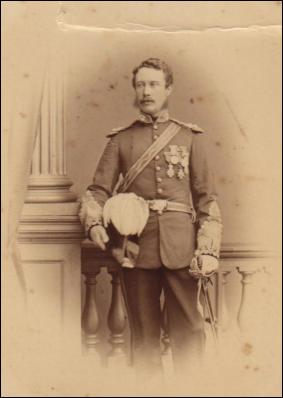
It is surely inevitable that there will now be a military intervention by Sudan’s former colonial power, Britain. (In one of those delicious ironies of history, it was precisely in China that one of the most famous colonialists of all, General Gordon of Khartoum, distinguished himself before becoming governor of Sudan, where he precisely intervened to protect the blacks in the South from the Muslims who sold them as slaves.[4] ) Tony Blair ostensibly tried to play down the news reports at his monthly press conference on 22nd July. But, while saying—as he had done on Iraq—that no decisions had been taken, the Prime Minister also reverted to his habitual use of the language of moralism. A question (planted?) made the comparison between Sudan and Kosovo and Blair replied, “I believe we have a moral responsibility to deal with this and to deal with it by any means that we can” (my italics).[5] This means war.
Blair evidently hopes that a humanitarian war will efface the memories of the “war for oil” in Iraq. The opposition to the Kosovo war having been minimal, and international support being widespread for an attack on the “genocidal” Sudanese government, his gamble is likely to pay off. It does not seem to matter to antiwar campaigners that the same language of moralism was used to justify all the other military interventions in Blair’s astonishingly militaristic premiership (the “Desert Fox” bombing campaign against Iraq in December 1998; the bombing of Yugoslavia in 1999; the intervention in Sierra Leone in 2000; the attack on Afghanistan in 2001; the invasion of Iraq in 2003.) Unfortunately, it is likely that the simple appeal of sending troops to help poor blacks against marauding Muslims will be too strong for most antiwar campaigners to overcome.
Indeed, the Darfur crisis is following a pattern which is so well-worn now that it has almost become routine. Saturation reporting from a crisis region; emergency calls for help broadcast on the electronic media (such as the one recently on the BBC Radio 4 flagship ‘ Today’ programme); televised pictures of refugees; lurid stories of “mass rapes”, which are surely designed to titillate as much to provoke outrage; reproachful evocations of the Rwandan genocide; demands that something must be done (“How can we stand idly by?”, etc.); editorials in the Daily Telegraph calling for a return to the days of Rudyard Kipling’s benevolent imperialism[6] ; and, finally, the announcement that plans are indeed being drawn up for an intervention.

In fact, the routine is now so well established that life even imitated satire when the Daily Telegraph dispatched its 90 year-old former editor, Bill Deedes, to report on the situation in Sudan. Deedes is himself the model for William Boot in Evelyn Waugh’s novel, Scoop, whose reports from a fictitious East African state on a war more or less invented by the press baron, Lord Copper, in London, were themselves inspired by the young Deedes’ reports from Abyssinia for the Morning Star in 1935.
According to Arab sources quoted by the informative Turkish paper, Zaman, oil is the basis of the crisis in Darfur.[7] These sources say that renewed fighting broke out at the very moment when a peace agreement was about to be signed which would have brought an end to 21 years of conflict. This is certainly what the Sudanese government itself alleges. If so, this would conform to the pattern established in Bosnia and Kosovo, when the international community moved to scupper peace deals, preferring to encourage wars which provide the pretext for intervention.
The Sudanese government, which is currently in the cross-hairs of the interventionist West, agrees that there is fighting and there is a humanitarian crisis. But it accuses Western humanitarian organisations and media of over-dramatising the situation in order to provide a pretext for military intervention. The Washington embassy issued the following statement: “Politicization of the situation in Darfur and its use as a tool to destabilize the Government of Sudan must be considered the major factor of the humanitarian disaster there.”[8] But it correctly denounces the media distortions and calls them propagandistic.[9] It also protests at the claim that it is backing the Janjaweed militiamen who are said to be causing so much trouble: this claim is repeated with the same relentlessness as was the similar claim that Serbia was pursuing ethnic cleansing in Kosovo. In reality, Janjaweed militiamen have been subjected to horrific punishments by the Sudanese courts, including amputation.[10]
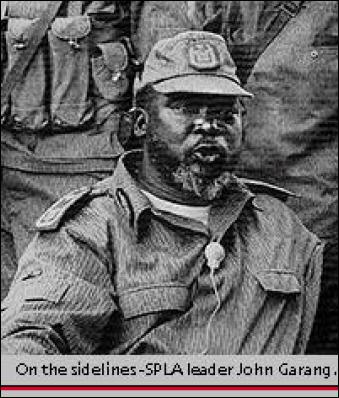
Zaman also alleges that some of the groups fighting the central government in Khartoum are supported by Sudan’s neighbours, by the US, European governments, and by Israel. The US is said to have given $20 million to the Sudanese People Liberation Army, led by a man who conforms perfectly to the model of the American agent. John Garang is a ruthless killer who has a doctorate from a university in Iowa, and who is a former Marxist who curries support from American Christian fundamentalists. (The support of American charities for the “Christians” in Southern Sudan has been a feature of the conflicts there for some years now, even though, as in John Garang’s case, the local tribes worship either the sky or animals.[11] ) Garang’s movement is supported by the Sudanese Communist Party: communists are, paradoxically, American allies all over Eastern Europe and in many Southern African states. The suspicion is that intervention will encourage the Southern part of Sudan, including parts of Darfur, will move towards independence, as neighbouring Eritrea did from Ethiopia, and become, like Eritrea, a territory for US bases. Ethiopia, for its part, has funnelled aid from Israel and the US to the SPLA.
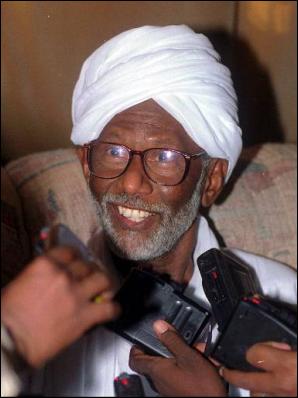
Another key figure is Hassan Turabi (Hasan al-Turabi) leader of the Popular National Congress, onetime leader of the Muslim Brotherhood and onetime ally of President Hassan al-Bashir. Turabi is known as an influential Islamist who is said to have given safe haven to Osama bin Laden. Although Turabi is denounced (especially by the Sudanese government he is attacking) as a Muslim fundamentalist, other Muslims regard him as a tool of the West.[12] Turabi was credited by American commentators as being the author of Sudan’s liberal and republican version of Islam.[13] Turabi’s Justice and Equality Movement is based in US-controlled Eritrea, from where it issues its official communiqués. As a turncoat former ally of the president, Turabi fits perfectly into the category of persons often used by outside powers (especially the US) to promote regime change. The tantalising possibility that an old friend of Osama bin Laden might be an American ally in Sudan only nourishes the kind of speculation indulged in by Michael Moore in Fahrenheit 9-11, which dwells at length on the business links between the Bush family and rich Saudis like the bin Ladins.
Intervention will allow Western forces to control an oil rich region, and perhaps to expel the present holders of concessions. The fact that the biggest of these is China, and that America’s other foreign adventures also seem to have as their goal the control of energy supplies to that strategic rival, only adds further piquancy to what is, otherwise, an all too banal case of modern imperialistic meddling.
[1] From Rudyard Kipling’s “The White Man’s Burden,” which laments the ingratitude of natives who benefit from British imperialism.
[2] See the interview President Bashir gave to China People’s Daily in December 2003: http://english.peopledaily.com.cn/200312/24/eng20031224_131143.shtml Bashir said that Sudan supported China’s policy of reunification with Taiwan.
[3] http://www.newsmax.com/articles/?a=2000/8/26/204458
[4] http://www.cis.upenn.edu/~homeier/interests/heros/gordon.html
[5] See Tony Blair’s press conference, 22nd July 2004, http://www.number-10.gov.uk/output/Page6153.asp
[6] “Britain must not turn its back on Sudan’s plight”, The Daily Telegraph, 19th June 2004
[7] “Oil Underlies Darfur Tragedy,” Cumali Onal, Zaman, 7th July 2004. http://www.sudan.net/news/posted/8991.html
[8] 19th July 2004, http://www.sudanembassy.org/default.asp?page=viewstory&id=288
[9] “The Darfur Crisis: Looking beyond the propaganda”, Embassy of the Republic of Sudan, Washington DC, 13th July 2004, see especially the section entitled “Propaganda distortions,” http://www.sudanembassy.org/default.asp?page=viewstory&id=285
[10] “Sudan jails Darfur militiamen, orders amputations,” Nima Elbagir, Reuters, 19th July 2004.
[11] See the BBC profile of Garang from 2002: “Africa’s enduring rebel” by Gray Phombea, http://news.bbc.co.uk/2/hi/africa/2134220.stm
[12] See this denunciation of his pro-Western ideas, as expounded in an interview in Foreign Affairs in 1995: http://www.allaahuakbar.net/individual_callers/hasan_turabi.htm
[13] http://www.espac.org/religion_sudan/religion_in_sudan.html
 Binoy Kampmark: Exiting The Oil Cartel - The United Arab Emirates Leaves OPEC
 Ian Powell: Hidden Waiting List Exposed; Unmet Health Need Unreported
 Ramzy Baroud: The Assault On A French Nun And The Forgotten Story Of Palestinian Christians
 Frances Palmer: Defending Values In A Volatile World
 Peter Dunne: Dunne's Weekly - Waititi Correct, But Unlikely To Get His Wish
 Keith Rankin: Does The United States Have A Debt Problem That Needs Fixing?