
 Scoop has an Ethical Paywall


Dinosaur Footprints Discovered In The South Island
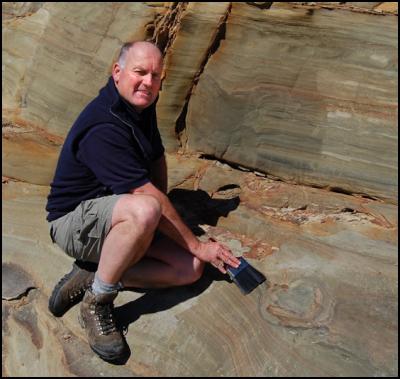
Dr Greg Browne, discoverer of the prints
More images at GNS
MEDIA RELEASE from GNS Science
7 November 2009
Dinosaur Footprints Discovered In The South Island
Scientists
have found 70 million-year-old dinosaur footprints in
northwest Nelson.
They are the first dinosaur footprints to be recognised in New Zealand and the first evidence of dinosaurs in the South Island. They were discovered by geologist Greg Browne of GNS Science.
Dr Browne found the
footprints while investigating the properties of the rock
and sediment formations in the northwest Nelson
region.
There are six locations over an area about 10km
in length where footprints appear. At one location there are
up to 20 footprints.
Dr Browne carefully considered all the possible geological and biological explanations for the features in the rock and was able to rule them out one-by-one. His investigation included comparisons with dinosaur footprints in similar aged rocks in other parts of the world.
He concluded that the most plausible explanation was the markings were made by sauropods - large herbivorous dinosaurs with long necks and tails and pillar-like legs.
The footprints were made in beach sands and were probably quickly covered and preserved by mud from subsequent tides.
“What makes this discovery special is the unique preservation of the footprints in an environment where they could easily have been destroyed by waves, tides, or wind,” Dr Browne said.
The depressions are roughly circular in plan view, with the largest about 60cm in diameter. Most are smaller – typically between 10 and 20cm in diameter and were probably formed by dinosaurs between 2m and 6m in length and weighing several tonnes.
While paleontologists know that dinosaurs were present in ancient New Zealand, which they refer to as Zealandia, the record of their presence is very sketchy.
Dinosaur bones, mostly vertebrae, have been found at only three locations – northern Hawke’s Bay, Port Waikato, and the Chatham Islands.
Dr Browne said the footprints added a considerable amount of information about how dinosaurs moved, how fast they moved, how big they were as well as how soft the sediment was when they moved through the area.
"This discovery opens the way for further study on a range of dinosaur-related issues in New Zealand."
As with much of New Zealand, northwest Nelson was largely submerged under the sea between 70 and 20 million years ago and the footprints would have been covered by hundreds of metres of marine sediments.
Then with the development of the
‘modern plate boundary’, New Zealand was uplifted and
northwest Nelson emerged from the sea.
During the past 20
million years, the overlying sedimentary rock has been
eroded away to expose the footprints again.
Dr Browne’s discovery will be published in the December issue of the New Zealand Journal of Geology & Geophysics.
END
 Google Threat Intelligence Group - GTIG: Google Threat Report Warns AI-Driven Cyber Operations Are Scaling Across Global Threat Landscape
 Commerce Commission: Baseline Research Report On The State Of Competition In New Zealand
 University of Auckland: Junk Food Designed To Make Us Eat More, Study Finds
 Spark: New Report Sets Out Outcomes-Led Approach To Lift Rural Connectivity Using The Right Mix Of Technologies
 Bill Bennett: Fixed Voice Rules Head For Deregulation
 UN Department of Global Communications: United Nations Proposes New Global Dashboard To Measure Progress Beyond GDP


