
 Scoop has an Ethical Paywall


Collapsed Scaffolding Had Basic Safety Flaws
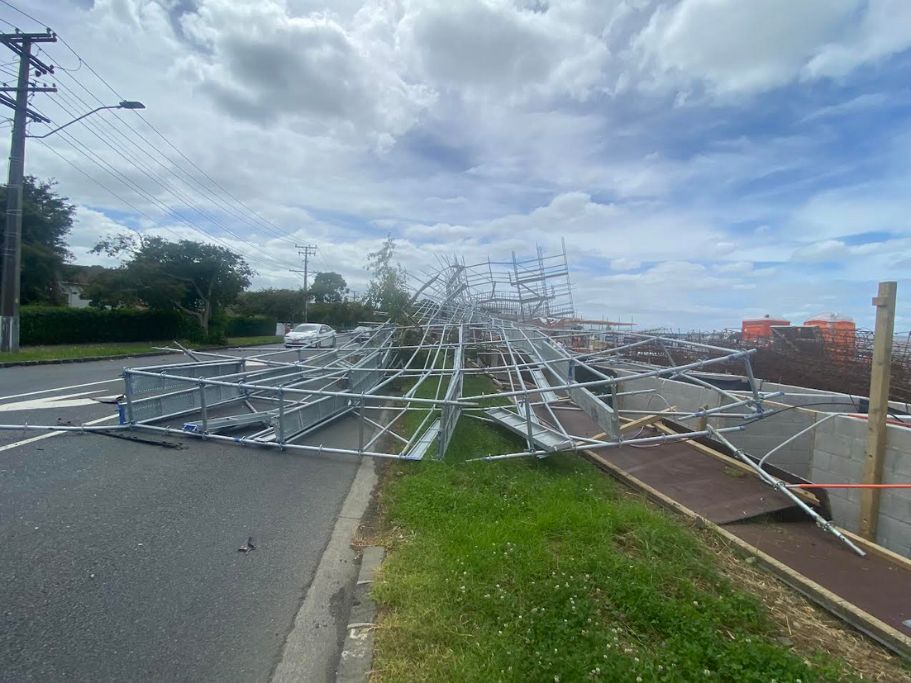
Details of a dramatic scaffolding collapse onto a busy Auckland road have been revealed for the first time by WorkSafe New Zealand, as its court case against the company responsible draws to a close.
The nine-metre-high scaffold was for townhouses being built on the boundary of the Ellerslie Racecourse. The structure fell into the path of cars along Remuera’s Peach Parade on a windy day in January 2024. A witness described it “start to curl like a wave” before coming down onto the road. Three workers were nearby at the time, and drivers were left traumatised from swerving to avoid injury or death.
A WorkSafe investigation found the scaffold was effectively free-standing and lacked the minimum safety features to anchor it. For example, it was not tied down, nor was there bracing (known as rakers) used to increase the base width for stability. However, CCTV footage showed workers installing rakers onto the collapsed structure after the incident.
Kylin Scaffolding Limited did not carry out a risk assessment for the scaffolding along the roadside, nor for installing the scaffolding without rakers. The company has now been sentenced, after pleading guilty to breaching the Health and Safety at Work Act 2015.
“Our official guidelines are clear that rakers, ties, and risk assessments are essential, not optional. Construction scaffolding design is complex, and you are gambling with lives if you cut corners,” says WorkSafe’s northern regional manager, Brad Duggan.
At the time of the collapse, Kylin Scaffolding Limited’s operations manager was qualified to design, construct, alter and dismantle the scaffold. The company could not explain the safety shortcomings to WorkSafe investigators.
“It is extremely disappointing that Kylin Scaffolding Limited failed to ensure that this structure was safe, and followed industry standards and guidance,” says Brad Duggan.
“How this collapse did not end in tragedy is nothing short of miraculous. This was a seriously deficient set up, and a blatant risk to public safety. Businesses must manage their health and safety risks and where they do not, WorkSafe will take action.”
WorkSafe’s role is to influence businesses and workers to meet their responsibilities and keep people healthy and safe. Our good practice guidelines for scaffolding have practical advice on the safe design, construction, use, and maintenance of scaffolding. These guidelines are widely used in the construction industry to help meet their obligations under the Health and Safety at Work Act 2015.
Read WorkSafe’s good practice guidelines for scaffolding in New Zealand: https://www.worksafe.govt.nz/topic-and-industry/working-at-height/scaffolding-in-new-zealand/
 Gordon Campbell: On Children’s Book Classics - The Moomins
 Zero Waste Network Aotearoa: Container Return Scheme Bill Would Double Recycling Rates And Put Money Back In Households
 Wellington City Council: Statement From The Wellington Mayoral Forum On Options For Regional Governance Reform
 MUNZ: TAIC Report On Kaitaki Incident Gives Shocking Picture Of Decline Of NZ Maritime Infrastructure
 Greenpeace: New Climate Report Yet More Reason To Reduce Dairy Herd
 Better Public Media: Opposing Plans To Scrap The BSA
 Internal Affairs: Citizenship Test For Citizenship By Grant Applicants From Late 2027


