
 Scoop has an Ethical Paywall


Tensions And Price Increases Ahead For Getting Roads Built

Phil Pennington, Reporter
The Transport Agency (NZTA) is juggling price increases due to the Iran war, including a jump in a three-week period of almost 75 percent in bitumen.
It was working on a framework to prioritise maintenance, operations, and capital projects "identifying critical work versus activities that could be deferred," it told the government in newly released briefings.
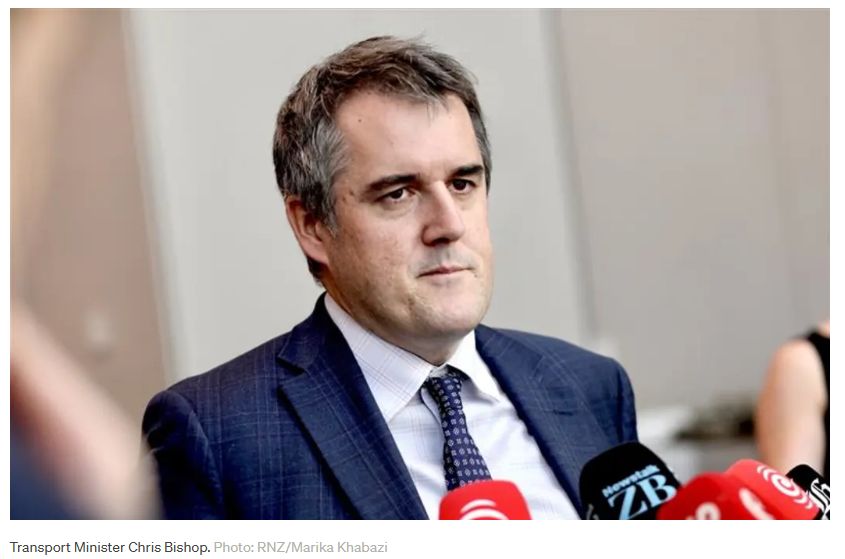
The four briefings to Transport Minister Chris Bishop in March marked out the wide impact of diesel price rises, and also foresaw tensions ahead as contractors tried to vary terms.
One paper showed by late March the spend at the pump nationwide was up $4.3 million a day, or 16 percent, while vehicle kilometres travelled were down 20 percent for cars and five percent for light and heavy commercial.
Another paper said NZTA's early modelling anticipated a five percent rise in big project costs if oil was at US$100 (NZ$168) a barrel, 10 percent at US$150 (NZ$252). Prices had been hovering around US$100 (NZ$168).
Bishop, asked to release any current plan to address pressures from the war on funding for the Roads of National Significance (RoNS), said "no such advice has been provided to me or my office".
He faces a keen pinch point with the government unlikely to go ahead with a 12 cent per litre increase to fuel taxes charges next January.
Bishop withheld in full a briefing titled "National land transport fund - revenue and expenditure pressures" and one titled "FED/RUC: Indicative revenue implications of 12-month deferred implementation". The acronyms stand for fuel excise duty and road user charges.
Previously released documents showed transport authorities in mid-2025 were revisiting the RoNS plans that at that stage covered 17 highways forecast to cost between $44 and $54 billion.
The investment cases were in line with a government policy statement for grade separated four-lane highways "which limits options to materially reduce scope and cost", one Ministry of Transport (MOT) briefing said.
"Scaling options have therefore been created by reducing the scope of projects based around this specification.
"NZTA has sought its board's approval to step away from RoNS standards or amend project scope on some projects when appropriate (for example for constructability purpose or where delivering the full scope is not value for money)."
One example was the board OK-ing an 80 km/h speed limit for the new Petone-Grenada highway.
The MOT briefings showed NZTA at that time working on a way forward "trading off the different revenue and expenditure options".
Extra revenue sources talked about included tolling and congestion charges.
However, in the latest Official Information Act about responding to Iran war pressures, Bishop said he had had no briefings on its impact related to tolling or congestion charging.
The briefings to him showed the toughest spot for NZTA's contractors was for those working on projects less than a year old because in that 12-month period any changes in fuel price indexes were not compensated for.
"During this time contractors will be exposed to the cost risk," NZTA said.
Diesel made up seven percent of the road construction index.
"If elevated prices persist, NZTA will face commercial tension, including requests for contract variation, slowed delivery or reprioritisation of work."
No force majeure claims had by then been lodged on its contracts.
It said bitumen importers were "confident" of supply for roading next summer for both NZTA and council roading, but at what price was the big questioin.
Bitumen pice pressure had eased a bit as sealing activity wound down, though it had been up 74 percent in the three weeks to March 20.
Market reports said in the past month it was up just on four percent, and 26 percent over a year.
The country's bitumen stocks were at 93 days or 51,000 tonnes in March, with 41,000 tonnes due in next few months - the next delivery due had been delayed a few days.
"NZTA's current response is close monitoring of availability, price movements, and market developments and working closely with All of Government agencies and industry," the agency told Bishop.
Another two-page briefing gave advice on 20 March about fuel tax options that was urgently requested by the ministerial oversight group.
It said reducing the fuel excise duty or road user charges would "provide limited relief" that was "poorly targeted".
"It will be difficult to ensure that reductions are fully passed to consumers," said Treasury which did not want any cuts.
"A universal reduction in FED/RUC will benefit consumers and businesses that consume the most fuel, rather than targeting those who have the greatest cost-of-living pressures."
It would also dampen the price signals to consumers.
The excise duty would be quicker to use than altering RUC, however, it would be hard to ensure any cut was only temporary as "past experience shows it is challenging to reverse price reductions'".
RNZ
New Zealand's public broadcaster, providing comprehensive NZ news and current affairs, specialist audio features and documentaries.
Radio New Zealand is a Crown entity established under the Radio New Zealand Act 1995. Radio New Zealand News are vital elements in our programming, providing impartial news and information to New Zealanders every day. Radio New Zealand (RNZ) provides listeners with exciting and independent radio programmes in accordance with the Radio New Zealand Charter.
 Gordon Campbell: On Children’s Book Classics - The Moomins
 Wellington City Council: Statement From The Wellington Mayoral Forum On Options For Regional Governance Reform
 MUNZ: TAIC Report On Kaitaki Incident Gives Shocking Picture Of Decline Of NZ Maritime Infrastructure
 Greenpeace: New Climate Report Yet More Reason To Reduce Dairy Herd
 Better Public Media: Opposing Plans To Scrap The BSA
 Internal Affairs: Citizenship Test For Citizenship By Grant Applicants From Late 2027
 Dayenu: Condemning Use Of Government Funding For Extremist Report On Antisemitism

