
 Scoop has an Ethical Paywall


Māori Wards Support Two To One In Favour
There are signs that community support for Māori wards will see Hawke’s Bay voters tick to keep them in referendums underway with the local council elections.
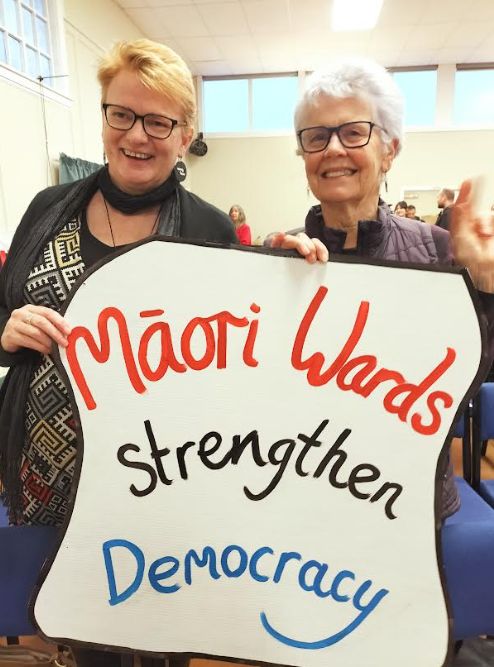
“Candidates across the region support Māori wards by a ratio of at least two to one and we’d expect to see that reflected in the community,” said For Wards Hawke’s Bay co-ordinator Neill Gordon.
“Our For Wards speakers who have spoken to groups in retirement villages tell us that even in those environments where you might expect conservative views, support is 60 to 40 in favour.
“Another very encouraging signal has been that demand for our Big Aroha for Māori Wards heart-shaped signs has been insatiable. We’ve put up close to 1200 hearts now and hundreds more have gone nationwide.
“The love for those signs has completely blown us away. People keep sending us photos and videos of them doing all kinds of things with them - ski-ing, swimming underwater, sailing, dancing, tramping in the hills, running through fields, on water slides and just holding them - hundreds and hundreds of photos of people embracing them.”
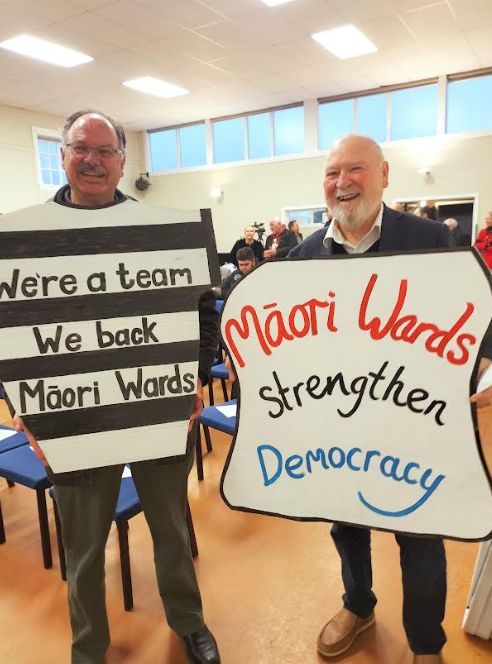
Referendums on keeping Māori wards, a rule that applies to Māori wards only, not rural or any other kind of ward, were made compulsory by the government. In voting papers delivered to all voters’ letterboxes for the local council elections, there are also two Māori wards questions: a vote to keep or remove Māori wards on city and district councils and vote to keep or remove Māori constituencies on regional councils.
“Overwhelmingly, councillors around the country who have direct experience of Māori wards are saying the same thing: they work brilliantly, cost us nothing and mean better decisions for everyone,” Neill says.
In Hawke’s Bay, more than 70 council candidates support Māori wards and 36 are either opposed or not stating their position.
Anyone can stand as a candidate in a Māori ward, which mirror the Māori seats in Parliament. They are one-person one-vote with candidates voted in or booted out by the voters on the Māori roll.

In Napier, for example, where there have been just three Māori councillors in 150 years, there will be two Māori ward councillors and nine other councillors elected by the Taradale, Central and Ahuriri ward voters. The mayor is elected by everyone.
“Regardless of the outcomes of the referendums, we feel we can’t lose because during this election process more people than ever before have stood up and said they support democratic Māori representation at our council tables because it is better for everyone.
“As a community we are now more united in support than ever. It is kotahitanga (unity) in action,” Neill says.
It is a postal vote and voting papers must be returned by October 11.
 Gordon Campbell: On Children’s Book Classics - The Moomins
 Johnnie Freeland: Ko Tātou Tātou - Climate Action In Aotearoa Begins With Relationship
 Zero Waste Network Aotearoa: Container Return Scheme Bill Would Double Recycling Rates And Put Money Back In Households
 Wellington City Council: Statement From The Wellington Mayoral Forum On Options For Regional Governance Reform
 MUNZ: TAIC Report On Kaitaki Incident Gives Shocking Picture Of Decline Of NZ Maritime Infrastructure
 Greenpeace: New Climate Report Yet More Reason To Reduce Dairy Herd
 Better Public Media: Opposing Plans To Scrap The BSA


