
 Scoop has an Ethical Paywall


Key Policy Considerations Raised By Leaders Of Ethnic And Faith Community Network With The Prime Minister
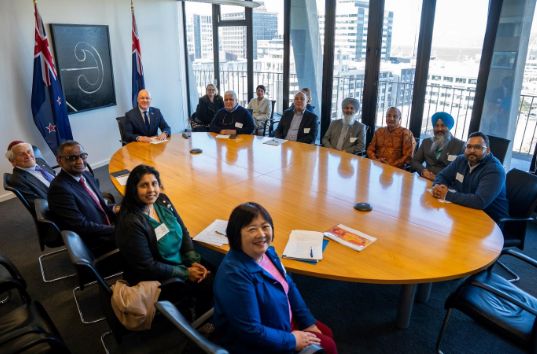
At a meeting on Tuesday, 11 November, ethnic and faith community leaders raised a number of policy issues for the consideration of the Prime Minister, Rt. Hon. Christopher Luxon.
“Each year we meet as an united group of Indian, Chinese, Sikh, Muslim, Buddhist, Jewish and African community elders and leaders to discuss common issues which impact us all. For next year we have focused on eight policy areas. In a changing demographic context with ethnic and faith communities represent 20% of the national population, there is a heightened need for our own evidence-based narrative to be included in the policy mix for political leaders to consider. It is also important that there is on-going and meaningful engagement with government agencies,” said Abdur Razzaq who is the national coordinator of the Ethnic and Faith Community Leaders Network.“
Debbie Chin from the Chinese community raised health equity policy considerations for Asians based on recent research on key public health indicators. These concerns ranged from mental health and greater prevalence of diabetes to barriers to access for primary and secondary health services. The research also highlighted distressing levels of bullying and discrimination against our young people. We discussed the impact of these on social cohesion.
Daljit Singh from the Sikh community highlighted some of the anomalies related to the policy settings and implementation of Culturally Arrange Marriages. He also gave examples of the difficulties communities face with respect to the financial threshold for sponsor’s income for parents’ visa, the high cost of the preacher’s visit visa. He also raised the possibility of a Limited Purpose Visa for such occasions as funerals, weddings and key cultural gatherings.
Gregory Fortuin from the African leaders collective highlighted that whilst we all agree with the foundational importance of freedom of speech, there also has to be some measures to prevent the detrimental effects which provoke and incite violence. This whole area needs to be revisited in light of the growing evidence of hate offences and incidents.
David Zwartz from the Jewish community raised concerns that the demise of the national in-person census and its replacement with administrative data and 3% sample census surveys may result in smaller ethnic and faith communities becoming statistically invisible. On behalf of the Network, he noted that it seems key decisions have already been made and we are being consulted at a very late stage.
Manisha Morar, from the Indian community, voiced strong concern over recent changes to the New Zealand curriculum and the effective dismantling of the Aotearoa Histories curriculum. She highlighted that ethnic and faith communities had spent years co-developing the curriculum, only to see it sidelined. “We risk raising a generation who don’t know the historical role or identity of their own communities in shaping Aotearoa. This knowledge is vital for social cohesion and tolerance,” she said. Morar warned that removing ethnic histories from the core curriculum erases visibility and undermines belonging. There was an urgent call to reinstate these histories as a central pillar of education. Suggestions were also made on how this gap may be addressed.
Richard Leung, Auckland Chinese community leader, raised the issue of foreign interference legislation which we all supported. He suggested that there is an urgent need for a Foreign Agents’ Register to provide transparency and safety for vulnerable communities. The network also raised the possibility of a variable one-day paid holiday for all the various ethnic and faith communities, which they can negotiate with their respective employers. This would be for all New Zealanders. This would enable our diverse communities to mark their special day for religious or cultural significance. “ Towards the end of our meeting, we all collectively applauded the Prime Minister for keeping his promise not to loosen the restrictions on military-style semi- automatic weapons (MSSAs) imposed after the 2019 Christchurch Mosques massacre”, said Abdur Razzaq from the Muslim community
The Prime Minister thanked the Network and commented that the issues raised would be considered he particularly appreciated that that the policy considerations were presented succinctly. He also noted that in his recent meetings with his counterparts in Australia and Canada, they were very interested in this type of united approach by communities. The next meeting is scheduled for mid-next year.
Earlier in the day, the Network also met with the Rt Hon Winston Peters (NZ First) as well as Chlöe Swarbrick and Marama Davidson (Green Party) .
 Gordon Campbell: On How US Courts Are Helping Donald Trump Steal The Mid-Terms
 Forest And Bird: Government Biodiversity Credit Scheme Welcomed As Opportunity For Restoration
 Office of the Ombudsman: Ombudsman Publishes Findings On Ministry Of Education Sensitive Claims Scheme
 Nelson City Council: Mayor Welcomes Auditor-General Decision Not To Prosecute Councillor
 Johnnie Freeland: Ko Tātou Tātou - Climate Action In Aotearoa Begins With Relationship
 Zero Waste Network Aotearoa: Container Return Scheme Bill Would Double Recycling Rates And Put Money Back In Households
 Wellington City Council: Statement From The Wellington Mayoral Forum On Options For Regional Governance Reform


