
 Scoop has an Ethical Paywall


Leading Northland Agricultural Businesses Encouraged To Support Northern Rescue Helicopters
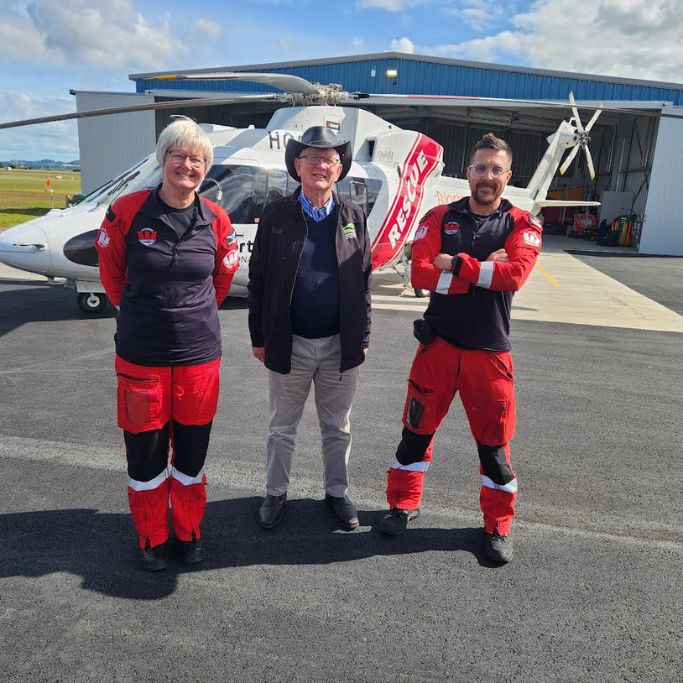
The leader of Northland Federated Farmers is calling on businesses Northland-wide to get behind the Northern Rescue Helicopter Annual Appeal as the service turns 37-years-old this week.
President Colin Hannah says Northland is blessed to have a world class air ambulance service providing extremely high levels of care. Already this calendar year it has completed more than 950 missions.
“However, the Northern Rescue Helicopters need ongoing financial support from businesses in the agricultural sector and businesses in general and I encourage them to step up now and get behind the 2025 Annual Appeal.
“Farmers spend a lot of money with businesses throughout the North every day and I would like to think those businesses can use some of those profits to pay it forward and help others.”
Hannah says the province of Northland Federated Farmers supports the service annually, as do a lot of its members on an individual basis.
“Given there are so many remote pockets around Northland, getting people to hospital quickly is critical to the wellbeing and safety of locals and visitors to our region. We can’t do that without everyone in the chain playing their part in providing care in a person’s time of need.
“That only happens thanks to the passion of all first responders, community volunteers and support networks who work together as a team with the crews on board our Northern Rescue Helicopters,” says Hannah.
“We need the speed of the Northern Rescue Helicopters to get us to a place of safety quickly because that greatly improves patient outcomes and saves lives.”
Hannah says rural Northlanders are heavily reliant on the service to keep the Northland community safe.
“That’s why it is critical we all support Northland’s community owned air ambulance service that was established by locals, for locals in 1988.
“You just never know when you or a loved one might need one of our Northern Rescue Helicopters. Donating now is like a form of insurance and paying it forward to help yourself or others.”
Hannah says one easy way farmers can donate is by gifting the proceeds of an animal every couple of years that they sell to the works or saleyards.
“I would like to hear from those farmers directly, so their generosity can be acknowledged by the fundraising team at Northern Rescue Helicopters.
“If we all did that, we would end up collectively providing a substantial amount of critical funds to make numerous lifesaving flights.
“Let’s face it, farmers are very common users of our Northern Rescue Helicopters. I know dozens of farmers - and rural folk in general - in Northland and around New Zealand who have had their lives saved after cardiac arrest, illness, farming, road or sporting accidents.
“In the 2024/2025 financial year alone, our Northern Rescue Helicopters flew over 1000 flights – 60 to Kaipara, 53 to the Mid North, 124 to Bay of Islands and 388 to the Far North among them.”
Hannah says the cost associated with running the service is immense when you consider a winch is worth $205k, a single rotor blade $405k and a pair of night vision goggles well over $2ok.
“The passion and dedication of the Northern Rescue Helicopter team is significant and I thank them for that,” says Hannah.
“As farmers, it is essential that we dig into our pockets and donate what we can at www.nest.org.nz/donate - and follow the annual fundraising campaign at www.facebook.com/northland.rescuehelicopter”
 Gordon Campbell: On Children’s Book Classics - The Moomins
 Nelson City Council: Mayor Welcomes Auditor-General Decision Not To Prosecute Councillor
 Johnnie Freeland: Ko Tātou Tātou - Climate Action In Aotearoa Begins With Relationship
 Zero Waste Network Aotearoa: Container Return Scheme Bill Would Double Recycling Rates And Put Money Back In Households
 Wellington City Council: Statement From The Wellington Mayoral Forum On Options For Regional Governance Reform
 MUNZ: TAIC Report On Kaitaki Incident Gives Shocking Picture Of Decline Of NZ Maritime Infrastructure
 Greenpeace: New Climate Report Yet More Reason To Reduce Dairy Herd


