
 Scoop has an Ethical Paywall


Groundhog Day For Fishermen As Tauranga’s Marine Precinct Consultation Begins…Again

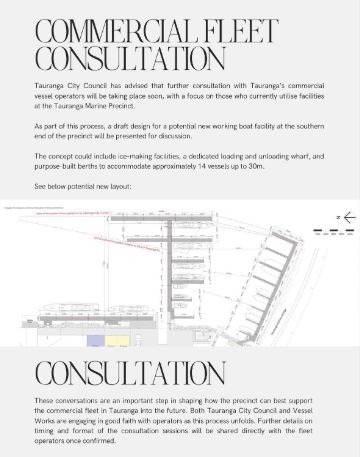
Tauranga fishermen are raising serious concerns that the Marine Precinct’s proposed transformation into a luxury superyacht hub will come at the expense of the working fishing fleet.
The precinct, recently sold by Tauranga City Council reportedly under market value and with public funding incentives to developers, is being re-envisioned as a high-end destination and haul-out area for large vessels. While city officials, including Mayor Mahe Drysdale, have promoted the redevelopment as progress for Tauranga’s waterfront, those who have depended on the site for decades say recent concept drawings, produced without their input, are fundamentally flawed.
Long-standing precinct users, many of whom have participated in consultations for over 15 years, say the new developers and current council leadership appear to have a very different understanding of what both the precinct and genuine consultation require.
Mayor Drysdale opened the 13 October meeting by presenting the latest concept drawings as a practical and comprehensive solution, suggesting they addressed previous feedback and could accommodate both commercial and recreational (Superyacht) users. However, current precinct users said this characterisation was detached from the operational reality of the site.
Tauranga’s Marine Precinct has one of the strongest tidal flows in the country. The proposed layout does not allow for the turning space, tidal flow management, or access infrastructure required for safe and functional commercial operations. Long-standing users observed that neither the Mayor nor the developers appeared to understand the fundamental requirements for vessel manoeuvring, unloading, or refuelling in these conditions.
They argued the design is not a balanced or informed solution, but one that would displace the commercial fleet and introduce unnecessary operational risks.
Steve Haddock, a commercial fisherman from Whakatāne with 48 years’ experience, described the proposal as unworkable and fundamentally unsuited to commercial needs during the meeting. He said the design gave the impression that working boats and fishing operators were no longer wanted in Tauranga. Citing long-standing operational issues, Haddock said he avoids Tauranga due to inadequate facilities and described the city as having fallen behind other ports over the past 25 years.
He emphasised that the fleet needs at least 100 metres of functional wharf space to safely unload, access ice, refuel, and carry out essential maintenance. Instead, the concept appeared focused on accommodating private vessels, forcing commercial operators into a constrained area that ignores the challenges of strong tides and scheduled ice loading. He warned the proposed layout would likely lead to serious insurance issues and increase operational risks for all vessels in the precinct.
An independent review by a professional marina consultant, stated that the proposed layout does not meet accepted maritime safety or environmental standards. The fairway widths are below New Zealand and Australian guidelines, and the use of pontoons with "skirts" to manage tidal flow was flagged as both unsafe and likely to require new consents. The current design was described as “non-compliant and environmentally risky.”
The proposed development wasn’t the only concern raised. Councillors and the developers heard strong objections about the process itself, which many attendees described as another failure in consultation. Several speakers noted the developers had limited operating experience in the precinct - one of the country’s strongest tidal zones - while consistently encouraging “positive feedback” even as commercial operators unanimously raised safety and viability concerns.
Mayor Drysdale continued to raise the Port of Tauranga and Sanford Wharf as fallback options, despite repeated and longstanding feedback from commercial operators that neither site could safely or practically support the working fleet. When users again explained why these locations were unworkable, the Mayor reportedly responded, “maybe we’ll just let you go and you can go and sort yourself out.” This remark was widely taken as a dismissal of serious operational concerns and further reinforced perceptions that critical infrastructure decisions are being made without meaningful input from those directly affected.
Wayne Kusabs, a local fisherman, challenged the Mayor’s remarks by asking, “Is that your answer?” While the discussion continued, many attendees felt it remained circular and unresolved. The Mayor appeared frustrated that no alternative had been accepted, and his comments were interpreted as a signal that if the current concept was rejected, commercial operators might be left to make their own arrangements. This reinforced a growing view that critical decisions had already been made, with little intention of genuine partnership or co-design with those most affected.
The meeting ended with a verbal assurance that commercial users would not be displaced without viable alternatives. However, despite repeated requests, no written guarantee has been provided. Attendees were told they would receive an email within a week outlining updates and next steps - more than eleven days later, no such communication has been received.
Precinct users have instead submitted their own record to ensure concerns and statements from all parties are preserved in the public domain.
Stakeholders also raised concerns about the scale of public funding involved -with over $29 million in ratepayer investment committed - without independent financial modelling or clear evidence of public benefit. Attendees have called for a full audit of project expenditure and a cost–benefit analysis before any further redevelopment proceeds using ratepayer funds.
In response to these concerns, precinct users have called on Tauranga City Council to take the following actions to restore procedural integrity, protect public investment, and uphold the Council’s stated obligations:
- Immediately pause further implementation of the current concept design, pending an independent review of the engineering, safety, and financial assumptions underlying the proposal.
- Provide formal written guarantees that no existing commercial user will be displaced, restricted, or made operationally non-viable without a fully completed, safe, and functional alternative facility in place.
- Formally reaffirm and deliver on previous public undertakings, including written and verbal commitments and references in public documentation that the Marine Precinct will continue to support Tauranga’s commercial marine industry, with protected long-term access to essential infrastructure and berthage.
Precinct users consider these actions necessary to meet the standards of good faith consultation, protect reliance interests, and ensure compliance with the Council’s obligations to its stakeholders and the wider public.
Erika Harvey, Director of Public Affairs for Lobby For Good and a stakeholder in the precinct through her family’s fishing business, said the current plans fall short of promises made by successive councils and Ministers.
“On the surface, this appears to be more promises without guarantees.
I’ve lost count of how many times we’ve been through this. After more than 10 years of trying to work constructively, it’s incredible that the Mayor can stand up and question business owners intentions, or accuse commercial operators of refusing to engage.
It’s time for TCC to take responsibility for a long line of governance failures. You can’t backtrack on commitments, then push through a non-tendered sale with public funding and no safeguards, and expect those affected to stay silent.
After more than a decade of this, I agree with commercial operators saying this feels like groundhog day.”
Precinct users are calling for transparency, accountability, and a genuine partnership approach, not another cycle of consultation without consequence. They remain willing to engage in good faith, but expect the same from Council. The future of Tauranga’s working marine community, and the public trust that supports it, depends on it.
 Bill Bennett: Fixed Voice Rules Head For Deregulation
 UN Department of Global Communications: United Nations Proposes New Global Dashboard To Measure Progress Beyond GDP
 Banking Ombudsman Scheme: Fraud Check Delays Well Worth The Inconvenience, Says Banking Ombudsman
 Asia Pacific AML: NZ’s Financial Crime Gap - Beyond The 'Number 8 Wire' Mentality
 Westpac New Zealand: Kiwi Households Adapting Despite Widespread Cost Pressure Concerns, Westpac Survey Shows
 University of Auckland: Kids’ Screen Use Linked To Long-Term Deficits In Self-Control And Attention


