
 Scoop has an Ethical Paywall


Auckland De-Throned As Most Expensive Property Market
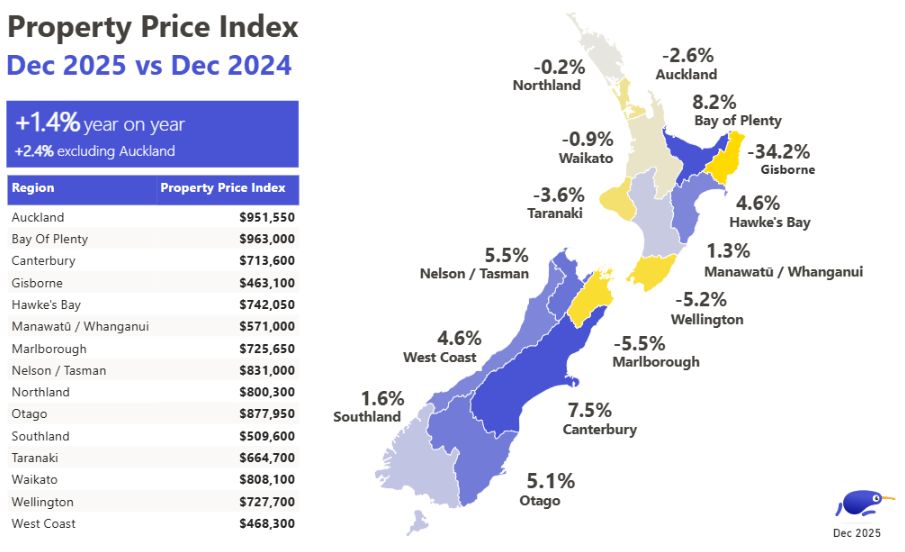
The national average asking price cooled to a one-year low in December, with the Bay of Plenty overtaking Auckland as the most expensive region in Aotearoa.
Trade Me Property Customer Director Gavin Lloyd said the regional shift marks a significant milestone for Aotearoa’s property market.
"For the first time in recent history, we’ve seen the Bay of Plenty take the top spot as the most expensive region in the motu, with its average asking price climbing to $963,000.
“This is a massive result for the region, especially considering Tāmaki Makaurau dipped below the million-dollar mark for the first time since August."
A decade in the making
While Auckland has held the most expensive crown for the last 10 years, Gavin Lloyd says the gap has been narrowing for some time.
“The price gap between Auckland and the next most expensive region has been steadily shrinking for a decade. Ten years ago the difference was over $300,000, but by 2025 it had narrowed to roughly $100,000–$150,000.
"In the last couple of years, the Bay of Plenty has almost always been ranked the second most expensive region, so it’s less of a shock and more of a natural progression," said Lloyd.
“Buyer demographics is a key driver behind the flip. In Auckland, we’ve seen a slight increase in properties under $800,000, the typical first-home buyer bracket while the percentage of high-end properties over $2 million is trending downwards.
“Conversely, the Bay of Plenty is seeing a surge in the luxury market. In December, the region had a higher percentage of properties over $2 million than Auckland. This suggests the buyer demographic there is shifting away from first-home buyers toward those seeking premium lifestyle properties," Lloyd added.
National price falls
The national average asking price in December was $800,700, down 6 per cent month-on-month and the lowest since December 2024. Prices remain slightly ahead year-on-year (+1.4%).
"While seeing Auckland 'dethroned' is notable, the broader national decline to a one-year low is a typical reflection of the summer holiday period as Kiwi shift their focus from house hunting to the holidays.
"However, it is encouraging to see the market ahead of where we were last December. This suggests a baseline of stability as we kick off a new year, even as the regional leaderboard gets a bit of a shake-up."
Regional growth hot spots
The 2025 calendar year was defined by a widening gap between high-growth regions and those facing market corrections.
In addition to the Bay of Plenty, other strong performers that bucked the national cooling trend included Canterbury, which saw an annual increase of 7.5 per cent to $713,600, and Nelson/Tasman, which grew by 5.5 per cent to $831,000.
In contrast, several regions underwent a recalibration. Gisborne experienced the most dramatic shift, with asking prices dropping 34.2 per cent year-on-year to $463,100. Other areas facing downward pressure included Marlborough, down 5.5 per cent to $725,650, and Wellington, which saw its average asking price fall 5.2 per cent to $727,700.
Gavin Lloyd says the figures highlight how varied the property landscape has become across the motu, but warns against taking the Gisborne figures at face value.
“Despite the sharp price drop, underlying demand in the region remains incredibly strong, with search activity surging 44 per cent year-on-year in December. This massive spike in interest significantly outstripped supply, which only grew by 3 per cent over the same period.”
Lloyd notes that because Gisborne is a smaller market with a lower volume of stock, prices can fluctuate more than in major cities.
“The clear appetite from buyers suggests that the current price dip may be a temporary fluctuation rather than a lack of interest.”
 Bill Bennett: Fixed Voice Rules Head For Deregulation
 UN Department of Global Communications: United Nations Proposes New Global Dashboard To Measure Progress Beyond GDP
 Banking Ombudsman Scheme: Fraud Check Delays Well Worth The Inconvenience, Says Banking Ombudsman
 Asia Pacific AML: NZ’s Financial Crime Gap - Beyond The 'Number 8 Wire' Mentality
 Westpac New Zealand: Kiwi Households Adapting Despite Widespread Cost Pressure Concerns, Westpac Survey Shows
 University of Auckland: Kids’ Screen Use Linked To Long-Term Deficits In Self-Control And Attention


