
 Scoop has an Ethical Paywall


Inflation Creeps Above 3%, And It’s The Dirty Details That Creep Us Out The Most
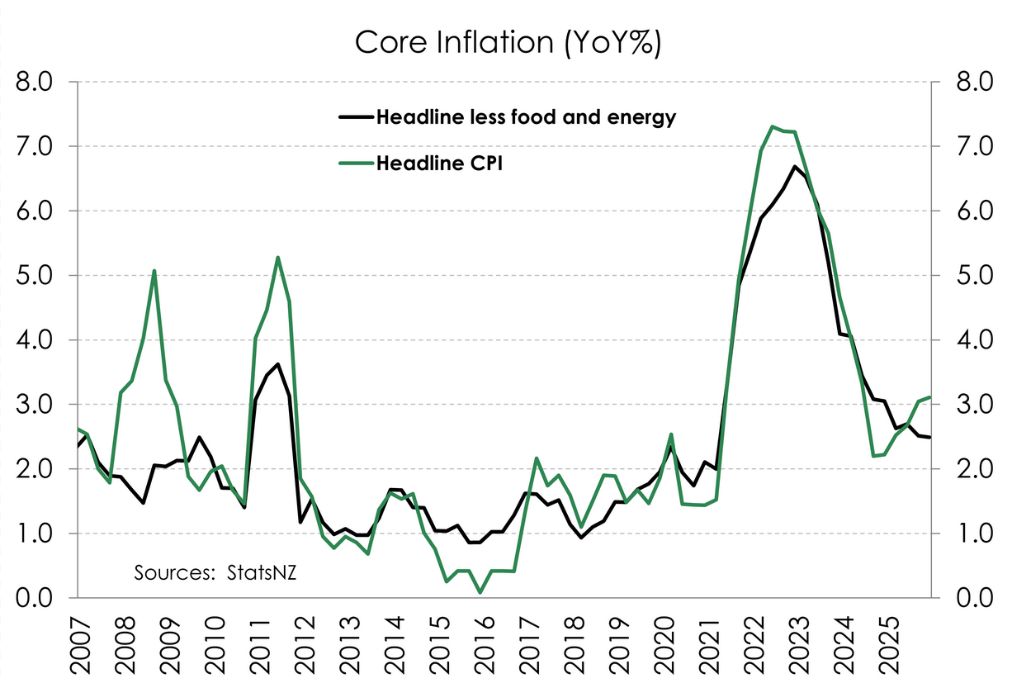
- No good. Kiwi inflation crept out of the RBNZ’s 1-3% target band to 3.1% at the end of 2025. The surprise came from how broad-based the price increases appeared to be. We can’t point the finger at just a handful of items. Underlying inflation is sitting at the upper end of the RBNZ’s target band. We still expect annual inflation to fall back within the band this year. But amongst traders and the like, the discussion is shifting from rate cuts to rate hikes – and soon.
- Our COTW takes a look at how the Kiwi housing market wrapped up 2025. Prices nudged higher in December, but were 0.4% below levels the year prior. We’re expecting firmer gains in 2026, although headwinds do remain.
Here’s our take on current events
Last week’s inflation print was no good... no good at all. The headline print of 0.6% on the quarter, and 3.1% over the year was slightly above our forecast 3.0%... but it was the dirty details that did us in (https://www.kiwibank.co.nz/business-banking/thrive-hq/kiwi-economics/commentary-insights/a-laser-focus-on-inflation-strains-the-eyes/)
There was a lift in petrol prices and airfares... we saw that coming. And tradables (imported) inflation lifted 0.7% to 2.6%. Not helping. But it was the heat in the domestic inflation that disappointed us the most. Non-tradables (domestic) inflation lifted 0.6%, running at 3.5%. We need that back down at 3% or below. Housing and utility costs remain heated, with electricity prices sparking concern at 12.2% over the year. There was also a notable lift in home construction costs. With construction contracting, you'd expect cost pressures to be easing. Not in this quarter.
In the same vein, the December quarter usually sees some softness across retailing goods given the usual round of discounting that comes with the holiday period. Again, not this time. The percentage of retail goods that were discounted over the December quarter dropped to just 15% down from 20% the same time last year. And the average discount applied was 10%, smaller than the 13% a year ago. For household furniture specifically, the average discount was just 3% compared to the 11% in December 2024. Discounts in 2025 just didn’t stack up to previous years. Instead, prices for clothing & footwear increased 0.8%, while household contents & services lifted 0.6%. Both stronger prints than we had expected. Still, it’s too premature to suggest a shift in demand just yet. Recent business surveys still lament the lack of demand. Rather, it seems that costs are building up and squeezing profit margins even tighter. It feels to us to be more of a cost push, rather than demand pull type of inflation.
Another concern is that we can’t just point the finger at administered costs for higher inflation. For some time, it had been items like council rates, electricity and the like, pushing headline inflation higher. But if we remove these government charges, headline inflation is within the RBNZ’s target band but is pushing higher – from 2.4% to 2.6%. There are other (frustrating) hot spots within the CPI basket. And that’s also reflected the stickiness in underlying inflation. Excluding food and energy prices, core inflation held at 2.5% after being on a general downtrend since hitting the peak in late 2022. Trimmed mean is another way of excluding volatility in inflation, and that measure accelerated to 2.8% from 2.5%. That’s not what we wanted to see.
With all that said, we still expect inflation to fall back within the RBNZ’s 1-3% target band. A move below 2% however looks less likely given tentative strength in domestic inflation – even if we exclude housing (rates and utilities).
The newly minted Governor and RBNZ officials are “laser focussed” on inflation, as they have always been. Above-target inflation and the plethora of good news, especially the lift in business confidence, means the need for further rate relief is evaporating, fast. Market traders have turned their attention to the possibility of rate hikes (not cuts) this year, with two full hikes priced in wholesale rates markets (namely the OIS strip). We agree, the next move is likely to be a hike. And we hope that is the case. Because rate hikes follow an economy that has recovered. But we think it is still a story for 2027. Although the risk of a hike this year is steadily increasing.
 UN Department of Global Communications: United Nations Proposes New Global Dashboard To Measure Progress Beyond GDP
 Banking Ombudsman Scheme: Fraud Check Delays Well Worth The Inconvenience, Says Banking Ombudsman
 Asia Pacific AML: NZ’s Financial Crime Gap - Beyond The 'Number 8 Wire' Mentality
 Westpac New Zealand: Kiwi Households Adapting Despite Widespread Cost Pressure Concerns, Westpac Survey Shows
 University of Auckland: Kids’ Screen Use Linked To Long-Term Deficits In Self-Control And Attention
 University of Auckland: Research To Address Equity In STEM For Māori, Pacific And Female Students


