
 Scoop has an Ethical Paywall


The Creative-Led Shift: How To Stop Wasting Marketing Spend
The Content Mistake: Why Creative Now Rules Performance
Marketing has always followed performance, until now. For decades, performance marketing evolved in clear, measurable phases. The rise of the internet in the 1990s marked the first major turning point, allowing businesses to track behaviour at scale. In the early 2000s, the emergence of web analytics, CRM systems and online advertising transformed marketing into a discipline grounded in data rather than instinct.
From there, the industry doubled down. Better data led to better audience targeting. Better audience targeting led to better return on ad spend or return on investment.
For years, success was defined by how precisely a business could identify and reach the “right” audience. For a long time, this approach worked. However, by the end of 2025 the rules quickly changed.
- The Old Rule: Performance was driven by manual audience targeting and data tracking.
- The New Reality: Platforms now use AI to "find" your audience based on the quality and variety of your creative assets.
- The Mistake: Treating content as a one-off expense rather than a cohesive, adaptive system.
The next performance shift is creative-led
Today’s leading platforms no longer reward businesses simply for having more data or more refined audience segments.
Updates such as Google’s and Meta algorithm delivery systems reflect a clear shift. Automation now prioritises quality, variety, creativity and adaptability over manual targeting. Platforms are increasingly deciding who sees content and creative assets are determining how effectively they find and reach the right audience.
The competitive advantage is no longer just who understands their audience best. It is who can translate that understanding into a broad, versatile set of creative assets that perform across multiple contexts, platforms and intent.
This shift is exposing a growing weakness in how businesses still approach content creation.
Where content creation is breaking down
Across industries, the same frustrations continue to surface.
Businesses are working with multiple contractors who do not talk to each other. They are also paying high costs for items made for one-time use. In-house teams are stretched thin trying to coordinate freelancers, agencies and platforms.
At the same time, AI-generated content has flooded the market. While efficient, much of it is recognisable, repetitive and stripped of brand voice. Filling feeds without creating content that is unique to the business.
The result is fragmented messaging, rising cost, time delays and content libraries that are difficult to reuse. In a creative-led marketing environment, that approach no longer scales.
Efficiency Killers:
- The Contractor Gap: Siloed freelancers who don't communicate.
- The "One-and-Done" Trap: High production costs for assets used only once.
- The AI Noise: Generic content that fills feeds but loses your unique brand voice.
The real cost of doing nothing
When the problem isn’t addressed, the effects tend to build over time.
Brands often struggle to maintain visibility as competitors appear more clearly and consistently. Social channels can begin to feel inactive or disjointed, making it harder to build trust. At the same time, investments in content production lose value when assets aren't designed to support both organic and paid activity in the long run.
As a result, content often exists in disconnected pieces rather than as part of a cohesive system. Brands end up asking audiences to do more work by joining the dots, remembering context and staying engaged without clear signals. In an environment where attention is limited, this leads to lower engagement and weaker conversion intent. Over time, campaign efficiency declines and return on investment or return on ad spend takes a clear hit.
What a modern content model actually needs to look like
The shift from manual targeting to creative-led delivery doesn’t mean producing more content; it means producing better-connected content.
That requires a different model; one that starts with deep audience understanding but is intentionally designed for adaptability and performance across all channels.
Instead of content being created in isolation for individual campaigns or platforms, it needs to be planned as a system:
- Assets are made with visual micro triggers for AI algorithms. These are subtle cues in videos and images. They include pacing, text overlays, and framing. These cues help signal relevance to platform algorithms.
- Adaptive creative developed with longevity in mind for both paid and organic channels
- Strategy, production and distribution aligned from the outset
Most importantly, it requires fewer handovers. Every additional contractor introduces delay, increased costs and inconsistency, making it harder for the content to perform as intended.
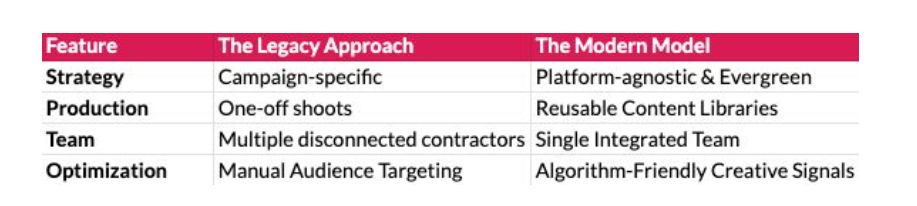
The following table breaks down exactly how this modern system contrasts with the traditional legacy approach:
How the model is being applied in practice
After years of working in paid media and performance-led environments, one pattern became increasingly clear. Businesses weren’t struggling with creativity, they were struggling with coordination, inefficiency and high costs.
As content delivery has become more automated and increasingly influenced by creative signals, these gaps have become harder to ignore.
By bringing strategy, on-site production, post-production and delivery into a single integrated team, the focus shifts. Instead of making content for one-time use, the focus is on creating evergreen assets. These assets can grow across platforms and support both paid and organic activities over time.
This is the model Conversion Marketing has built into its new Multi-channel Content Creation service. The outcome isn't just better content. It’s a clearer direction, reduced friction, more efficient use of budget and creative assets that actively supports performance rather than working against it.

Proof the model works in the real world
This model has already been trialled on New Zealand companies, where content needs to perform across channels.
In each case, the focus was on building cohesive content libraries designed for adaptability and performance.
Claire from Showerdome NZ shared:
“Conversion Marketing was fantastic to work with. They took the time to truly understand our product and knew exactly what we were trying to achieve with the new content. They planned and structured the still shots, and video footage to perfection, meaning minimal time on set, and really efficient use of everyone’s time.
They have amazing technical ability and knew exactly what was needed to bring everything together into a cohesive and valuable final result. We were extremely impressed and wouldn’t hesitate to recommend them to anyone wanting quality content, put together by some of the nicest people in the business!”
In practical terms, clients are left with a clearer content strategy, a set of reusable assets, greater profitability and confidence in how they show up online. This is achieved without the ongoing cost and complexity of managing multiple contractors.
What this means for businesses going forward
The way people discover, evaluate and choose brands has changed and it isn’t changing back.
With most lead generation and purchasing journeys now starting online, audiences don’t just look for products and services. They are looking for consistency, relevance and proof that a business understands who it is speaking to and why.
The businesses that will perform well moving forward will not necessarily be the ones producing the most content. They’ll be the ones producing content with intent. Content that can adapt across channels, supports paid and organic performance and remains useful beyond a single moment in time.
The shift doesn’t require louder messaging. It requires a smarter structure and content designed to work with evolving platform automation systems, rather than against it.
For businesses reassessing their content creation structure and wanting to plan, create and apply stronger content in this new environment, contact us through our website or call +64 9 950 5320.
 Stats NZ: Economic Impacts On New Zealand From Conflict In The Middle East – Report
 Advertising Standards Authority: ASA Annual Report 2025 - Platform-Neutral Regulation Keeps Pace With Digital Advertising
 Science Media Centre: Lead Pipes Banned For New Plumbing – Expert Reaction
 New Zealand Young Physicists Trust: Auckland To Host The ‘World Cup Of Physics’ In 2027; Search Begins For Student-Designed Tournament Logo
 Oxfam Aotearoa: Top CEO Pay Increased 20 Times Faster Than Workers’ Pay In 2025
 Bill Bennett: TUANZ Report - Networks Built, Value Missing


