
 Scoop has an Ethical Paywall


What Size Boardroom Table Do I Need?

Table Size Guide for Workplace Boardrooms – We’re often asked for advice on table sizing in workplace settings, so here’s our guide.
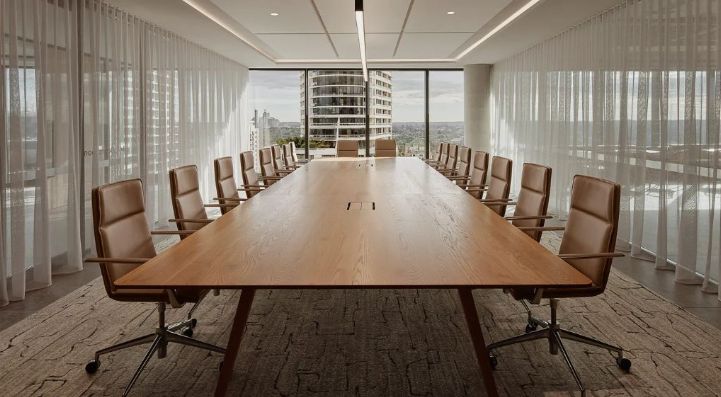
To decide what size boardroom table you need, first consider how many people it must seat. Also consider what types of meetings you will host.
How Much Room Per Person?
For boardroom settings, each person should have an allowance of between 600 to 800mm. This ensures enough personal space for laptops, notebooks and refreshments, maintaining comfort during longer meetings. For more executive or presentation-style environments, where a sense of spaciousness and formality is desired, consider accommodating the upper end of this allowance. This extra spacing creates a more premium experience and supports longer, more strategic sessions.
To determine how many people your table can comfortably seat, or how big a table you need:
- Total table length ÷ chosen spacing allowance x 2 sides; or
- Number of people ÷ 2 sides x chosen spacing allowance
Keep in mind that you might want to seat people at the ends, so incorporate that into your calculations depending on your preference. Some examples
- Medium Meeting Room (6-10 people): 1800 – 3000mm length
- Large Boardroom (10-14 people): 3000-4200mm length
- Extra Large Boardroom (14+ people): 4200-4500mm length
Harrows’ collection of NZ designed and manufactured Conference Tables and Boardroom Tables start from 3000mm long. Smaller sizes within the same design families are available for meeting rooms and breakout spaces. Most designs are available in standard sizes at 100mm increments of length.
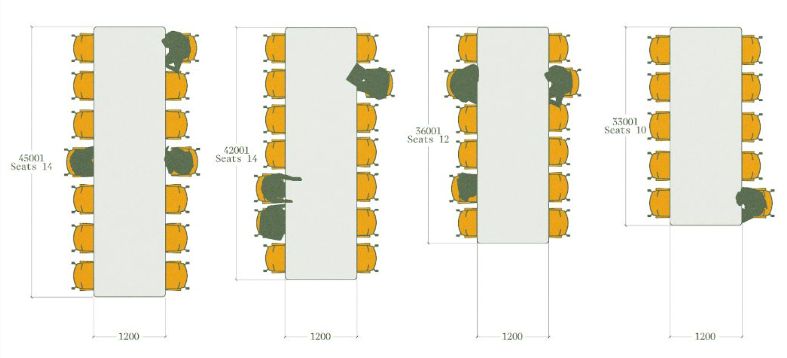
How Wide Should a Boardroom Table Be?
- Standard width: 1000 – 1200mm
- Wide/Executive width: 1400 – 1600mm – better for larger rooms and more equipment
Harrows recommends a conference table width of between 1200mm and 1600mm for boardroom settings, offering ample space for work materials and comfortable face-to-face communication. For smaller meeting rooms 1000mm is sufficient.
Will My Conference Table Be One Solid Top?
It is important to note that when tables or learners are manufactured at lengths over 2400mm, they will typically feature a “dry join” running through the centre. A dry join is a clean precision join where two sections of the tabletop are mechanically fixed together on site without visible brackets, plates or surface interruptions.
The dry join is neat and subtle, but it is not a single continuous slab. Once assembled, they function as one solid surface with full structural integrity, but this approach factors in constraints in the raw material size, and allows easier transportation and installation of tables into the space.
Will My Boardroom Table Fit?
If you have the space at hand, mask out your proposed table size and test it in your space, leaving enough room for people to walk behind an occupied chair. Recommended minimum distance between wall and table to accommodate pulling out a chair and walking behind is 910mm. Consider placing laptops, notepads or coffee cups on the masked space, is there enough elbow room? Factor in how your meetings typically run; collaborative workshops with shared documents or devices may require additional surface area.
When planning your layout, it’s important to think about how the space will function. Narrower tables can create a more intimate atmosphere for smaller groups, while larger tables with generous depth and width give room for larger teams while conveying presence, professionalism, and room for ideas.
Browse more boardroom table options.
 Advertising Standards Authority: ASA Annual Report 2025 - Platform-Neutral Regulation Keeps Pace With Digital Advertising
 Science Media Centre: Lead Pipes Banned For New Plumbing – Expert Reaction
 New Zealand Young Physicists Trust: Auckland To Host The ‘World Cup Of Physics’ In 2027; Search Begins For Student-Designed Tournament Logo
 Oxfam Aotearoa: Top CEO Pay Increased 20 Times Faster Than Workers’ Pay In 2025
 Bill Bennett: TUANZ Report - Networks Built, Value Missing
 Workers First Union: May Day - Union Warns Against Fuel Crisis Opportunism By Employers


