
 Scoop has an Ethical Paywall


February Housing Market Marked By Patience As Buyers And Sellers Navigate Changing Conditions
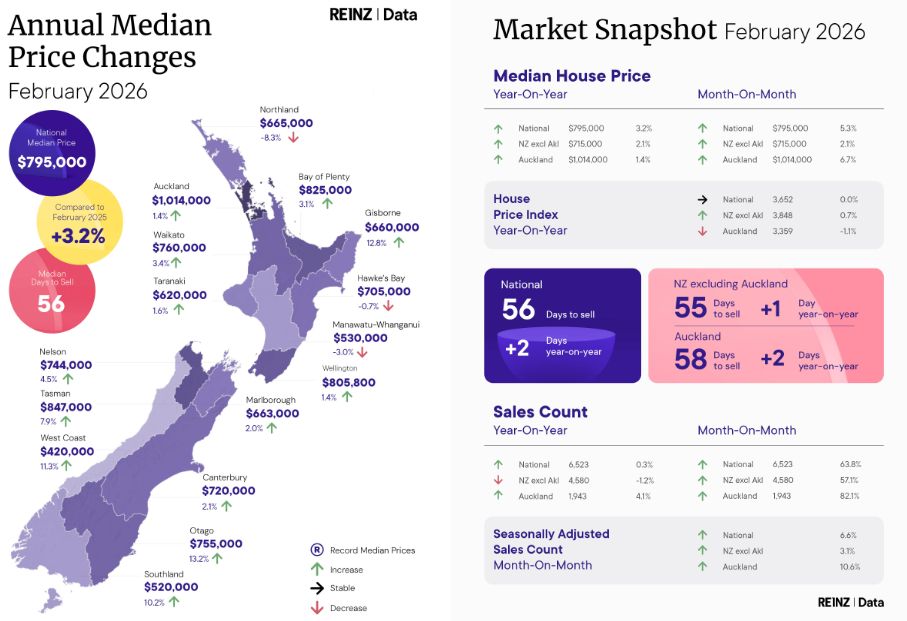
February’s housing market shows patience on both sides, with selective buyers and sellers prepared to wait for the right price. The latest data from the Real Estate Institute of New Zealand (REINZ) shows the national median price rose 3.2% year-on-year to $795,000, while sales activity remains largely steady and properties are taking longer to sell.
Major regions such as Auckland, Canterbury, and Waikato saw their highest February sales counts since 2021, signalling stronger activity in parts of the market. Otago led the country with a 13.2% increase in median price, reaching $755,000. However, longer selling times remain a consistent feature nationwide, with most regions recording median days to sell above their 10-year February average.
“The three-month data gives us the clearest picture of the market’s underlying direction,” says REINZ Chief Executive Lizzy Ryley. “The southern regions, particularly Otago and Southland, are maintaining strong momentum. In contrast, Northland continues to feel some downward pressure following recent severe weather and flooding. Nationally, the three-month trend points to a modest but steady lift in median prices nationally, up 1.9% to $780,000, reinforcing the gradual recovery we began to see earlier in the year.”
Sales activity across New Zealand increased slightly by 0.3% year-on-year, with 6,523 sales reported. Excluding Auckland, sales fell 1.2% to 4,580. When adjusted for seasonality, which accounts for typical monthly fluctuations, national sales rose 6.6% compared with January 2026, showing steady underlying growth despite large changes in raw figures. For New Zealand, excluding Auckland, seasonally adjusted sales climbed 3.1%, rather than the 57.1% suggested by the unadjusted numbers.
“Sales naturally fluctuate over the summer months,” Ryley explains. “Once we adjust for seasonal trends, the February data shows steady growth compared with January, both nationally and in New Zealand, excluding Auckland, highlighting the underlying strength of the market beyond the large fluctuations seen in raw figures.”
National median days to sell were 56 days, up only two days year-on-year and month-on-month. Excluding Auckland, median days to sell increased similarly by two days to 55. New listings in New Zealand rose 7.8% year-on-year to 12,252, with an increase of 6.1% in New Zealand, excluding Auckland, to 7,692. National inventory levels grew 1.8% from last year, reaching 36,357. Christchurch City recorded its only Territorial Authority record this month, with a median price of $735,000, a 0.7% increase from its previous record in November 2025.
“Three key forces shaped market activity during February: weather, interest rates, and the approaching election. Severe weather disrupted activity in several regions, while the Reserve Bank’s decision to hold the Official Cash Rate at 2.25% signals that the period of falling mortgage rates has likely ended. The confirmation of the November election, alongside renewed policy debate around a potential capital gains tax, is also creating some uncertainty for investors,” Ryley states.
Auction activity rose compared with January, as more auction campaigns were launched. Nationally, there were 1,214 auction sales, accounting for 18.6% of all sales. In New Zealand, excluding Auckland, 631 properties were sold at auction (13.8%), while Auckland accounted for 583 auction sales, or 30% of its total.
The national House Price Index (HPI) remains at 3,652, unchanged over the past year, and is 14.6% below its peak. Canterbury reached a new HPI record of 3,917, an increase of 3.2% over the past year.
“The housing market has been stable for some time, with buyers and sellers having growing confidence, although this does vary around the country. Prior to the current geo-political situation, New Zealand’s housing market has continued its stable growth, and is expected to continue through to autumn, with Canterbury and Otago likely to lead growth and Auckland gradually improving. Wellington and the storm-affected northern regions may take longer to return to normal levels. Rising costs, ongoing weather disruptions, and election uncertainty mean buyers are likely to remain cautious,” says Ryley.
She adds, “The situation in the Middle East is something we are monitoring closely, as it may influence household confidence and the cost-of-living environment in which buyers and sellers make decisions. We are keeping a close eye on any flow-through effects on household confidence and disposable income for both prospective and current homeowners.”
*Inventory and Listings data courtesy of realestate.co.nz
Fact sheet
National Highlights for February:
- The total number of properties sold in New Zealand increased by 0.3% year-on-year, from 6,502 to 6,523 sales. New Zealand, excluding Auckland, saw a decline of 1.2% year-on-year, from 4,635 to 4,580.
- Nationally, the seasonally adjusted figures for New Zealand show a sales count increase of 6.6% compared to last month. Seasonally adjusted sales figures for New Zealand, excluding Auckland, show a 3.1% month-on-month increase.
- Listings* nationwide increased by 7.8% year-on-year, reaching 12,252 new listings. New Zealand, excluding Auckland, saw a rise of 6.1% year-on-year, reaching 7,692 new listings.
- The median Days to Sell for New Zealand increased by two days compared to February 2025, reaching 56 days. The median Days to Sell for New Zealand, excluding Auckland, increased by two days, to 55 days.
Regional Highlights for February:
- Thirteen of the sixteen regions
recorded increases in median prices; the highest increases
were observed in:
o Otago, up 13.2% to $755,000
o Gisborne, up 12.8% to $660,000
o West Coast, up 11.3% to $420,000 - Six regions recorded an increase in sales
compared to February 2025. The highest were in:
o Otago, up 12.9% to 419 sales
o Waikato, up 8.5% to 703 sales
o Northland, up 6.0% to 177 sales
 Bill Bennett: Fixed Voice Rules Head For Deregulation
 UN Department of Global Communications: United Nations Proposes New Global Dashboard To Measure Progress Beyond GDP
 Banking Ombudsman Scheme: Fraud Check Delays Well Worth The Inconvenience, Says Banking Ombudsman
 Asia Pacific AML: NZ’s Financial Crime Gap - Beyond The 'Number 8 Wire' Mentality
 Westpac New Zealand: Kiwi Households Adapting Despite Widespread Cost Pressure Concerns, Westpac Survey Shows
 University of Auckland: Kids’ Screen Use Linked To Long-Term Deficits In Self-Control And Attention


